Searching Underwater for Moses’s Undiscovered Tomb? | Expedition Unknown
Searching Underwater for Moses's Undiscovered Tomb? | Expedition Unknown


For centuries, the story of Moses has stood as one of the most powerful and mysterious narratives in human history. From leading the Israelites out of Egypt to the legendary parting of the Red Sea, the tale is deeply rooted in religious tradition and cultural identity. Yet one question has remained unanswered: where is Moses buried?
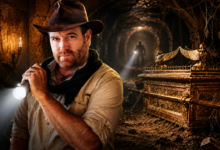
In an unforgettable episode of Expedition Unknown, host Josh Gates embarks on a daring journey to explore a theory that pushes the boundaries of both archaeology and faith—could the tomb of Moses lie hidden beneath the waters of the Red Sea?
The Biblical Mystery
According to the Bible, Moses died after leading his people to the edge of the Promised Land. The exact location of his burial, however, is deliberately obscured in scripture. The Book of Deuteronomy states that he was buried in a valley, but no precise site has ever been identified.
This mystery has sparked countless theories over generations. Some scholars believe the burial site was intentionally concealed to prevent idol worship. Others argue it may have been lost to time, buried beneath shifting landscapes—or even submerged due to geological changes.
This is where Expedition Unknown takes a bold leap: what if the truth lies underwater?

A Radical Underwater Theory


One controversial theory suggests that parts of the ancient Exodus route may now lie beneath the Red Sea, particularly in areas like the Gulf of Aqaba. Some explorers and independent researchers claim to have found unusual formations on the seabed—objects resembling chariot wheels, human remains, and other artifacts that could date back thousands of years.
While mainstream archaeologists remain skeptical, the idea is intriguing enough for Josh Gates to investigate firsthand.
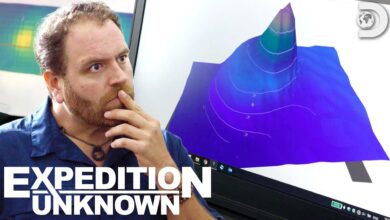
Equipped with diving gear, sonar technology, and a team of experts, Gates ventures beneath the surface to examine these claims. The underwater environment presents immediate challenges: limited visibility, strong currents, and the immense pressure of the deep.
Yet what they find is enough to raise eyebrows.
What Lies Beneath
During the dive, the team documents a series of coral-encrusted shapes that appear strikingly artificial. Some formations resemble circular structures, while others hint at symmetry not typically found in nature.
Could these be remnants of ancient chariots? Or are they simply natural rock formations shaped by currents and marine life?
Josh Gates approaches the findings with cautious curiosity. Rather than jumping to conclusions, he consults marine archaeologists and geologists who offer alternative explanations. Coral growth, they explain, can form around almost any object—natural or man-made—making identification extremely difficult without direct sampling.
Still, the possibility lingers.
Science Meets Faith


One of the most compelling aspects of this expedition is the intersection of science and faith. The story of Moses is not just a historical question—it is a spiritual cornerstone for billions of people worldwide.
Josh Gates navigates this delicate balance by presenting evidence while respecting belief systems. He acknowledges that not all mysteries can—or should—be solved purely through scientific means.
The search for Moses’s tomb is as much about understanding human history as it is about exploring the unknown. Even if no definitive proof is found, the journey itself offers valuable insights into ancient civilizations, migration patterns, and geological changes in the region.
Challenges of Underwater Archaeology
Searching for ancient remains beneath the sea is no easy task. Unlike land-based excavations, underwater archaeology requires specialized equipment and techniques.
Visibility can drop to near zero, and artifacts are often buried under layers of sediment or disguised by coral growth. Additionally, the preservation of organic materials—such as wood or human remains—is extremely rare in marine environments.
This makes the search for something as specific as a tomb extraordinarily difficult.
Despite these challenges, advancements in technology—such as 3D sonar mapping and remote-operated vehicles—are opening new possibilities. Expeditions like this one demonstrate how modern tools can be used to explore ancient mysteries in ways that were once unimaginable.
Skepticism and Controversy
Not everyone is convinced by the underwater tomb theory. Many experts argue that there is no credible archaeological evidence linking the Red Sea floor to the Exodus story.
Critics point out that extraordinary claims require extraordinary evidence—and so far, the findings remain inconclusive at best.
Josh Gates embraces this skepticism as part of the scientific process. Rather than presenting the theory as fact, he frames it as a question—one that invites further exploration and debate.
This open-ended approach is a hallmark of Expedition Unknown, encouraging viewers to think critically while remaining open to new possibilities.
A Journey Into the Unknown
What makes this episode truly captivating is not just the mystery itself, but the sense of adventure that comes with it. From diving into deep, uncharted waters to analyzing ancient texts, the search for Moses’s tomb is a journey that spans both physical and intellectual realms.
It is a reminder that history is not static—it is a living puzzle, constantly being reinterpreted as new evidence comes to light.
Conclusion: Mystery Beneath the Waves
The question remains: could Moses’s undiscovered tomb באמת lie beneath the waters of the Red Sea?
For now, the answer is uncertain.
But as Expedition Unknown demonstrates, the pursuit of that answer is what truly matters. Each dive, each discovery, and each debate brings us one step closer to understanding our past—even if the final truth remains just out of reach.
In the end, the story of Moses continues to inspire not only faith, but also curiosity. And as long as there are mysteries hidden beneath the surface of our world, explorers like Josh Gates will be there to खोज them—one expedition at a time.