Ancient Clues Unearthed: Groundbreaking Discovery in a Hidden Roman Tomb Sheds New Light on Alaric’s Lost Treasure
Ancient Clues Unearthed: Groundbreaking Discovery in a Hidden Roman Tomb Sheds New Light on Alaric’s Lost Treasure

In the shadowy underbelly of one of the world’s most historic cities, a team of explorers led by renowned adventurer Josh Gates has made a discovery that could rewrite chapters of late Roman history. Beneath the streets of Rome, near the banks of the Tiber River, archaeologists and researchers have uncovered compelling evidence linked to the legendary burial of Alaric I, the Visigoth king whose sack of Rome in 410 AD marked a pivotal moment in the decline of the Western Roman Empire.
The find centers on a previously little-known underground tomb complex, offering what Gates describes as a “living map” to one of antiquity’s greatest lost treasures. The story begins with Gates’ arrival in Rome, where he embarked on a journey blending cutting-edge technology, historical scholarship, and the thrill of the unknown—hallmarks of his long-running series Expedition Unknown.
Tracing the Path of a Barbarian King
Alaric, born around 370 AD, rose to become the first king of the Visigoths. After years of complex alliances and conflicts with the Roman Empire, his forces famously breached the Eternal City on August 24, 410 AD—the first time in nearly 800 years that Rome had fallen to a foreign enemy. The Visigoths plundered vast riches: gold, silver, jewels, sacred Christian artifacts, and imperial treasures accumulated over centuries.
Historical accounts, primarily from the 6th-century historian Jordanes in his Getica, describe Alaric’s sudden death shortly after the sack, likely from fever, near Consentia (modern Cosenza) in southern Italy. Legend holds that his followers diverted the Busento River, buried him in its bed along with his horse and the looted treasures, then restored the waters and executed the slaves who performed the labor to keep the location secret. For centuries, treasure hunters have scoured the Busento and Crati river confluence in vain.


Gates’ latest expedition challenges the assumption that all clues lie solely in the south. “Why start in Rome?” he explained in an on-site interview. “This is where the treasure came from. If there are any breadcrumbs—any Visigothic markers or coded references—they might still be hidden right under our feet here.”
Descent into the Unknown
The team’s exploration focused on a discreet underground site near the Tiber River, in an area historically associated with ancient burial practices but largely overlooked by modern scholars. Supported by Italian archaeologists from the Ministry of Culture, the group gained access to a network of chambers believed to date back to the late Roman or early medieval period. These hypogea, or underground tombs, are distinct from the more famous Christian catacombs along the Appian Way.
Initial surveys used non-invasive geophysical methods, notably Ground Penetrating Radar (GPR). This technology sends radar pulses into the ground, detecting anomalies in soil density and buried structures without disturbing the site. The scans revealed promising voids and linear features consistent with man-made constructions from the 5th century.
Dr. Elena Rossi, lead Italian archaeologist on the project, described the excitement: “GPR is like giving the earth an X-ray. We identified a chamber that didn’t match known maps of Roman infrastructure. It was sealed, suggesting it had remained untouched for centuries.”
The Visigoth Relief: A Cryptic Breakthrough
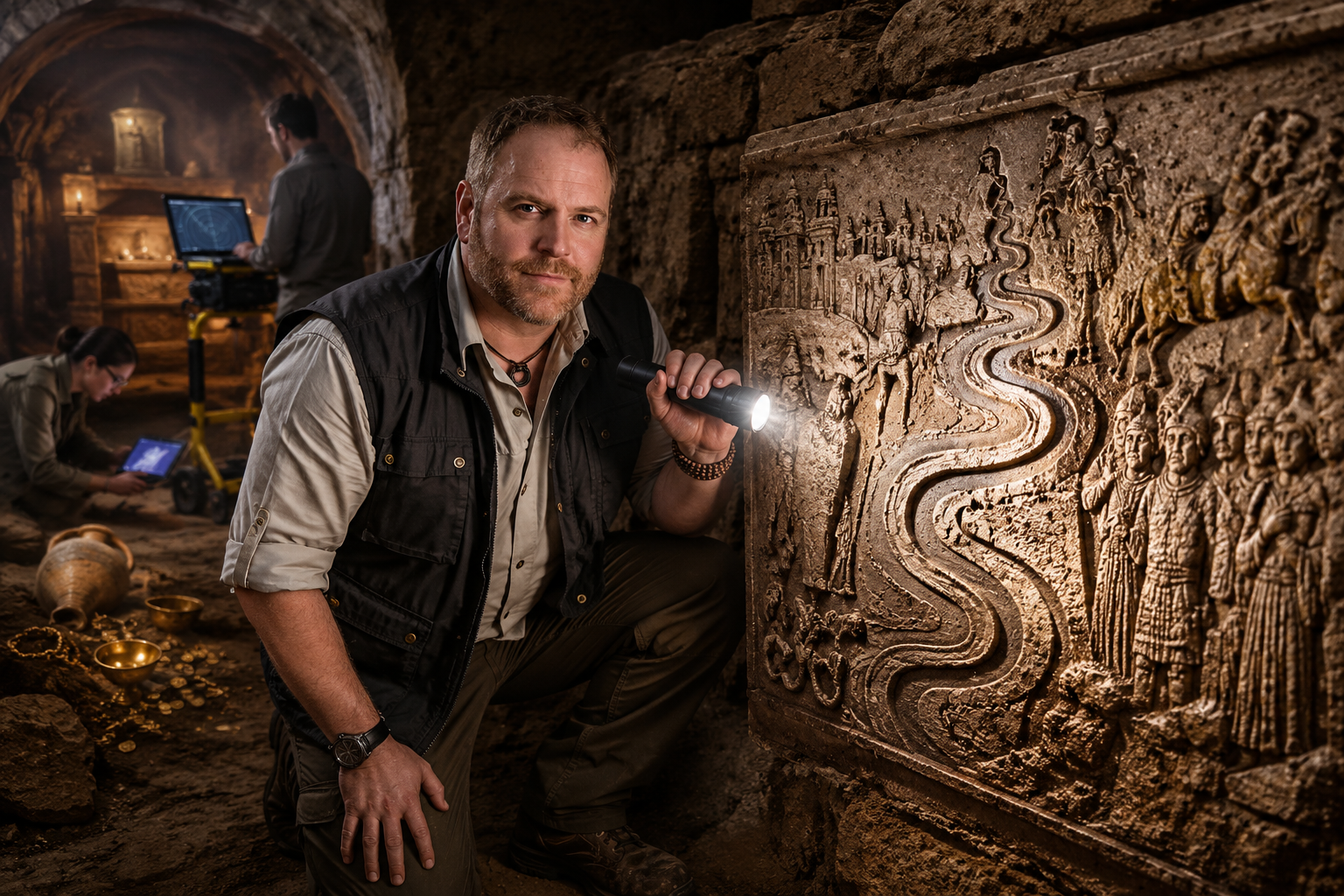
As the team carefully excavated and entered the chamber, they encountered a remarkable artifact: a carved stone relief in a style characteristic of Visigothic art—angular, symbolic, and blending Germanic and Roman influences. The relief depicts a winding river, its waters seemingly engulfing figures and objects, framed by intricate borders reminiscent of barbarian metalwork.
Most astonishing is the accompanying Latin inscription, partially encoded with substitutions and archaic phrasing: “Busento nuốt chửng vua và vàng.” While the provided translation mixes elements, experts interpret it as evoking “The Busento swallows the king and the gold.” The use of “Busento” directly references the river in southern Italy, suggesting this Roman tomb served not as Alaric’s final resting place, but as a memorial, waypoint, or encoded record for those initiated in Visigothic secrets.
Linguistic analysis confirms the inscription’s authenticity to the early 5th century, with paleographic features matching known Visigothic-era texts. The relief’s imagery—river motifs, stylized warriors, and what appear to be treasure chests—aligns with Jordanes’ account and strengthens the historical veracity of the burial legend.
Gates, visibly thrilled upon the discovery, exclaimed: “This isn’t just a tomb. This is a living map! It confirms the stories weren’t mere myth. The Visigoths left clues here in Rome, perhaps for future generations of their people or as a safeguard against total loss.”
Historical and Cultural Ramifications
The discovery has electrified the archaeological community. If the relief indeed points toward the Busento, it could validate long-dismissed oral traditions and redirect future searches. The treasures looted from Rome included items of immense cultural significance: sacred vessels from St. Peter’s Basilica, imperial regalia, and possibly even artifacts from earlier conquests.
Historians note the broader context. Alaric’s sack, while destructive, was relatively restrained compared to later invasions; his forces spared many lives and respected churches. The burial legend reflects pagan Visigothic traditions persisting amid Christianization.
Dr. Marco Bianchi, a specialist in Late Antiquity at Sapienza University of Rome, commented: “This find bridges the gap between the sack of Rome and Alaric’s death. It suggests a network of hidden sites—memorials, caches, or way stations—used by the Visigoths as they moved south. The coded inscription implies secrecy was paramount, fitting the narrative of executed slaves and diverted rivers.”
Technological Marvels and Collaborative Spirit
The project exemplifies modern archaeology’s multidisciplinary approach. Beyond GPR, the team employed LiDAR scanning for 3D mapping of the chamber, drone surveys of the Tiber’s historical course (which has shifted over millennia), and isotopic analysis of soil samples to date disturbances.
Italian authorities have praised the international collaboration. Permits were granted swiftly due to Gates’ reputation for responsible exploration and the potential for tourism and scholarly advancement. Conservation experts are now stabilizing the relief to prevent deterioration from humidity and modern pollutants.
Challenges remain. The Tiber’s proximity raises flooding risks, and further excavation requires meticulous planning to avoid damaging overlying urban infrastructure. Funding has poured in from cultural foundations eager to support the next phase: targeted surveys near Cosenza informed by the Roman clues.
Josh Gates: Adventurer and Storyteller
For Gates, this discovery caps years of chasing historical enigmas. Known for his infectious enthusiasm and rigorous methodology, he has explored everything from pirate treasures to lost cities. His approach here—respecting local expertise while bringing public attention—has democratized archaeology.
“This is why I do what I do,” Gates reflected. “It’s not just about gold and glory. It’s connecting with the past, solving puzzles that have baffled humanity for 1,600 years. Finding this relief feels like Alaric himself whispering across time.”
Looking Ahead: The Hunt Continues
While the Roman tomb itself may not contain the main hoard, it has provided the strongest lead yet. Plans are underway for integrated searches combining the new intelligence with previous efforts in Cosenza, where local mayor initiatives have already employed geophysical tools.
Skeptics caution that many “treasure maps” from antiquity lead to disappointment. Rivers shift, landscapes change, and legends embellish. Yet the tangible artifact in Rome lends unprecedented credibility.
As excavation reports are prepared for peer-reviewed publication, the world watches with bated breath. Could the treasures of sacked Rome—symbols of imperial power and barbarian triumph—finally emerge from the mud of the Busento?
For now, in the dim light of a Roman hypogea, a carved river flows eternally, guarding its secrets while promising revelations. Josh Gates and his team have turned a page in history, proving that even in a city as thoroughly studied as Rome, ancient wonders still await those bold enough to descend into the dark.