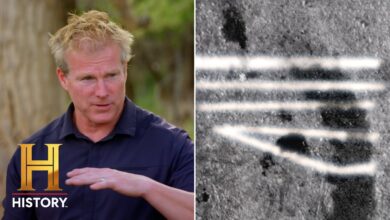
Travis Taylor discusses recurring dreams related to his work at skinwalker ranch & the ufo question
Travis Taylor discusses recurring dreams related to his work at skinwalker ranch & the ufo question

The Scientist at the Center of the Mystery


Travis Taylor is not the kind of scientist you’d expect to openly discuss dreams—especially not ones tied to unexplained phenomena. With advanced degrees in aerospace engineering and physics, and a career grounded in defense and space research, Taylor built his reputation on data, not intuition.
Yet during his time investigating Skinwalker Ranch, he has acknowledged something unusual: recurring dreams that seem connected to the ranch and its unexplained activity.
When Science Meets the Subconscious


In interviews and discussions surrounding The Secret of Skinwalker Ranch, Taylor has described experiencing vivid, repeating dreams during periods of intense investigation. These weren’t random or symbolic in the usual sense—they often mirrored:
- Locations on the ranch
- Experimental setups
- A sense of being “observed” or guided
For a scientist like Taylor, this presents a dilemma. Dreams are typically understood through neuroscience as the brain processing memory and stress. But the consistency and thematic overlap with real-world experiments raised questions even for him.
He has suggested a few grounded possibilities:


- Cognitive overload from high-pressure research
- Subconscious pattern recognition
- Psychological effects of working in a highly suggestive environment
Still, he has not completely ruled out more unconventional explanations.
The Ranch’s Psychological Effect


Investigators at Skinwalker Ranch have long reported strange mental and emotional experiences, including:
- Heightened anxiety or unease
- Vivid dreams and nightmares
- A persistent feeling of being watched
These effects are not unique to Taylor, which complicates the explanation. Some researchers believe the environment itself—whether due to electromagnetic fluctuations or psychological priming—may influence perception and cognition.
Taylor has remained cautious, emphasizing that subjective experiences must be separated from measurable data. But he also acknowledges that ignoring them entirely could mean missing part of the phenomenon.
Dreams and the UFO Question


The connection between Taylor’s dreams and the broader UFO (UAP) question is where things become truly intriguing.
At Skinwalker Ranch, multiple experiments have documented aerial anomalies—objects that appear to:
- Move at hypersonic speeds
- React to human activity
- Appear in the same regions repeatedly
Taylor has speculated—carefully—that if these phenomena represent non-human intelligence or unknown technology, then traditional methods of observation might not be enough.
His dreams, while not treated as evidence, raise a provocative idea:
Could human perception—conscious or subconscious—play a role in how these phenomena manifest?
This is not a claim, but a question he has entertained in discussions. It echoes broader debates in UFO research about observer interaction, where the act of observation might influence what is observed.
A Scientist Walking the Line


What makes Taylor’s perspective compelling is his balance:
- He does not present dreams as proof
- He insists on repeatable, instrument-based evidence
- He remains open to possibilities without abandoning skepticism
This approach reflects a broader shift in how some scientists engage with the unknown—not by accepting extraordinary claims outright, but by expanding the scope of what questions are worth asking.
Final Thoughts: Signal or Noise?
The recurring dreams reported by Travis Taylor sit in a gray area between psychology and mystery. They could be:
- A natural byproduct of stress and immersion
- A subconscious synthesis of complex data
- Or something we don’t yet fully understand
At Skinwalker Ranch, where unexplained aerial phenomena and environmental anomalies are already under scrutiny, even the inner experiences of researchers become part of the larger puzzle.
For now, Taylor treats his dreams not as answers—but as questions worth investigating.