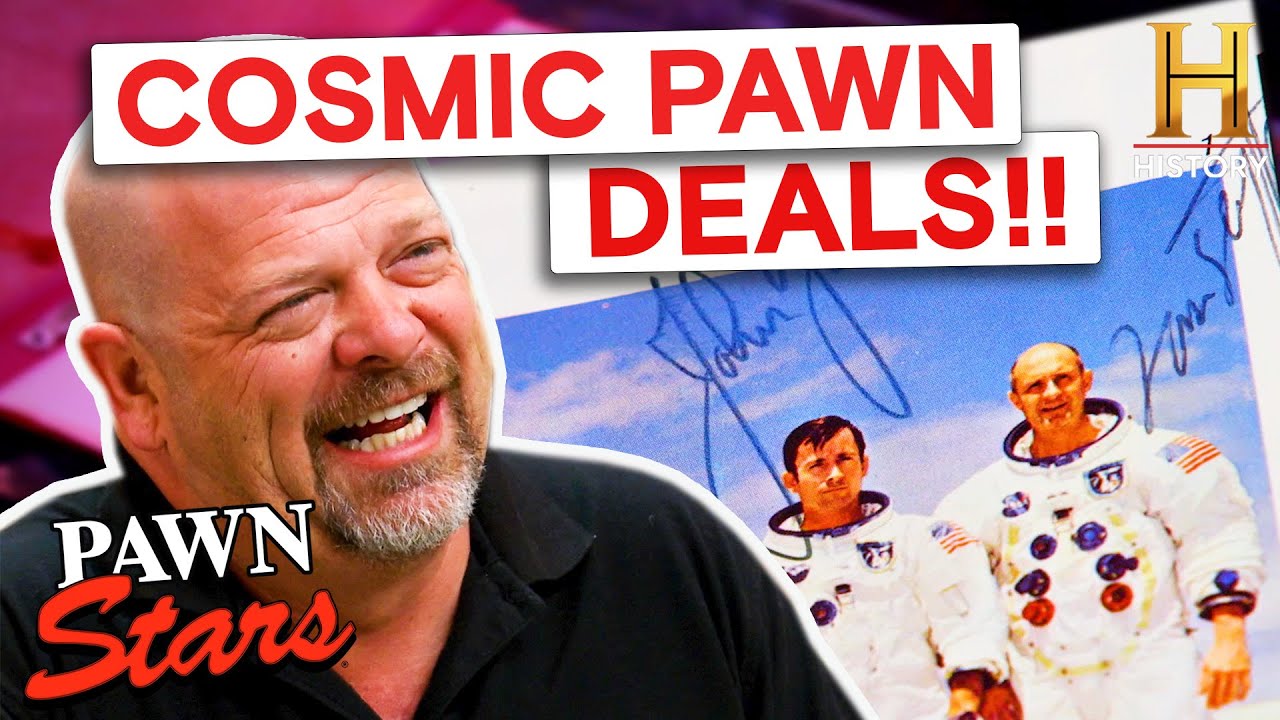
– What do we have here? – I got a picture of the Gemini launch space program.
It’s got a whole bunch of autographs from a lot of the astronauts.
Buzz Aldrin’s on it right here.
– You have Buzz Lightyear on there?
[laughter] [customer] Coming to the pawn shop today to try and sell my autographed picture of the Gemini launch.
I want to sell it today because I feel like it could be on display someplace where somebody might enjoy it.
I’m looking to get more than $1,000, maybe $2,000, I don’t know.
– Where’d you get that?
– I was going through my grandfather’s stuff.
He was a fighter pilot for the United States Air Force.
I fly for the Air Force now, figured might bring it down here, see what you guys think.
– Flying this kind of stuff is like the holy grail for you guys, right? – Holy grail.
So I mean, this is like the peak of the peak, the mountaintop.
– Back in the ’60s, NASA was all about trying to get to the moon, and the Gemini program really helped them pave the way.
It was basically a bunch of space and test flights designed to help develop equipment for the Apollo missions which got us to the moon.
Man, you got a lot of signatures on here.
I mean, you got Buzz Aldrin, I know who he is.
Grissom… – A lot of these guys were very prominent in taking part in the actual launch of the Gemini itself.
– And do you got any paperwork verifying any of these signatures?
– I don’t, but I have no reason to believe that they’re fakes.
I mean, my grandpa wouldn’t have anything in his basement that he made up.
And, I mean, you can tell how each signature is individualized, they’re authentic.
– NASA is known for having astronauts sign stuff for senators and other big shots around the country, but everything I’ve seen before hasn’t had nearly this much signatures on it.
We’ve had a lot of success with NASA stuff in the past, but my only concern is a lot of these guys I’ve never heard of.
What do you want to do with it?
– It’s been sitting in the basement collecting dust.
I wouldn’t mind selling it.
– You got a lot there. – Right.
– I know Buzz Aldrin.
I have no idea who “Wally Shimma” is.
I’ll tell you what, let me call a buddy of mine down.
He’s with Authentic Autographs Unlimited, and he’ll be able to tell us about all these guys.
– Absolutely. – All right, man.
Let me give him a call. – Okay.
[Ryan] Feel great about an expert coming in to check out the picture, find out exactly the history, and find out the worth of the item.
– How are you guys doing?
I’m Drew with Authentic Autographs Unlimited.
I’m a forensic document examiner.
Is this that Gemini piece we’re talking about?
– Yes, it is.
I know Buzz Aldrin, Grissom, but that’s all I see on there that I know.
– Right. You failed to notice probably the most important signature, if it’s authentic.
First man who walked on the moon, Neil Armstrong.
– I didn’t even notice that. – If this is authentic, that would be the number one of the most valuable signature definitely. – That’s why we call you in, man.
Holy [bleep], Neil Armstrong. How did I miss that?
This thing went from being cool to really cool.
– Now, this is really important because we have Edward White up at the top, and Gus Grissom.
Those were Apollo One astronauts, and they were the ones who were killed in the fire.
– Gus Grissom was the second American to go into space, so I can’t imagine there’d be too many items signed by both Grissom and Ed White out there.
Their lives are tragically cut short when Apollo One had a fire during the test mission.
– Now, the thing that’s very important when you’re dealing with astronaut signatures is auto pens.
It’s a machine that does them.
Now, you can totally see the pressure of all the signatures are different.
You got feathered endings and things like that.
Okay, these are definitely not auto pens.
Okay, so now we have to move on to the next stage to find out if they’re authentic or not.
Here we go with Neil Armstrong.
Well, you can see it’s kind of faint, but it’s definitely there.
Charles Conrad, handwriting looks right.
He’s another moonwalker.
We have James Lovell, Apollo 13 from the movie, Tom Hanks played him.
– So, Drew, what do you think?
– Well, you put all the evidence together.
We know it’s not auto pens.
All the capital letters, the speed, consistency, altogether…
this thing is absolutely real.
Absolutely real. – Nice! I knew it was.
– So you got any idea of what it could be worth?
– Well, this is a very rare type of piece because it’s got so many signatures on it.
I would say, actually, retail…
$4, $5,000.
– Wow. – Absolutely worth it.
– That’s impressive.
– Hey, appreciate you coming down.
– All right, guys. – Thanks a lot.
We’ll see you guys again.
– Thanks for looking. – Take care.
– So what were you looking to do with it, man?
You want to sell it? Pawn it?
– Well, yeah, let’s go ahead and sell it.
I mean, he said $4 or $5,000.
– $4 or $5,000, that’s a real high number in a real high end location.
I’d like to offer you somewhere around $1,500 for it.
– What do you say about 3,000?
– I’ll bump it up to $2,000 if it helps you out, man.
– 2,500?
– Unfortunately, man, $2,000 is going to be max for me.
– I guess I’ll go ahead and take 2,000.
– All right, my man Chum here will write you up.
– Thanks.
[Ryan] I’m happy with $2,000, but at the same time, after hearing the value of it, I wish I could’ve gotten more, but I’m fairly happy with $2,000.
Thank you.
– Hey, how’s it going? – Good.
Have a few packs of seeds here that were flown on the LDEF satellite.
– Okay.
They’re space seeds.
– Sweet.
– LDEF, do you know what that stood for?
– Long Duration Exposure Facility.
– Okay, all right, so…
– You didn’t know that? – No, I didn’t know that.
[man] I came to the pawn shop in order to try to sell my space seeds.
The space seeds were flown on the LDEF satellite, and they distribute them to high schools across the country.
I’d like to get about $120 for the whole lot.
It was put up in 1984 on the Challenger and was supposed to stay up for six months.
– “Returned to Earth January 20, 1990, on Space Shuttle Columbia.” – Because of the Challenger mishap, it stayed in space for six years.
– NASA has been sending stuff into space for decades.
They’ve tested the effects of weightlessness, extreme cold, radiation, and a thousand other things.
These seeds were sent to schools to basically get kids interested in science.
– Were they trying to make a garden in outer space?
– Yeah, they wanted to see what the effect of radiation was on the germination of the seeds.
– I had a bunch of students in an astronomy club, so we grew the seeds, we measured them, reported that back to NASA.
They collected all that data and compiled the results for the tomato seeds.
– Was there any way to measure how much radiation they got?
– NASA did measure it.
They said because it was up so long, it was much more than they ever expected.
But there was no danger once they were grown.
– So they weren’t like giant tomatoes or something like that?
– No…
[laughter] NASA did a lot of things that people thought were impossible.
They put a man on the moon. It’s part of the American Dream, and collectors will shell out good money for anything connected to it.
What’d you wanna do with these? – I’d like to sell them.
– What were you looking to get out of them?
– I was hoping to get about $20 a pack.
That’s around what I can sell them for.
I’ll tell you what, I’ll give you $60 for ’em.
– These are actually from outer space, so I was sorta hoping for $120.
– Believe it or not, I’ve actually seen these before.
There was a lot of seeds in space.
[laughter] I’ll give you $80.
– Give me $100, and that’ll be it.
– Okay, I’ll give you $100.
All right, Chum, you want to write these up?
– Meet you over there. – Okay.
[Dick] I was hoping for $120, but I got $100 for them, and I’m really happy with that.
– What do we got here? – I’m bringing the word of God to Sin City in the form of a lunar Bible.
– So you’re saying you have one of the microfiche Bibles that went to the moon? – I do.
It’s something I think you’ll find was out of this world, but now it’s back in this world.
– It’s a Bible, which is a book…
but it’s microfiche, it’s sorta weird.
[laughter] ♪♪ – I’m coming to the shop today to sell a lunar Bible.
It’s 1,245 pages on a single piece of celluloid.
I’d like to sell the Bible because it really should be on public display so that the public can see what a lunar Bible actually looks like.
– Really interesting. Where did you get it?
– It’s given to me approximately 44 and a half years ago by Reverend John Maxwell Stout, who was the founder of the Apollo Prayer League.
I had written about the Apollo Prayer League in 1969, and as a reporter, it was given to me.
– Some of them actually went and landed on the moon, and the other ones were in the Kitty Hawk, right?
– Kitty Hawk was the command module, and Antares was the lunar module.
– Okay. – And astronaut Ed Mitchell had 100 in his personal preference kit, but there were a total of 512.
This one did not go to the surface of the moon, but did go into space.
[Rick] A lunar Bible is really cool, but the problem is no one really knows how many there were up there.
If this thing is legitimate, I’m definitely interested.
I always love to make money, but you’re going to have to do a lot of proving and show me a lot of facts.
So how much do you want for this?
– Well, noting what they’ve been selling for in the last three or four years, I’m asking 70,000.
– Whoa.
– Uh, one sold in May of 2014 for 75,000.
– I mean, do you have any, like, paperwork or…
– I have an Apollo Prayer League newsletter.
And inside, you will find photos of Mitchell returning it to John Stout.
You’ll also find my story.
– But you don’t have any paperwork or a letter from him saying he gave it to you.
– I only have personal letters.
– If you don’t mind, I’d like to call a friend of mine and get her down here.
She’s an expert on very expensive books, and I’m sure she would know about this, and she’d give us some info on it and we’ll go from there, because that’s a lot of money and it’s a little odd.
So give me a few minutes, okay?
– Thank you.
If I get 70,000 for this Lunar Bible, my wife and I are going to go to Europe, and we’re gonna spend a lot more than a week.
– Well, there it is, the tiny, tiny, tiny book.
– This is the book you brought me?
[laughter] – I have no clue. – It’s pretty complicated.
Could I take a look at it?
– Yes.
– When the Apollo missions were started in order to put a man on the moon, there was a league put together, it was the Apollo Prayer League, that actually created little microfiche that they could send with an astronaut to the moon.
There it is. All right, so you’ve got all 1,245 pages here.
– Correct. – It’s the NCR.
That’s the National Cash Register Company.
They were the ones who created this particular type of microform.
Bible number 715, which is the edition that these were purchased from.
They actually tried to get it to the moon three different times before they succeeded in getting a certain amount.
It was Apollo 12, 13, and then finally successfully in 14.
But normally, it’s trimmed very, very close to the edges here.
If you’re talking about taking something to the moon and every single tenth of an ounce counts, you can see why they would trim that.
– Okay. – That doesn’t mean that some don’t exist that were untrimmed, but logically, it makes sense that they would only be trimmed.
And previous copies that have sold in the past have had serial numbers.
This one does not have a serial number.
And in some ways, that’s too bad, because if it did, that would help a lot.
Is there even enough there for you even to morally sell it as such?
– I find the idea of this really amazing.
But if I don’t have something definitive that I can latch onto…
– I can only tell you thousands of newspapers carried my byline, and I wouldn’t have written a story about something that I could not physically see.
– Unfortunately, I’m in a business where I can’t just trust someone’s word.
There’s a lot of ambiguity here that makes this much more of a risk than your average item.
More risk for you as the dealer.
– You can expect some liability if you sell this as a real thing.
– Right, so do with that what you will.
I’ve given you the opinion from a rare book dealer.
– You are the best. – Yep, thanks.
– Thank you. – Thanks, take care.
There’s a lack of comps issue, plus there’s an issue of exactly what is going on here.
Until I feel completely sure, I don’t feel comfortable stating what kind of value it would have.
– Okay. 70,000.
Your story is great, and it’s probably true.
I don’t doubt that. – Thank you.
– But I can’t sell it to somebody and say “I’m pretty sure it’s real.” I am going to pass.
– Okay. – Okay?
I appreciate you bringing it in. It’s really, really neat.
It is the smallest book I have ever seen in my life.
– And it’s a good read, too.
– It’s pretty damn cool.
Okay, thanks for coming in.
– Well, thank you for your consideration.
– No problem, bye bye.
[Preston] I’m really upset that we couldn’t make a deal but I would like to offer it to a university seminary for display so that the public can enjoy it.
– What do we have here?
– A piece of heat shield off the Apollo 11 space capsule.
– You need some help with that, buddy?
– Yeah. [laughter] – That’s seriously cool. – Yeah.
[laughter] [boy] We decided to come to the pawn shop today to sell our piece of the Apollo 11 space capsule.
The least I’ll take is half a million because it’s from the Apollo mission.
– 11 years old, we need to start thinking about the college expenses.
– Where in the world did you get this?
– My great grandfather found it washed up on the beach in the Bahamas.
– So how does that mean it came from the Apollo 11 capsule?
– Well, it was the only thing at the time they were using this for.
– And do you know why they need a heat shield?
– It keeps the astronauts inside the capsule from burning up when the capsule reenters the atmosphere.
– Oh, you’re good. [laughter] It took the Apollo program years to come up with a fiberglass heat shield that could protect the astronauts.
Have you had it checked out by anybody?
– Some NASA experts said it looks like a piece of heat shield from one of the Apollo capsules.
– I mean, if it’s off Apollo 11, it’s pretty cool.
I mean, first time we landed on the moon.
One small step for man, one giant leap for mankind.
– Still makes my hair stand up.
– The Apollo 11 moon landing is one of the greatest events in human history.
A piece of it would be a huge find.
But before I’m gonna make an offer, I need the answers to a lot of questions.
You go to the Aerospace Museum?
– Yep. – It looks exactly the same size and shape as the missing coat on the capsule.
– So what’s that mean?
– It’s most likely from the Apollo 11 capsule.
– I have no idea.
Let me have someone look at it, though, okay?
The Apollo space program represented the best of America, and to hold anything associated with it is really cool.
If it’s real, we got some serious money here.
Hey, Rick.
The guys usually call me down here when they’ve got an interesting piece, they need a little bit more history on it, and I try to help them out.
So what have we got today?
– A piece of heat shield they claim is off the Apollo 11 capsule.
– That’s cool. I can remember when we stepped onto the moon.
It was a hugely important thing.
And it was the culmination of that Space Race that John F. Kennedy set us on when he said, we will go to the moon within the decade.
And we made it.
The heat shield part of the space program was one of the most important parts.
It’s an aluminum honeycomb.
And then this is a phenolic resin, is what they call it, and this was literally individually injected in each part of the honeycomb.
To be able to come up with a heat shield that could slow down the transmission of heat from tens of thousands of degrees on the outside to 70, 75 degrees on the inside, it was a technological marvel.
So what are your concerns?
– I just don’t know, is it off Apollo 11 capsule?
– It is, I believe, from the Apollo program.
There were a number of rockets sent up to test the various thicknesses of heat shields.
One of the things about the heat shield on the command module is you’ll never find holes like this in it.
It had to be a solid piece.
– When I was looking at it, this seems to fit on here.
– No, I don’t think so.
The other thing is there’s no charring.
So this is a piece that didn’t make it through the atmosphere.
This is not off the command module.
However, I do believe that it’s off something within the Apollo program.
Probably one of the test rockets.
I think you’ve got a really wonderful piece.
– Well, thanks, Mark. – Very good to meet you.
Thank you for bringing it in.
Even though, no, it’s not off the command module, no, it’s not off Apollo 11, it’s still out of that program.
So he ought to be proud that he’s got it.
– Unfortunately, I couldn’t make you an offer.
– That’s really kind of disappointing news but…
– Still extremely cool, and I still love it.
– Okay, all right.
Thanks for coming in. I appreciate it.
– You bet, thanks a lot.
[Rowan] I was a little disappointed when he didn’t make me an offer, but maybe I’ll just keep it.
-Howdy. -Hey, what do we got here?
I have a rocket engine that was used to train the astronauts before they landed on the moon.
So you have a rocket engine? [chuckles] I do.
Super cool. Um…
When they first built the lunar landing training vehicle, it wasn’t that stable.
As a matter of fact, um…
I’m pretty sure Neil Armstrong had to eject out of that thing when it crashed.
[owner]I’m looking to sell my Apollo Lunar Lander Training Vehicle rocket engine.
Igot this rocket engine from Edwards Air Force Base at a surplus auction.
I’m asking for $20,000 for this rocket engine because it was directly connected to the Apollo astronauts that went to the moon and came back.
[Rick] That’s really cool.
This is one of the rockets from the…
Lunar Lander training vehicle?
[Scott] That’s correct.
This was removed from Lunar Landing Test Vehicle No. 3.
[Rick] Wow!
This right here was a major, major part of NASA.
And it was never really talked about that much.
They had this crazy vehicle.
It simulated the moon’s gravity which is a lot less than ours.
Now, somewhere over here there was a tank of 90% hydrogen peroxide.
And somewhere past that was probably nitrogen tank with like a few thousand pounds psi.
And right around here there was a valve.
And they would open that up and it would shoot hydrogen peroxide down there.
When you have that pure hydrogen peroxide, -it immediately reacts. -[Scott] Right.
[Rick] And creating 500 pounds of thrust.
Okay, so right here we have…
That’s actually the paperwork that came with this engine that was issued by NASA and it has the vehicle number.
I mean, if you look, the paperwork correlates with this tag.
-And you got pictures of it– -Yeah.
So, if you can see, the engines are actually installed in a bank of four on the chassis of the LLTV.
-[Rick] That’s amazing. -[Scott] Yeah.
It’s epic. I’ll give you that.
Um… how much do you want for it?
Twenty thousand.
[exhales] The flown rocket engines are very rare.
-Especially– -I know they are very rare.
…with their traceable provenance.
I’ll give you 10 grand for it.
Um…I would be hesitant to let it go at that price.
I’ll counter with $16,000.
I mean, the thing is, I have no idea what this thing is gonna sell for.
You have an amazing provenance. Hasn’t been to space.
I’ll take a shot at 11,000.
[exhales] -Can you do 15? -I’ll do 11,000.
[sighs] -[exhales] Congratulations. You got yourself an artifact.
-So we got a deal? -Yeah.
Alright. I’ll meet you right over there.
We’ll do some paperwork and I’ll get you paid.
-Ok, thank you. -Alright, no problem.
I didn’t get my asking price today, but now that it’s gone, it’s one less thing taking up space.
-Hey, how’s it going? -How are you today?
I’m doing great. What have we got here?
What we have here is the schematic diagrams of the lunar landing module, Apollo 11.
Okay, um…
This is pretty amazing.
The lunar module, a/k/a The Eagle, was the first manned spacecraft ever to land on the moon.
And we poured tons of money into it.
We spent $50,000, I think it was, designing a space pen.
A pen that would write in space.
You know what the Russians used?
-A pencil. [laughs] -[laughs] [rocket engine revs] [seller] I came to the pawn shop today to sell my Apollo 11 Lunar Landing Module schematic diagrams. The pictures are a representation of the changes that were made to the modules inside the landing vehicle. The condition is good. It has been in a sealed safe for many years. It hasn’t seen the light of day until… today.
[Rick] Incredible stuff here. Apollo 11.
It was one of the greatest events in the history of mankind.
Just think about the timeline here, okay?
1958, we put our first satellite up, which basically did nothing.
It beeped, I think. [chuckles] [both laughing] I mean, and then 12 years later, we’re landing on the moon with a rocket that’s like 300 feet tall, I mean, with a computer the equivalent of a pocket calculator.
[chuckles] We went so far, so fast.
It was one of the greatest engineering projects the world had ever seen.
-Where did you get these? -My grandfather.
He worked on the project.
He worked for Corning with the tiles and the heat shields for the modules.
[Rick] So your grandfather actually worked on the space program?
-Yes, sir. -[Rick] That is neat.
And do you know why he had these?
I think he was given this file as a gift when he retired.
Okay, um…
I’m assuming this is like a design layout.
Obviously, engineers were working with this because this is just, like, exed out with a pencil.
[Geoff chuckles] It is pretty interesting right here, like, “Get rid of this. We have a new panel.” These are exed out. And…
This is nice. This is dated 1967.
So this was during the design phase.
This is the photo of the Lunar Module right here.
-The interior of it. -Yes.
That’s pretty cool, because this whole thing lines up with that.
So we have pictures right here, of this panel right here.
Which is super cool.
So how much you want?
I’m looking to get $100,000.
Hoo!
How did you come up with that number?
Idid some research.
I looked at a lot of items that were being sold for the 50th anniversary through an auction house in New York.
And a lot of the things they were selling were comparable to that price.
[Rick] These are really historically significant.
But $100,000 is kind of out of this world.
-Okay? -[chuckles] You start talking those numbers?
That stuff went into space.
I’ll give you, like, three grand for it.
-Three grand? -Three grand.
How about five?
[sighs] I’ll go, like, $3,200. That’s it.
Sold.
All right, sweet!
We’ll get the paperwork done.
Thank you.
Well, apparently, this guy was shooting for the stars.
[Rick] What do we have here?
I’ve got possibly the best piece in the pawn shop here.
You’re looking at an address book signed by no other than Edwin Hubble.
-[broker] Address book? -[seller] Yeah.
Does this have Jimmy Hoffa’s last-known address?
[owner] Today I’ll be selling an Edwin Hubble signed and addressed notecard.
What makes the Hubble note so special is the fact that he wrote in his observatory where he made so many famous discoveries.
If I can get a deal done today, what I’m gonna do is take some of that money and honor Hubble and buy myself a telescope.
This is really super nerd cool. I’ll tell you that.
Edwin Hubble. I mean, really, really amazing guy.
No one knew about him until we put up the telescope in space, named after him.
They just believed all the stars, planets and mass was in our galaxy and there was nothing beyond that.
Hubble came along and later discovered, “Hey, this isn’t the only galaxy. ” There’s, like, a gazillion of them out there.
-The universe is expanding. -[Jared] Yeah.
When Edwin Hubble discovered the universe was expanding, it changed everything.
It changed the way we thought about physics, astronomy and a whole lot of other things.
And the fact that it’s got Mt. Wilson as his address, that is so over-the-top nerd cool.
Or “over the moon”?
Okay, now, the big question, how much do you want for it?
So, for this in particular, I’d be looking for $8,000.
You rarely ever see his autograph.
[Rick] Okay.
[exhales sharply] Um…
Do you mind if I call someone and take a look at this?
-Make sure it’s legit. -No problem.
-Absolutely. -[broker] I got a friend.
He’s like the number one autograph guy in the world.
Let me have him take a look at it.
If it’s legit, and, um…
-we’ll talk about price. -Sounds good.
I’ll be right back. Let me make a phone call.
All right.
I absolutely think this requires an expert’s evaluation because when I bought this, I really had no idea.
I’m really excited to have someone of knowledge look at it.
[Rick] This is it, Edwin Hubble.
To me, this is like, a really cool and amazing guy.
His discoveries are right up there with Galileo, Newton, and Einstein. They really were.
[expert] Absolutely.
And you know what’s interesting in that period about 1920s, when he started becoming popular, ’23, ’25, people started to know about him.
People did collect autographs.
But I don’t see this guy signing a lot of autographs.
Not on personalized stuff.
So, he’s very difficult to verify.
Very few authentic examples.
You gotta realize he also worked the night shift.
-Yeah. -[laughing] There’s no doubt, when I hear Edwin Hubble’s name mentioned in terms of autographs, I get pretty excited.
I mean, I could literally think of the times I’ve seen his signature live and in person.
I can almost count it on one hand.
So, he’s that rare and he’s that desirable for collectors.
So… is it real?
Well, first thing I want to do is look at the ink.
Obviously make sure we’re looking at a live signature.
And if you take a look here, you kinda see the cut right through.
You see the nib of the fountain pen.
No doubt from what I see here, ink’s live.
Next thing, I want to look at known examples of a signature.
We go into the last name here, ‘Hubble.’ He takes these b’s, he comes over to the right here into the l and e and he angles slightly off with the e .
And he’s doing that here.
[Rick] Okay. So you’re saying it’s good.
Well, based on ink analysis, based on comparison signature, no doubt. That’s 100% authentic.
[broker] Okay, so what’s it worth?
[Steve] Well, something like this, it’s so ultra rare.
You just don’t see these every day.
But it’s something you have to find a specific person for, I can see this, you know, selling for easily $4,000-$5,000 range.
-Okay. Thanks, buddy. -[Steve] Good to see you.
-Good luck, man. -Thank you.
In terms of collecting Hubble, he’s kind of in this weird genre.
You know you have to find, like, an ultra nerd, kind of someone like Rick Harrison, So, it’s a nice signature.
But you’re only gonna get someone to pay so much for something like that.
[Rick] Okay, now, what do you want for it?
I mean, I’m pretty firm.
I just think it’s something where, for the right person, I know you could probably get $10,000 to $15,000.
At that kind of price range, you have choices.
-[owner] Sure. -You know.
You can get Einstein for less.
I would give you three grand for it.
Yeah, I mean…
$3,000 is a fair price for this.
The best I would do…
is probably $6,500.
Yeah, I can’t go $6,500.
I mean, I’d go $3,200.
-That’s my best offer. Really. -I… You know– Which is crazy for me to go that high, but I think it’s really cool, so.
I’m sorry, I just can’t do it. I appreciate the offer though.
-Have a good one, man. -Thank you.
I’m passing on $3,200 because I think there’s somebody out there that’s gonna pay real good money for this thing and it’ll take time to find the right person but I’m willing to wait.
-[man] Hi, good morning. -[Rick] What is this?
That is a watch I found in a steamer trunk.
My dad was a watch collector.
This was a watch I remember we couldn’t play with.
“The world’s smallest, private mini radio.” This is cool.
“Space 2005.” I love all this stuff. All old toys– 1999, the year 2000, everything like that.
Everyone would be wearing those silver suits with a nehru collar?
[owner] Yeah.
They’d all look like Doctor Evil. [chuckling] My father, he used to bring howe a lot of space toys because my birthday was the day they took off for the moon.
I’m gonna ask for $200.
And I know people get nostalgic for things of that nature.
So I figured somebody might want this thing.
[Rick] Is there a patent date on it or anything?
I know it’s from sometime in the ’60s.
[Rick] Okay.
The ’60’s and the space race, a neat time in American history.
Every kid in the world loved space.
We have a little picture of Sputnik right there.
That’s what started it all. 1957, the Russians put a satellite in space and everyone was like, [gasps exaggeratedly] The scariest thing in the world.
The Russians are in space?
They’re gonna nuke us tomorrow.
[owner] Right.
We figured by 2005, we’d be having, like, colonies on the moon.
The space race captured everyone’s imagination. And led to all sorts of toys, TV shows, movies, you name it.
And if you had this wrist radio, you’d be the coolest kid on the block.
And today, adults, that were children in the ’60s, absolutely love these things and pay a fortune for them.
This is really, really cool.
What I remember, the way that you turned it on was plugging the earphone in and you turned it off by taking it out.
So there was no power switch other than that.
[Rick] Itdid work though.
And on your wrist, you’d have to run this down your shirt, -intoyour ear. -[Paul] Right.
-It is, um, the first Walkman. -[Paul chuckles] Yeah, I guess it would be the first Walkman.
[Rick] This is pretty neat though.
I’m super impressed with it.
-How much did you want for it? -[Paul] I was thinking $200.
I got a buddy who’s got a shop right down the street.
Let me give him a call. He’ll run up here.
He does it for me all the time.
And let me have him take a look at this thing.
-[Paul] Great. -[Rick] I will be right back.
And I’m gonna bring this with me, so I can just read it off to him.
Okay? Be right back.
I could not find anything online, that could substantiate what it was worth, So anyone’s expert opinion is better than none.
Good to see you, man. What you got for me to look at?
-High tech stuff. [chuckles] -Sweet, man.
Classic ’60s stuff right here.
“The world’s smallest private mini radio.” And that could very well be true.
After World War II, I mean, the Japanese were jumping into transistor radios, technology, and they started to make them smaller and smaller.
Later on, they started to get more into electronics like Nintendo and other items.
I mean, this was cutting edge technology back then.
Back in the ’60s, John F. Kennedy was pushing for kids to learn about science.
Space was big, transistor radios were fairly new technology and there was a lot of guys who’d collect these items.
What are your concerns?
The big thing is what’s it worth?
That all looks period. That looks all right.
The headphones, and the box is in a really good condition.
It’s super rare.
I mean, in all my time doing toys and I’ve maybe seen one other one in my lifetime, so.
The item’s in pristine condition.
I could see easily getting $350, maybe $400 for this.
-[Rick] Okay, that much? -Wow!
There’s guys who collect old transistor radios.
Imean, that guy would pop an item like this.
-Okay, well, thanks, dude. -[Johnny] All right. Cool.
I think Rick should buy this item. It has a lot of things going for it. Condition’s great.
So he should have no problem selling it if he picks it up. [Rick] So it’s worth a little more than we thought.
I guess it is, yeah.
I’d have never thought it.
Okay, I’ll give you $200 for it.
Well, the more that we’ve been talking about it, you know, a kind of nostalgia set in, and, you know, I do remember this as a kid.
He said $300 to $400.
An hour ago, when you wanted 100 bucks, it didn’t have all that sentimental value.
I think $200 is more than a fair price.
Well, I’ll tell you what.
Ithink $250’s gonna be my lowest number.
[Rick] It’s a cool piece. I really dig it. It’s neat.
Um… Yeah, $225 is going to be it.
I think I’m gonna hold onto it for a few more years and we’ll see if it goes up in value any more at that point.
Okay. All right, thanks, man.
-Nice meeting you. -All right.
[Rick] You know what?
-Come on, I’ll give you $250. -You sure?
Yeah, I didn’t think you were gonna walk.
Okay, I’ll meet you right up front.
-Great, thanks. -Cool.
Emotional attachment.
I feel great. To be perfectly honest, Ihad no emotional attachment to that thing whatsoever.
I was just looking to get as much money as I could.
-Hey, how’s it going? -Good, good.
What do we have here?
I’ve got an autographed moon booklet.
Couple different signatures in it.
CharlesSchulz and a Snoopy drawing.
[Rick] Okay, that’s pretty amazing.
Just so you know, when I was five years old, I literally was the hugest Snoopy fan And when Snoopy fought the Red Baron, I thought it was the coolest thing I’d ever seen in my life.
[Rick laughing] [owner] I’m at the Pawn Shop to sell my autographed booklet about the missions to the moon.
It’s signed by two of the astronauts of Apollo 10 as well as Ronald Reagan and Charles Schulz.
I’m asking $10,000 on it.
I’m trying to buy a house and so it would go toward that.
[Rick] This is really cool.
So, where did you get it?
Got it at an estate sale few years back.
[Rick] Okay, this looks like NASA in the 1960s.
The whole moon program’s here.
Probably something from their PR department commemorating everything they did.
The 1960s with the space race was absolutely insane.
John F. Kennedy said, “We will be to the moon by the end of the decade.” Most people said, “Are you crazy?” -[RJ chuckles] -Okay.
“I mean, you’re just a politician. That’s impossible.” But in the end, it turned out, JFK was right.
So, who’s this first signature?
That’s John Young, one of the astronauts, Apollo 10.
[Rick] And this one right here?
That is Stafford, the commander.
The cool thing here is you have this signed by Charles Schulz.
Charles Schulz worked a lot with NASA.
On Apollo 10, they nicknamed the lunar lander Snoopy and Apollo 10 was the first time they did color broadcast from the moon.
To make sure that the color was correct on the cameras, they held up pictures of Charlie Brown and Snoopy.
And even to this day, it’s still one of the logos NASA uses.
So, it’s really cool.
Charles Schulz didn’t sign his name very often, and the fact that you got Snoopy below it, is really, really cool.
And then on this page we got Ronald Reagan.
That’s really cool.
And the Ronald Reagan thing makes a little bit of sense because Ronald Reagan and Charles Schulz were good friends.
He even declared one day Charles Schulz Day.
They corresponded a lot.
[owner] Ithink the astronauts went to Sacramento.
Charles Schulz actually presented them with some type of an award, each of the astronauts.
It was some kind of a Snoopy-related award.
That was the opportunity for them to get together.
And some very wise person got one of these books, and went there hoping to get autographs and he did.
Now how much do you want for this?
Well, I just wanna throw out $10,000.
Okay, you got some really cool stuff here, The astronaut’s signatures are worth good money.
Ronald Reagan’s signature is worth money.
The Charles Schulz, my understanding, -can be worth a lot of money. -[owner chuckles] But actually sounds a little high.
I have a buddy.
He knows everything about autographs.
So, give me a few minutes, I’ll give him a call.
All right.
Now Charlie Brown, definitely the best hairdo of any of the Peanuts.
Well, here it is, we have Reagan, we have the astronauts, we have the 1960s.
Here is the super special one.
-[Steve] That’s pretty cool. -[Rick] Yeah.
So Charles Schulz was part of the space program at its inception in the ’60s.
So that’s kind of a big deal to have him associated with space stuff.
I don’t see much stuff like that.
The history of the book, I’m guessing based on the astronauts in there.
Is that post-1969 to 1972 range?
Yeah, Reagan was governor and Schulz presented a little Snoopy memento to the astronauts at that particular time.
Oh nice. So they were together at the same event. Okay.
-[Rick] So what do you think? -Let’s take a look and see what we have here first of all.
You know, John Young had a pretty basic signature.
His ‘js’ were very distinctive.
And again, I kind of see the same thing here, so, let’s go over here to Reagan.
The thing I look for in Reagan is the volume of the R’s.
Typically, with Ronald Reagan, his R’s were different heights.
And that’s a great indicator when you start looking at him, for the real ones.
It’s the same thing as my examplars.
It’s the same thing here.
But this is the big one, Rick.
The thing I like to look for is he had this fantastic autograph that usually, was connected.
So Charles M. Schulz.
And he’d always bring these two together.
And we’re seeing kind of a similar pattern here.
He had just a free-flowing signature, went to the right.
But take a look at that and it’s almost perfect here.
Now, the dog is a little different.
Obviously, he’s drawn with a marker.
It’s going to be a little different than a pen.
And that’s pretty neat in itself right there.
To be quite honest with you, it’s a great looking piece.
Signatures match up perfect.
No question about this, Rick. It is fantastic.
[Rick] So the big question is, um, what’s it worth?
Based on everything I see here, signatures are all real, I think the book is worth about $3,000.
-Thanks, man. Appreciate it. -[Steve] Absolutely.
Okay, um…
-You still want $10,000 for it? -[RJ chuckles] Of course.
What would you be willing to take?
I have to frame this stuff up, I have to resell it.
-It takes time. -A bit different from what I was thinking, what I had in mind.
Because you were shooting for the moon.
-I mean, could you do $2,500? -No.
I’ll give you 1,500 bucks, not a penny more.
Um… I might have to hang onto it.
You won’t take $1,600?
-No. -Okay.
-Have a good one. -Alright. Thank you.
I’m a little disappointed in the value.
I’m not selling it for peanuts. So, I’ll take it home with me.
Hey, I have this newsletter from the ’60s that my dad got working for the space program.
It’s signed by several astronauts and test pilots.
Whoa! These guys were pretty badass.
Imagine going home and telling your wife that, “I’m gonna go be the first person on the moon.” [owner] I’m here to sell my America’s Space Pilots newsletter.
I got this newsletter from my dad.
He was a purchasing agent.
He would order parts that the astronauts needed and every time they came in, he would get his newsletter out and ask them to sign it.
I’ve had this newsletter for about 15 years because it’s one of a kind.
[Rick] That’s pretty cool.
This was like a NASA newsletter or something like that?
-Yeah. -[Rick] Okay.
These were real common with just about every company or government agency Because in the 1960s there was no internet.
So they made their little company newsletter.
“What was going on, what are we doing this week?” Oh, this is really, really cool.
I mean, you start off with Neil Armstrong.
[Barbara] Oh yeah.
[Corey] I gotta say, badass hall of fame there.
[Rick] Frank Borman, Charles Conrad.
-Wow! James Lovell. -Mm-hmm.
Some of these guys are the ones who passed away at the Gemini accident.
It talks about space school.
Mm-hmm. Women in space.
Was this distributed to the public?
No. There are a few in existence, but none signed that I’ve been able to find.
[Rick] Pretty incredible. I’ll give you that.
-What would you like to do? -My sister and I want to sell.
And just go party a lot?
I was going to ask when you’re going to take us out tonight?
Okay, so…
How much were you looking for?
$15,000.
Okay, um… I don’t know.
I know some of these signatures are pretty rare.
Let me call somebody up.
I have a buddy who’s an autograph expert.
He deals with this stuff all the time.
And he’ll give me a better idea what we can get out of this.
-Okay. -All right.
I’ll give Steve a call and be right back.
-Okay? -Okay.
I feel fine about the expert coming in to let us know if those are actual autographs of the astronauts.
Here is like the holy grail of astronaut signatures.
[Steve] No doubt about it.
When I hear about astronaut stuff, I get excited.
The early stuff is amazing.
Wait till you see these things, okay?
-Very first one Neil Armstrong. -[Steve] Okay.
So the interesting is, you had two different groups of astronauts.
You had the first astronauts, the Geminis.
Then in ’62, they brought in a whole new group.
Armstrong was a part of that group.
And we know what Armstrong did.
The first man to walk on the moon.
So, his legacy will live forever.
What did Armstrong do after he went to the moon?
He was still involved with NASA but then became a professor.
He lived in Ohio for many years.
And he was kind of, like more or less the face of NASA for a long time. Whenever you looked at NASA, you looked at the guy whofirstwalked on the moon.
We also have all these other ones too.
I know some astronauts died during the early test flights.
I think some of those guys are in here.
-Ed White. -Okay.
[Rick] That happened early on in the space program.
I don’t think his autograph would be that common.
[Steve] Well, it’s not. You know that’s the thing.
I just want to take a look at the ink first and kind of see a few of these, especially, with Armstrong.
Because when you talk about the guy who’s gonna drive the value, it’s gonna be one thing. Neil Armstrong.
So, and…
You can just see that right away.
That’s definitely live ink on there.
I like to look at examples too of how these guys signed during the period, and I do have some stuff on file.
Neil Armstrong, his signature was usually pretty beautiful.
He had this big N, flowed down here.
So, no issues on that.
I want to flip this page here.
And this one is one of the coolest signatures here.
You know, Ed White was our first guy who actually did a space walk.
Obviously died too young.
So really tough autograph.
And beautiful signature.
And once again, he put his two after.
Rick, you could tell these guys took pride in their signatures.
So, what do you think they are worth?
Based on what I’ve seen here, price comparison is another stuff.
I do follow this stuff pretty actively.
The nice signatures, all beautiful.
Iput the value of this right about $4,000.
[Rick] Okay.
-Thank you. Appreciate it. -[Steve] Yeah.
-Good luck. Thanks. -Thanks, Steve.
[Rick] Okay.
How much you looking to get out of it?
My sister and I talked about it and we said, if it wasn’t gonna go for very much, we’d just keep it in the family.
Okay, because I’d give you $3,000 for it.
No, we’re gonna keep it in the family.
Thanks for coming. I really appreciate it.
Thank you so much.
If you change your mind, you know where we are.
Thank you very much.
I didn’t make a deal today because I felt the offer was too low.
But I’m going to take it home and keep it safe and maybe try again in a few years.
What do we got here?
[owner] It’s a GI Joe Buzz Aldrin.
[Rick] One of the first men on the moon.
It was “One small step for man, one giant leap for mankind.” [Rick] Yeah, except, he didn’t say that.
-[owner] Oh, he didn’t? -No, Neil did.
[Rick] Neil did.
[man] Two, one…
[rocket engine revs] [owner] Came down to the shop today to try to sell my Buzz Aldrin GI Joe.
It’s gotta be worth at least $100.
I’m looking to sell it today because I need to do some work on my car.
Any little money will help.
Where did you pick this up at?
I went to a swap meet and I found it.
[Rick] Okay, it’s pretty cool.
You know what? I like to do crazy stuff but going to the moon was one stuff I wouldn’t have done.
There was a real possibility they weren’t gonna get back.
The Apollo 11 moon landing was one of the greatest events in human history.
It made instant celebrities out of Neil Armstrong and Buzz Aldrin.
To this day, they are the most well known astronauts ever.
It’s in good shape, still in the box.
I’ve been pretty tempted on opening it and looking at it, but I figured, value-wise, better leave it– The stuff is worth a lot more when left in the box.
Some of the older GI Joes go into the thousands in really good shape in the box.
No one ever thought a GI Joe was gonna be worth anything.
I had him as a kid.
Actually, it wasn’t a doll, it was a guy, but…
GI Joe is one of those classic toy brands that every little boy knows and loves.
So I won’t have any trouble finding a buyer for this thing.
But even with the original packaging, its resale value is pretty limited.
What do you want to do? Pawn it? Sell it?
Sell it. I need to work on my car.
Um…
I hope you’re not banking on this thing.
Unfortunately, it’s pretty new.
It’s ’99. It’s not old.
Iwill give you $25 for this.
It’s still 35.
Here’s a secret on this.
“Classic Collection.” Anything new that is sold to collect, is not gonna go up in value.
Twenty five bucks is the most I can pay for this.
I mean, it might buy a set of pads.
Well, give me a tank of gas.
Okay, that’s what I can do. $25. That’s what it’s worth.
[owner] Um.
-Okay. Deal. -[Rick] Right.
I’ll meet you up front. Let’s go.
I thought that I’d make at least 75 to 100 bucks.
It’s only $25 today.
But I’ll take what I can get.