NO DEAL! Iconic Sports Collectibles Rick Walked Away From | Pawn Stars
NO DEAL! Iconic Sports Collectibles Rick Walked Away From | Pawn Stars

CHRIS: An old Dodgers Stadium chair.
CHUMLEE: Oh, the [bleep] team is America.
CHRIS: Oh, really?
What’s your favorite team?
CHUMLEE: San Francisco Giants, man.
CHRIS: They’re even worse than we are, man.
Come on, please.
No one’s worse than the Dodgers.
The Giants just won the World Series.
CHRIS: All right, guys, please don’t tell me I’m going to have to break up a fight, here.
You might have to.
[laughter] [music playing] CHRIS: I came into the pawn shop today to sell my Dodger Stadium chair.
I just love going there.
Dodger Stadium is one of the oldest stadiums around.
I was looking to get about $300 bucks for taking my son to Disneyland.
I want some extra cash.
COREY: So where do you get this, man?
CHRIS: In 2007, when the Dodgers remodeled their stadium, I went out there and saw this whole pile full of chairs.
And I’m like, hey, can I get one?
And they were like, sure, no problem.
We’ll be throwing them away, anyway.
Think about the lucky fan that got to sit in this chair and watch the Giants just crush on the Dodgers.
CHRIS: Come on, please.
I mean, it’s a historic baseball park.
“Sports Illustrated,” at one point, said it was America’s best baseball park.
Baseball stadium seats have actually become a real big collector’s item.
Because not only do they look cool, you can actually set them up in your house and use them.
But there’s a couple of details that could make these seats really valuable or total junk.
Any idea how much you want for it?
I’m looking at $300 bucks.
COREY: OK.
You got any plates or anything with it?
No.
COREY: The ones that are worth a lot of money are branded.
There should be an official MLB tag of it becoming merchandise and not just a fantasy.
And since you don’t have that, we have absolutely no way to prove what it is.
You know, if they would’ve put the Dodger logo on the back of it, something like that, all day long you’re looking at good money.
With it just being a plain Jane stadium seat like that, then I’m not going to even be able to make you an offer on it.
You can’t give me, like, $50 bucks for it or anything?
I can’t give you $50 bucks for it.
Sorry we couldn’t make a deal, man.
All right.
Giants still suck.
Oh, that’s why you didn’t get no money for your seat.
COREY HARRISON: How’s it going?
Pretty good.
I have an idea I think you might be interested in.
It’s a 1988 Olympic gold medal from the Seoul Olympics.
So where’d you get it?
Obviously you didn’t play for the basketball team.
No.
I like the Olympics because it’s an event where everybody comes together, and it has recognition all over the world.
I think it’s just the coolest thing to have.
I bought the medal for about $13,000, and I’m hoping to get about $18,000 at the pawn shop.
COREY HARRISON: What do we know about it?
Well, I know that they usually engrave the side.
So there’s no engraving on the side, so that probably means it’s for a tie breaker.
COREY HARRISON: Not necessarily.
I’ve got a few right here with nothing on the side.
BRIAN: OK.
And I actually got those from the guy who won.
BRIAN: OK.
COREY HARRISON: So we have no idea where it came from.
I know that it’s just from another collector.
COREY HARRISON: OK.
What you have here is something kind of interesting, man.
I wish you had more of a story to go with it.
This could be a sample, or it could literally be Carl Lewis, because no one’s going to know.
Is there any way to find out who owned the metal and maybe the story behind it?
COREY HARRISON: Not really.
You know, I’ve dealt with it before.
It will drive you crazy trying to figure it out.
When it comes to sports collectibles, an Olympic gold medal is one of the coolest things out there.
But it really matters who it belonged to.
It could have been one of the 36 who won that year, or it could have been one that never was handed out.
Without a story behind it, it’s hard to guess a price.
Do you mind me asking what you paid for it?
I paid about $13,000 for it.
You paid $13,000 for it?
I think too much?
COREY HARRISON: It’s really one of the only major sporting events that you can own the biggest trophy.
You know, you’re never going to own the NBA championship trophy.
You’re never going to own the World Series trophy.
You can actually get a hold of an Olympic medal.
You know, and it will be the prize of any sports collector’s collection.
BRIAN: OK.
COREY HARRISON: Olympic medals from this year have sold for $80,000.
There’s also ones that are sold for $5,000.
But you don’t have the full story with it, and the money in these is in the details.
That being said, what are you looking to get out of it?
I was looking for about $18,000.
I’m not going to pay that.
I’m not going to pay anywhere close to it, simply because I don’t know what it’s from.
If you want to sell it to me today, you’re going to take a $3,000 loss.
I’ll buy it for $10,000.
BRIAN: Can you move up a little bit, or is that price firm?
COREY HARRISON: $10,000 is a lot of money for it.
I’m not going to pay any more.
I was hoping to at least break even on the item, so– You know, I think you paid a little too much for it.
You kind of took a leap of faith there.
OK All right, so it’s up to you. $10,000 is what I’ll pay.
I really don’t want to take a loss on it, so I think I’ll hold on to it and maybe do some more research. – All right, man.
– OK. – Appreciate it.
Thanks.
I thought the offer was pretty fair, considering that we don’t know who the athlete was that won the medal.
But I’m going to go home and try to do some more research and figure out more details.
Hey, how are you doing? COREY HARRISON: Hey.
How’s it going, man? – Good.
What do we got?
BOB: I got a 1967 autographed Chicago Bears football.
Da’ Bears!
That’s right.
MAN: Hike!
BOB: I came to the pawn shop today to try to sell my football.
Money would be just a nice little bonus from holding on to it for 45 years.
I’m putting it at a $10,000 mark.
COREY HARRISON: So, how did you get it?
BOB: My uncle gave me the ball.
It was given to him by Ronnie Bull, a Chicago player, at a banquet.
You can see him handing it there.
’60s Pro Football wasn’t at the level of college football yet.
I mean, if you would read some of the programs they had from the games, there’d be giant ads talking about, can local businessmen in the area please give the players jobs during the off-season– BOB: Right.
Correct.
–so they don’t have to leave town to find work.
Right.
It isn’t like today where this guy would be, at a minimum, making $4 million a season.
BOB: Right.
There’s a story about a guy on the Packers who would actually come and do the maintenance on the field– BOB: Right.
COREY HARRISON: –during the off-season.
This is cool because it comes from a time when Pro Football was just starting to explode in popularity.
And back then, those guys didn’t have all of the protective gear they have now.
So those guys were grinding it out all season long.
So, this one should have Dick Butkus or?
BOB: Yes.
He’s on there.
The big name to me is George Halas because this is the last year that George Halas was a head coach.
And he started in 1920, and this is 1967.
I mean, he was pretty much one of the guys that helped start the NFL into what it is, right?
He sure was.
He sure was.
COREY HARRISON: And it’s got Gale Sayers and Brian Piccolo on it, right?
BOB: Both of them.
COREY HARRISON: Those are pretty desirable.
“Brian’s Song,” the movie, everybody knows it.
Right. Right.
COREY HARRISON: It was a huge movie.
Brian Piccolo gets cancer.
And it’s about him and Gale Sayers’ relationship.
Brian Piccolo’s signature is pretty rare.
He died at the age of 26 and became a legend because of his story.
Pair that with his friend Gale Sayers’ signature and a bunch of other Hall of Famers, this thing can be worth a lot of money.
So, what did you want to do with it, man?
Sell it.
COREY HARRISON: Any particular amount you’re looking for?
BOB: Just from what I’ve seen on the — and so what I put on it was $10,000.
[suspenseful music] COREY HARRISON: You know, here are some of the concerns I have with it.
We have a picture there, obviously.
But we have absolutely no authentication for the ball.
Do you mind if I give a buddy of mine a call?
He can kind of appraise it.
Sure, that’s fine with me. COREY HARRISON: All right, man.
I’ll give him a call. – All right.
Thank you.
There’s no way that these can be faked because my uncle received the ball from Ronnie Bull, a player on the Chicago Bears at the time.
So, yeah, I feel good.
I feel very good about it.
1967 Bears.
Not their greatest year, but– JEREMY BROWN: No other team in the NFL has more wins than the Chicago Bears.
The 1967 season was absolutely huge, but it wasn’t because of their record.
They barely had a winning season, but that was the last year of an era for them.
Coach George Halas, after 40 years, that was his last year coaching.
The 1967 squad also had some marquee players in Dick Butkus, Gale Sayers, and what became Brian Piccolo as well.
The Chicago Bears are one of the two oldest teams who are still playing in the NFL.
And as far as fan bases go, they have one of the most loyal fan bases of any team out there.
What concerns do you have?
COREY HARRISON: There’s a lot of signatures on this ball.
Plus, I don’t know what to price it as because they’re relatively famous players.
JEREMY BROWN: Absolutely.
And, as we all know, Brian Piccolo isn’t around anymore.
All right.
So right here, first off the bat, we have Gale Sayers.
He went to the Pro Bowl five consecutive years, had two Russian titles, and is the youngest guy ever to be inducted in the Hall of Fame.
From there, we go on to Dick Butkus who is in the Hall of Fame as well.
Right in the middle, George Halas, legendary coach, probably one of the most influential and important people in football history.
Now, to the left of his name, right here, we have Brian Piccolo, who, at this time, was just a backup to Gale Sayers.
But over time, he would become immortal, thanks largely to “Brian’s Song,” the movie, which makes him, of everybody on this whole ball, the most important signature on here.
Brian Piccolo came to the Chicago Bears as a backup to Gale Sayers.
Unfortunately, he had a run-in with cancer and passed away at the age of 26.
“Brian’s Song” came out in the early ’70s, and he became an instant phenomenon amongst fans.
Now, if we’re dealing with an official ball, mint condition signatures, we’d be talking several thousand dollars.
Now, in looking at some of the signatures, we have to determine whether or not these are even authentic ones.
With George Halas, the two key characteristics are the G in George and the H in Halas.
These signatures are very difficult to fake.
And it’s the same thing on Dick Butkus.
I mean, his D almost looks like an N. A lot of people say, hey, who’s this guy, Nick Butkus?
But he’s got a very distinct signature.
So those signatures, they’re 100% spot-on, exactly what I want to see in a 1967 ball.
Now, the other signatures, you’ve really got to focus on the characteristics of the autograph compared against other ones that have been proven to be authentic.
And if we compare the Brian Piccolo signature here to the one on the football, primarily in the B, how it forms, and how, at the end here, the L and the O dips off, these are contrasting signatures and very typical for what you see in a clubhouse signature.
They were signed by somebody else other than the athlete.
[suspenseful music] BOB: What about the Gale Sayers?
JEREMY BROWN: Gale Sayers, his signatures that I’m familiar with, it’s a very robust, full letter G. This one just isn’t characteristic of other Gale Sayers I’ve seen from the late part of the 1960s.
So, the Sayers, like the Piccolo, in my opinion, these are clubhouse autographs.
This is very common.
And all it really is, somebody knows his signature and does their best interpretation of it to try to make it look as authentic as possible.
BOB: I never heard of that before.
And here, I had the ball for 45 years.
I thought all of those signatures are legit on that ball.
It still has authentic autographs.
George Halas and Dick Butkus, that’s two solid Hall of Famers and are always going to have value.
Considering the kind of ball it’s on, which ones are real versus which ones are clubhouse, you’re looking at, maybe, tops 1,000 bucks.
CHUMLEE RUSSELL: That’s a big difference.
BOB: Right.
COREY HARRISON: Jeremy, man, I appreciate you coming in.
– Anytime, Corey. – All right.
See you later.
JEREMY BROWN: Sadly, in sports memorabilia, it’s a part of my job to have to break people’s hearts sometimes.
I will stand behind my opinion in that these are clubhouse signatures.
All right, man.
So, you heard my guy.
He says it’s worth probably around 1,000.
I mean, I’ve got a feeling this is going to sit around for years.
I’d offer you around 100 bucks for it.
[music playing] I’ll just keep holding on to it.
COREY HARRISON: Right on, man. I appreciate it.
BOB: I feel pretty let down.
I think clubhouse signatures are very deceitful.
I’d like to meet the people that do that and give them a piece of my mind.
Psh, anybody want to buy a football?
[Bob chuckling] COREY: What have we got?
Well, I have Bucky Dent’s cleats from the famous 1978 tiebreaker game between the Yankees and the Red Sox.
COREY HARRISON: Hell yeah.
Bucky [bleep] Dent.
Ah-hah.
Yes, that’s the one.
COREY HARRISON: I’m definitely interested.
CHRISTINA: In that 1978 game, the Red Sox thought they had it won, and here comes Bucky Dent, and he hit one of the top home runs in baseball history to knock the Red Sox out of the playoffs.
The least I’ll take is 3,000.
COREY HARRISON: I mean, this is like one of most famous games of all time.
You have the Yankees and the Red Sox playing in a one game playoff to make the playoffs.
Out of nowhere, here comes Bucky Dent, hits a 3-run home run and knocks them out of the single game playoff, though Bucky Dent was an average batter at best.
He hit 40 home runs in his entire 12-year career.
That’s it.
This is the only one I remember.
That’s exactly it.
COREY HARRISON: So show me the cleats.
Well, they still have dirt caked into them from Fenway Park.
Also, it’s got his number on there– 20.
COREY HARRISON: How’d you get these?
Well, my husband’s uncle was able to obtain these cleats from a charity auction that year.
And part of the auction item is the picture.
He wrote “good luck in my home run shoes.” COREY HARRISON: Did he give him any other kind of paperwork.
CHRISTINA: You know, they don’t have any records of the auction.
COREY HARRISON: Sports memorabilia is great, but stuff related to major moments in sports history are pretty much priceless.
If these are legit, they’re a big deal.
Any idea what you’re looking to get out of them?
Yeah I’m thinking 6,000.
Here’s my concerns.
I wish you had a little bit more than what I’m looking at here.
I mean, you would think if he was auctioning off his home run shoes, he would have at least signed in the same color ink.
I got a buddy that deals in this stuff all the time.
You mind if I give him a call and have him come down?
That’d be great.
I’m absolutely confident that these are the shoes.
That being said, I’m a little nervous, because I’m not sure what he’ll say they’re worth.
I have no idea, so I called Jeremy in to take a look.
What I love about these shoes is, they just scream “the curse of the Bambino.” When the Yankees started the season, they were quickly falling out of contention.
Even at one point, they were like 14 games behind Boston.
And by the end of the year, they actually tied Boston and forced the one game playoff.
So by the seventh inning, the Red Sox fans, they could already see themselves playing the Royals in the ALCS.
They were up 2-0.
Well, then all of a sudden, Bucky Dent’s up next.
Well, who knew the little light-hitting shortstop would end up a crushing home run?
The Yankees won 5-4, and Bucky Dent’s home run is one of the most important moments in baseball history.
So if these are actually the shoes that he wore in 1978 when he hit that home, we’d be looking around $20,000 or $25,000.
Great.
COREY HARRISON: So is that a Bucky signature?
We have two different colors of ink.
The top portion is his handwriting.
The bottom is just a copy of his signature printed on the paper.
OK.
COREY HARRISON: OK, so it looks like he wrote the note, but he didn’t sign it.
Can you authenticate the shoes?
All right, so we do have a pair of Adidas size 8 and 1/2 shoes with the number 20 marked on the back.
Now, when Bucky Dent came to the Yankees in ’77, he did change his number from 30 to 20.
He also did wear size 8 and 1/2.
Specifically, Bucky Dent wore the MVP model of Adidas, which if you look right here above the stripe, it’s hard to see, but it does say MVP on it.
Yeah.
What I can tell you about these shoes, these are absolutely authentic game-worn Bucky Dent shoes.
COREY HARRISON: Oh, wow.
The value– as is, you’re looking around $300 or $400.
COREY HARRISON: Aw, man.
Why is such a big swing?
Well, in order to get $20,000 or $25,000, we would need a lot more proof that these are in fact the shoes he wore October 2 when he hit that home run.
Why would he write “good luck with my home run shoes”?
The problem is, there’s nothing saying that these shoes are the home run shoes.
You have a photo and a pair of shoes, and no common denominator.
Well, I respect your opinion.
I appreciate you coming down, ma’am.
Thank you.
See you later.
CHRISTINA: I have to admit, I’m disappointed in what he said, because I feel like you guys could get these authenticated and make that 25,000 easily.
And I will right now.
I’ll buy them off you for $300 bucks.
And I’ll go out, and I’ll do all the leg work, and get them authenticated, and I’ll sell them for $25,000.
No way.
You can’t meet me somewhere down the middle of the road there?
I’ll come down to 4,000.
COREY HARRISON: You’ll come down to 4,000?
CHRISTINA: Yes.
All right, and I’ll go up to 400.
Well, fair enough then.
I’ll take them home with me.
All right.
CHRISTINA: All right.
Thank you so much.
I was pretty disappointed when he said $300 to $400.
I absolutely think I have enough proof based on the evidence.
What do we have here?
This is a tire from Dale Earnhardt’s car, signed by Dale Earnhardt.
I hope you never worked for his pit crew.
No, I did not.
You’re a little slow bringing it in.
Sorry about that.
RICK: It’s OK.
MARK: I’m here at the pawn shop today to sell my autographed Dale Earnhardt tire.
I’ve had it long enough, and I’m hoping to get $1,500 for that tire.
RICK: So where did you get it?
MARK: My wife bought it for me for a birthday present at a sports memorabilia shop.
RICK: OK.
And then after Earnhardt won his Daytona 500 in 1998.
I figured the tire needed a signature, so I sent it off to him, and he signed it and sent it back to me.
Dale Earnhardt is probably the best NASCAR racer to ever live.
This guy was a badass.
He wouldn’t wear a full-face helmet, he wouldn’t wear neck restraints.
You’re talking about a guy also that died blocking so his kid could win a race.
Dale Earnhardt’s NASCAR accomplishments are legendary.
The guy won 76 races, 7 Winston Cup championships, and the Daytona 500.
I mean, you got to be pretty badass to earn a nickname The Intimidator.
Now, how do we know this was on Dale Earnhardt’s car?
The fact that it had all the right markings on it.
It says “save number 3” on the side, because these all go back to Goodyear.
What’s the LR 8 mean?
MARK: That’s “left rear,” and I believe it’s the eighth set for that tire.
And when my wife got the tire, it came with this.
RICK: The problem I have with certificates like that– anybody can make them.
All you got to do is whip out the home computer, get some fancy paper, print these out, and just claim they’re all from Dale Earnhardt’s car.
MARK: I checked with Goodyear about the tire, and they were able to back up the certificate, that this is from 1997, used on the Winston Cup circuit in NASCAR.
All right.
Did you get any paperwork on the signature?
No, they just shipped it back to me.
RICK: OK.
So I’m assuming you want to sell it.
Yes, I do.
How much you looking to get out of it?
$1,500 Not out of the realm of possibility.
My big concern is that Dale Earnhardt signature.
Unfortunately, in sports memorabilia, there are a lot of fakes.
One of the biggest names in NASCAR is Dale Earnhardt, and if this tire is authentic, I want it.
So let me call my buddy up, he’ll check out the signature.
We’ll see what we got, and if everything checks out, I’m sure it’ll sell.
Sounds good.
RICK: I’ll be right back.
MARK: OK.
I’m 100% positive that this is an authentic signature.
I’m sure he’ll find that it’s authentic, also.
How you doing, guys?
COREY: Doing well.
Whenever the guys have a problem with signatures, they always give me a call to play it safe.
RICK: It’s on a tire.
Racing tire, too, huh?
RICK: Yeah.
DREW: Well, as you know, Dale Earnhardt has had the most amazing career.
He had over 400 top 10 finishes.
He was also Rookie of the Year, and, of course, it was pretty tragic about his death, but if there was anything good to come out of it, there was a lot of safety features that now they force the drivers to do.
And safety records are much better these days.
Dale Earnhardt has got seven overall championships, and his signature is rare.
In racing, his signature is probably one of the most valuable.
All right, let’s take a look.
Well, it’s written with the gold felt tip pen.
He always puts the first name, Dale, on top, and then the Earnhardt would be on the bottom, which occurs here.
His capital D and his L are usually similar in shape.
Now, with regard to the “Earnhardt” and the capital E, I see the bottom’s flat, swings up.
A lot of the patterns look appropriate, but I don’t know.
If you put everything together, well, somebody signed this, but it wasn’t Dale Earnhardt.
Aw.
RICK: Absolutely positive?
DREW: Absolutely positive, yeah.
RICK: Signing on a tire, I imagine, is more difficult than a piece of paper, so it could be he screwed up the signature?
It would be, but in this particular case, you can see how he could rest his wrist, so it would be very similar to a piece of paper.
I don’t think it would affect him much at all.
The “Earnhardt” should be over in the middle.
You can see how it’s so far to the left.
Mm-hmm.
And the capital E– this should be coming down much further and then hooking up toward the capital D.
He’s added his number, which he hasn’t done before that I’ve seen.
So you’ve got, like, three major problems right there alone.
OK. RICK: Well, thanks, Drew.
Well, I never like to give people bad news, but I’m here to tell the truth, and that’s what I did.
RICK: I’m sorry, but it does happen.
OK.
Hey, thanks for bringing it in.
I’m really disappointed that that wasn’t the authentic signature from Dale Earnhardt.
Lost a little faith in NASCAR today.
COREY: Hey, how’s it going? RICHARD: I’m well.
How about yourself?
Doing good.
What do we got here?
Well, what I have here is the Holy Grail of all championship rings, the 2004 Boston Red Sox World Series Ring.
COREY: No way. [ball hitting] [cheers] RICHARD: The ring belonged to a Red Sox player, Brandon Puffer, who was a relief pitcher.
I’m hoping to get $89,000.
The least I’d be willing to take, $65,000.
I’d like to sell the ring today just to free up some money and maybe put it on a down payment for a house.
COREY: So where in the world did you get this?
RICHARD: I came across it through a sports memorabilia dealer in Boston.
COREY: So I take it you’re from the Massachusetts area?
Oh, yeah.
Can you tell by the accent?
COREY: Yeah.
You mind if I take it out?
RICHARD: No, not at all.
Please.
Yeah, this is the quintessential– COREY: Screw baseball– I mean, Boston sports area, sports thing.
Exactly.
Yeah.
I mean, this is when they, you know– Everybody pretty much said, you know, the curse was alive and well, and they were going to get swept by the Yankees.
And lo and behold, they came back from being 0-3 in the series and then ended up sweeping the Cardinals, right?
Yes, they did.
It made the 2004 title just so sweet, absolutely fabulous.
COREY: So what can you tell me about the ring, man?
RICHARD: The ring belonged to Brandon Puffer.
COREY: OK.
I know that it’s one of 51 player rings.
Mm-hmm.
I mean, the ring is awesome.
It says, Greatest Comeback in History, 2004.
All the diamonds are real, and they made it out of 18 karat.
That’s rare for a sports ring.
RICHARD: Yes.
COREY: Generally, they’re 10.
How much do you want for the ring?
Well, I’d like $89,000 for it.
And I’ll tell you where I came up with that number.
Scott Williamson, an unknown compared to Puffer, his ring sold for $89,000 online.
OK.
Everyone loves a good underdog story, and the 2004 Red Sox definitely fit that description.
It was an epic moment for Boston sports fans, but there’s a little bit more to this ring than meets the eye.
Typically, on something like this, I’d offer you around $60,000.
You have one huge problem with this ring.
And that is what?
That it’s a Brandon Puffer ring.
Yeah.
COREY: I mean, this guy has quite the reputation.
He was sent to prison for intent of sexual assault, a felony.
Right there, that is going to take the value to this ring to less than– less than I would ever pay.
RICHARD: Well, let me give you my argument.
It’s still a player’s ring.
I look at it as, all right, here’s a guy.
Obviously, he had his off-field problems.
But when I put on his ring, I feel, wow, this guy, he’s turning his life around.
He’s doing the right thing.
Isn’t he still in prison?
That I don’t know if– Yeah, he gets out in 2014.
You know, buddy, at the end of the day, if this had anybody else’s name on it, any unknown player that I’d never heard in my entire life, I would offer you $60,000 for that ring.
It’s just that ring right there is probably the one Red Sox rings from ’04 that’s not worth any money to me.
You’ve got to ask yourself, when is a 2004 player’s ring going to come back into this shop?
It’ll probably be a while, and it may never.
But it’s a chance I’m willing to take.
Have a good day. Thanks for bringing it in.
It was really cool to see.
RICHARD: I completely respectfully disagree with his opinion.
The name to me is irrelevant.
That was a player’s ring, and I think he let it slip through his fingers.
I’ve got a letter from Coach Knute Rockne, former Notre Dame athletic director.
RICK: Win one for the Gipper, right?
SCOTT: You bet.
That was a time where you had professional college athletes.
You know, guys that were paid by Notre Dame just to play football.
It wasn’t like college football today.
Well, sort of maybe like college football today.
Yeah.
I decided to come to the pawn shop today to sell my letter that was signed by the most famous Notre Dame football coach, Knute Rockne.
I’ve had it appraised at $5,000.
I’d be willing to go $4,000, maybe $3,500 to get it sold.
RICK: Where did you get this thing?
Well, my grandfather, he’s who the letter was addressed to.
He had a project in elementary school to write to a famous person, try to get a response, and this is the response that he got.
Knute Rockne.
He’s the football coach that, you know, football coaches look up to.
I mean, god, this is the guy that made the forward pass in football popular.
He had five undefeated seasons without even a tie.
I mean, the Win One for the Gipper speech is still being talked about today.
Well, it’s part of the reason football is football today.
He made it extremely popular.
Knute Rockne is one of the greatest coaches ever.
His strategies and tactics changed the way football was played and made it a national obsession.
A couple of things I think are interesting about the letter.
It talks about the effects of tobacco on athletes.
RICK: So your grandfather wrote a letter to Knute Rockne about athletes and cigarette smoking?
That’s right.
I don’t think the science was really out there as far as what kind of effect it had on athletes.
“Dear Edward, it has been my experience that tobacco slows up the reflexes of athletes and does nothing constructive.
Any advertisements to the effect that smoking cigarettes helps an athlete is a falsehood.
Yours truly, Knute Rockne.” Yeah, I mean, everyone knew cigarettes were bad for you.
Yeah, duh.
Even back then.
But remember, you had really powerful interests who did not want that in the newspapers or on the radio at the time.
The other thing I think that’s really interesting, if you’ll note the date on there.
It’s March 13, 1931, so 18 days after the date of this letter, he died.
So this has to be one of the last things Coach Rockne ever signed.
I mean, my big concern is whether or not he actually signed it.
I mean, it was real common back in the day, people who were famous, they would get all these letters in from people, everyone wanting autographs, and they generally assigned somebody to sign everything for them.
Let me get my guy down here just to make sure this is an authentic signature of Knute Rockne, because if it’s signed by a secretary, I don’t want it at all.
– That sounds great. – All right, I’ll be right back.
Thanks. I know it’s real.
I don’t have any doubt that it’s real.
But it’ll be nice to receive some verification of that and get somebody else’s expert opinion as to what it’s worth as well.
Drew.
– What’s up, gentlemen? – How are you doing, buddy?
All right. Good to see you guys.
I’m a forensic document examiner, and I love my job, every day it’s a whole new whodunit.
Knute Rockne you were telling me, right?
RICK: Yeah.
The legend.
Well, at least I’m thinking it might be him.
You’re hoping it’s good, right?
OK.
What a fascinating life this guy had.
He was like pretty much one of the founding fathers of college football.
I know that he’s only lost like 12 football games in his entire career.
I mean, that’s unbelievable.
I don’t see too many of these, so if this thing is authentic, it’s going to be worth some money.
In the 1930s, actually, college football was the biggest thing there was.
Knute Rockne was at the top of his peak, so it’s very possible this could be a secretarial, so we’re going to take a really close look at it to make sure.
Now, it is dated March 13, 1931, so this was right before he died.
Appears to be University of Notre Dame letterhead.
It does appear to be written with a fountain pen, which is good, because ballpoint pens didn’t come out until like the mid ’40s.
So if this was written in a ballpoint pen, we’d know it’s bogus, right?
So.
He tends to write a very distinctive capital R, and there’s a type of buckle to the K. Well, if we just take the evidence of the signature itself, and, of course, all the other totality of the document, it’s dead on.
This thing is definitely real.
Great. RICK: All right.
DREW: Excellent.
So what do you think it’s worth?
Now, it is interesting that he is talking about cigarette smoking, and this was years and years and years before the surgeon general said it was bad for you, so it would be worth more if it was a handwritten letter, OK?
I would say, retail-wise, $3,000 to $5,000.
For a super duper Notre Dame fan, they’ll pay top dollar for something like this.
Excellent, excellent.
You’re the best.
Thank you.
Take care.
Now that I know the signature is really Knute Rockne’s, I really want this thing.
College football collectors would go crazy for anything related to him.
All right, so how much you looking to get out of it?
I probably want $5,000 for it.
To get that kind of money, you’re going to need to open up a store in Indiana.
You have to be realistic.
I have to make money off this thing.
I can give you $1,500.
I can imagine a lot of Notre Dame fans come through your store.
You know, I think I can go as low as $4,000.
I liked what’s in the text, I like that he signed it, it’s Knute Rockne, but I got to take it out of this frame right here, because, quite frankly, your frame sucks.
Your picture of Knute Rockne sucks.
You know, it sits around for a while.
If you want $2,000, I’ll give you $2,000.
I’m probably going to get more out of it than that because of the date on it, and I can see going as low as maybe $3,500.
I think that’s my bottom dollar.
I mean, if I put it on my shelf, I’d take the first $3,000 offer that came along.
2 grand would be it.
It really would.
I don’t think I’m going to get to $2,000.
I just– I think it’s worth more than $2,000.
Well, it looks like it’s not going to happen.
OK.
I appreciate you guys.
All right, thanks for coming in, buddy.
Thanks a lot.
Thanks.
It sucks we couldn’t make a deal.
Knute Rockne is a college football legend, and I would have loved to have this item in my store.
Hey, can I help you?
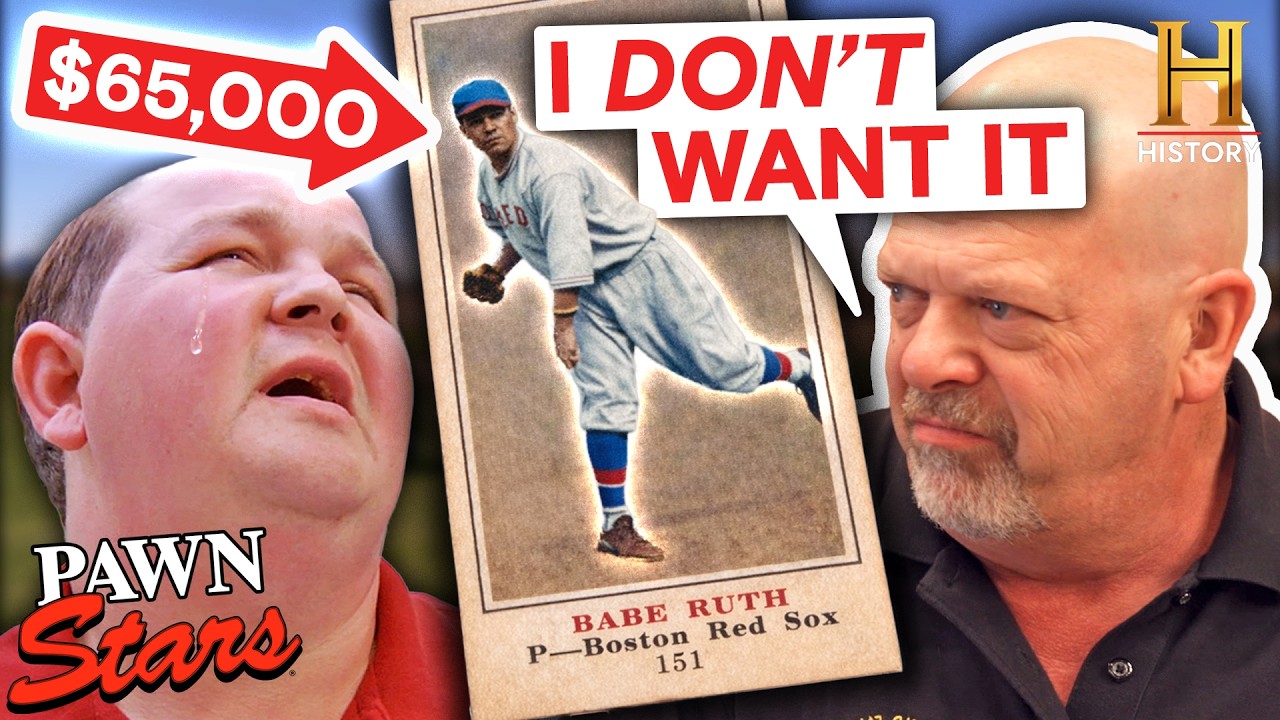
I have a Babe Ruth baseball card.
CHUMLEE: Did you say Babe Ruth candy bar?
Really?
I was hungry.
BALLPARK CONCESSION MAN: Hot dog!
DEREK: I came down to the pawn shop today to try to sell my Babe Ruth baseball card.
When I found this card, holy moly, I almost crapped my britches.
I’d like to sell it because I would like a new car.
Asking $65,000 today, but the lower I would go, probably about $45,000.
Where did you get this?
I found it in our shed in our backyard.
You just found it in a shed?
It was in a lockbox.
It was my grandfather’s.
All right, you know, this is Babe Ruth when he was still with the Red Sox.
Some people consider him the best baseball player ever.
I mean, if he wasn’t a pitcher at the beginning of his career, he would have probably hit over 1,000 home runs.
Wow.
No one knew him as a pitcher.
Yeah, most people don’t realize he started off as a pitcher.
And most people don’t realize what a great pitcher he was.
I mean, literally, one year of pitching, his ERA was 1.75.
What happened with Babe Ruth, I believe, is he kept on telling the owner of the Red Sox, I want to be a hitter full time. I don’t want to pitch.
I don’t want to pitch.
And he eventually ended up going to the Yankees.
That’s got to be the dumbest trade in baseball history.
You know what?
That’s why they didn’t win the World Series for a very long time.
It was the curse of the Bambino.
Babe Ruth is one of the guys who made baseball America’s favorite pastime.
His record of 60 homers in a season took over 30 years to break.
And his lifetime home run record took even longer.
Baseball cards like this were generally sold in cigarette packs.
Back in the day, major stars used to endorse cigarettes.
Nowadays, they don’t do that.
Now this one, I find it a little weird that it’s got a newspaper advertisement on the back of it.
Do you have an idea what you wanted for it?
$65,000.
$65,000, this is the big thing with a Babe Ruth baseball card.
They’ve been faking these things since the ’40s and the ’50s.
They’ve always been worth money, so they’ve always been faked.
So I’m not going to say it’s real until I have someone else look at.
That sounds awesome to me.
If it’s real, you hit a jackpot.
It’s extremely rare for authentic Babe Ruth memorabilia to walk into the store.
This could be an absolute jackpot.
But 65 grand is way too much to risk without getting it checked out first.
What’s going on, Rick? Chum.
CHUMLEE: How you doing?
Doing good, man.
What do we have?
RICK HARRISON: The Great Bambino.
We got an old Babe Ruth card, man, you got to be kidding.
This is just awesome.
I own Ultimate Sports Cards & Memorabilia here in Las Vegas.
The guys call me down to the shop anytime a card comes in the shop that they need some help with.
In baseball, there’s no name bigger than Babe Ruth.
By the time he was 19, he signed a minor league contract.
The problem was since he wasn’t 21, the owner of the minor league organization had to take custody of him so he could sign the contract.
Then his teammates kind of teased him saying, hey, that’s Jack’s newest babe.
And that’s how the name Babe Ruth came to be.
RICK HARRISON: That’s cool.
JEREMY BROWN: Then after that, that’s when the dumbest move in sports history happened when he got sold to the Yankees.
It’s been over 90 years.
And I’m telling you, Red Sox fans are still pissed off that the best player in the sport was dealt to finance a Broadway play to a rival, especially.
To finance a Broadway play?
JEREMY BROWN: Yeah, the owner of the Red Sox had, I guess, another interest aside from the sport.
And it’s known as the dumbest move ever to happen in sports.
But Babe Ruth items, especially from his playing days, these are pretty much one of the only guarantees in sports memorabilia that always go up.
Babe Ruth items, they appeal to any collector.
His name is just so important with sports in general.
It’s an absolute must-have for any sports fan.
What you have here is one of Ruth’s earliest cards.
And it’s the very first to ever feature him in his Major League uniform.
This is a top five must have for any serious collector.
What this is, the sporting news, they basically had two 200-card sets that were distributed in their publications every week.
On this one, we have “The Tribune” advertisement, which of the two Babe Ruth’s, this one’s the more preferred one.
Last time I checked, there might have been maybe 40 or 50 these known to exist.
The highest graded example of this I saw sell for over $200,000 not too long ago.
So is it real?
We’re going to find out right now, man.
All right.
JEREMY BROWN: Let’s start with condition.
It’s not mint, but it’s not bad.
The corners and the edges are actually quite nice.
And what’s amazing about it, the centering is almost dead-on.
What we’re looking for is we need to analyze the paper stock and just overall feel and texture.
Now as far as value on this, nothing.
What we have here is not a real card.
The whole texture is off.
The coating on the surface, and especially the printing.
Even though the technology was pretty weak back then, it was a lot more clear than what it appears on the Babe Ruth card here.
So this is without a doubt a reprint.
Ah, [bleep].
JEREMY BROWN: Yeah, unfortunately, you don’t have a winning lottery ticket here, man.
It is what it is.
Yeah, sorry, man.
Hey, well, thanks, man.
JEREMY BROWN: Hey, you got it, Rick.
Later, Chum.
See you later, man.
JEREMY BROWN: These days, fake cards are actually more prevalent than ever just because the technology and the means to print them are so available.
But that’s the nature of the game.
Well, it’s a bad day now. RICK HARRISON: I’m sorry, man.
Well, have a good one though. – You too.
$65,000 that close but no cigar, you know, I’m just disappointed.
HOW’S THAT WORLD SERIES RING TREATING YOU?
– GOOD, GOOD.
YOU LOST WEIGHT, MAN. YOU LOOK GOOD.
– YEAH, I’M TRYING, MAN.
WHAT DO WE GOT HERE?
– A PROGRAM FROM SUPER BOWL NUMBER ONE, PACKERS AND CHIEFS, FROM 1967.
– THIS COULD BE VERY VALUABLE.
– I FEEL LIKE MY WIFE’S GETTING SICK OF ALL MY STUFF, SO SHE SAID, “EITHER GET RID OF THE STUFF OR GONNA GET RID OF YOU.” – SURE YOU’RE MAKING THE RIGHT CHOICE?
– [laughing] BACK IN 1967, MY COUSIN WENT TO THE GAME, AND HE KNOWS I COLLECT SPORTS MEMORABILIA SO HE GAVE IT TO ME.
YOU KNOW, MY WIFE’S JUST GETTING SICK OF ALL MY STUFF.
SO IF I DON’T SELL IT TODAY, I’LL PROBABLY JUST HIDE IT FROM HER AND THIS WAY, I WON’T BE ON HER BAD SIDE.
– “WORLD CHAMPIONSHIP GAME. AFL VERSUS NFL.” WE ALL KNOW IT AS THE SUPER BOWL, BUT THEY HADN’T COME UP WITH THE NAME “SUPER BOWL” YET.
THIS WAS A BIG DEAL WHEN THEY DID THIS.
HIS NAME WAS HUNT.
HE WANTED A FRANCHISE OF THE NFL AND THEY SAID, “NO.” AND HE SAID, “WELL, SCREW YOU GUYS.
I’LL GO START MY OWN LEAGUE,” AND HE FORMED THE AFL.
AND IT WOULD HAVE, YOU KNOW, ALMOST LIKE THE WORLD SERIES.
THE AFL, NFL CHAMPIONSHIP TEAM WOULD MEET EACH OTHER AND, YOU KNOW, DECIDE WHO’S BETTER.
BACK IN THE DAY, COLLEGE FOOTBALL WAS WAY MORE POPULAR THAN THE NFL.
THEY ALWAYS CALLED POSTSEASON GAMES IN COLLEGE, “BOWL GAMES.” SO THE AFL’S FOUNDER, LAMAR HUNT, JOKINGLY CAME UP WITH “THE SUPER BOWL” AND THE NAME ACTUALLY STUCK.
HAVE YOU EVER HAD IT LOOKED AT OR ANYTHING BEFORE?
– NO, NO ONE’S LOOKED AT IT.
I’M NOT EVEN SURE WHAT THE GRADE IS, BUT ALL THE PAGES ARE INTACT.
NONE OF THEM ARE TORN.
– THE ADS ARE WHAT’S ALWAYS COOL TO ME.
‘CAUSE YOU JUST DON’T SEE THIS KIND OF STUFF ANYMORE.
LIKE, “WHAT IRRITATES JOHNNY UNITAS?” APPARENTLY FOOT FUNGUS.
– I MEAN, LOOK AT THE HELMET. LOOK AT THE UNIFORMS.
– YEAH.
I’M SURE THERE WAS A LOT MORE CONCUSSIONS BACK THEN THAN THERE IS NOW.
SO WHAT DO YOU WANT TO DO WITH IT?
– I WANT TO SELL IT.
– ALL RIGHT. HOW MUCH YOU LOOKING TO GET?
– I THINK 600’S FAIR.
I’VE SEEN A FEW ONLINE AND THEY GO ANYWHERE FROM 500 TO 1,000.
– HERE ARE MY CONCERNS, MAN.
IT’S NOT A RING, IT’S NOT A SIGNED BALL, IT’S A PROGRAM, AND I JUST DON’T KNOW HOW MANY ARE AROUND AND WHAT THEY’RE WORTH TODAY.
DO YOU MIND IF I HAVE A BUDDY OF MINE COME DOWN AND TAKE A LOOK AT IT?
– ALL RIGHT. LET’S SEE WHAT HE HAS TO SAY.
– ALL RIGHT. LET ME GIVE HIM A CALL.
– ALL RIGHT.
– CONSIDERING OVER 100 MILLION PEOPLE WATCH THIS GAME EVERY YEAR, THERE’S NOT A DOUBT IN MY MIND THAT THIS THING WILL MOVE QUICKLY.
SO I’M NOT GONNA LET THIS THING OUT OF MY SHOP BEFORE I KNOW WHAT IT’S WORTH, AND EVEN IF I BUY IT, I’M NOT SURE IF I’LL SELL IT.
IT’S A WORLD CHAMPIONSHIP GAME AFL VERSUS NFL.
– FANTASTIC, MAN.
I MEAN, THIS IS OBVIOUSLY BEFORE THEY COINED THE TERM “SUPER BOWL.” FROM THEN ON, I MEAN, FOOTBALL IS THE AMERICAN SPORT THESE DAYS, AND THE REST IS HISTORY.
AND THIS THING RIGHT HERE, THIS IS ERE IT ALL BEGAN.
I MEAN, THIS IS A GREAT PIECE OF SPORTS MEMORABILIA.
AFL-NFL CHAMPIONSHIP GAME, THE FIRST ONE THEY HAD, YOU KNOW, 50,000, 60,000 PEOPLE TUNED IN, AND, YOU KNOW, TICKETS WERE JUST VERY REASONABLE COST.
NOWADAYS THE SUPER BOWL HAS BECOME SO POPULAR, YOU KNOW, WELL OVER 150 MILLION PEOPLE CAN TUNE IN, COMMERCIALS ARE GONNA RUN YOU $4 MILLION JUST FOR A 30 SECOND SPOT.
IT’S BECOME A NATIONAL HOLIDAY.
– YOU KNOW, I’VE NEVER EVEN SEEN ONE OF THESE.
WHAT DO YOU THINK IT’S WORTH?
– WELL, THERE’S NO SHORTAGE OF THESE OUT THERE.
THE COLISEUM WAS ENORMOUS.
THEY PRINTED QUITE A BIT OF THESE, BUT FINDING ‘EM IN GOOD SHAPE IS PRETTY HARD TO DO.
MIND IF I TAKE A LOOK AT THE PROGRAM?
– SURE. GO AHEAD.
– I MEAN, JUST LOOKING AT THE COVER ALONE, I MEAN, IT’S IN PRETTY GOOD CONDITION.
NO MAJOR SCRATCHES ON IT.
SPINE OVERALL LOOKS TO BE IN PRETTY GOOD SHAPE.
THERE IS SOME ROUNDING ON THE CORNERS DOWN HERE ON THE BOTTOM.
THIS IS VERY COMMON ON THESE BECAUSE THEY HAVE THE THREE PAGE FOLD-OUT HERE, AND OVER THE YEARS, IT CAN GET WORN DOWN.
OTHER THAN THAT, I MEAN, THE PAGES STILL HAVE GREAT COLOR, I DON’T SEE ANY KIND OF CONDITION ISSUES WITH THE PAGES THEMSELVES.
SO AS IS, YOU’RE LOOKING AT AROUND 250, 300 BUCKS.
– THAT SEEMS KIND OF LOW.
I MEAN, WHAT IF IT WAS IN PERFECT CONDITION?
WHAT WOULD IT BE WORTH?
– MINT CONDITION EXAMPLES I’VE SEEN SELL FOR ABOUT $600, $700, UP TO 1,000 BUCKS.
– SO YOU DON’T THINK A PACKERS FAN WOULD PAY $500, $600 FOR IT?
– NOT A PACKER FAN WITH ANY SANITY IF THEY HAVE THE INTERNET.
– APPRECIATE IT, MAN. – HEY, YOU GOT IT, MAN.
IN TERMS OF SUPER BOWL PROGRAMS, THIS IS THE ONE YOU WANT TO HAVE.
THIS ONE’S IN DECENT CONDITION, BUT IT’S KIND OF MIDDLE OF THE ROAD.
– I MEAN, YOU STARTED OFF AT 600, MY–YOU KNOW, JEREMY’S SAYING IT’S WORTH ANYWHERE FROM 250 TO 300.
WE’LL CUT THE WHOLE SONG AND DANCE AND NEGOTIATE NOW.
THE MOST I CAN PAY IS 200 BUCKS.
– HOW ABOUT I SELL IT RIGHT HERE TO THESE PEOPLE FOR 600 BUCKS?
– HOW ABOUT I HAVE ONE OF MY SECURITY GUARDS THROW YOU OUT OF MY STORE?
– I’LL LET IT GO FOR 500, BUT THAT’S AS LOW AS I’LL GO.
– I’LL GO 200.
– NO, 200’S JUST TOO LOW.
I MIGHT AS WELL JUST HANG ONTO IT.
– THAT’S ALL UP TO YOU, MY MAN. – ALL RIGHT.
– OFFER STANDS IF YOU CHANGE YOUR MIND, BUDDY.
– OKAY.
I’LL TAKE IT BACK HOME, AND I’LL GIVE IT TO MY SON, AND YBE IN 30 YEARS, IT’LL BE WORTH $255.
How you doing, boss?
I have a 1934 USGA “Rules of Golf” book for sale.
CHUMLEE: “Rules of Golf.” So this is what they referred to last year when Tiger had that shady drop?
[laughs] There you go.
RECORDING: Aw!
MAN: What’s in this book is basically the rules of golf as they were in 1934.
Obviously, the dress code’s changed.
The equipment’s changed.
But, at that time, that’s what they went by when they played the game.
CHUMLEE: This is pretty cool, man.
And, you know, people really do collect golf stuff.
I mean– SCOTT: Oh, yeah.
CHUMLEE: –from famous players. – Sure.
Golf clubs and bags go for big money sometimes.
SCOTT: Oh, absolutely.
CHUMLEE: How long have you had this?
SCOTT: It’s been in my family since before I was born.
It was my grandfather’s.
He was probably about 20 when that came out.
– Was he a big golfer? – Oh, yeah.
Yeah. – OK.
Amateur.
Oh, so he probably would refer to this often.
SCOTT: Yeah.
And back then they wore knickers and, you know, steel spikes on their shoes and a suit and tie.
[laughs] CHUMLEE: Suit and tie?
Oh, yeah.
They used to play with jackets and ties.
[laughs] CHUMLEE: Golf has been around for hundreds of years, and it makes sense.
You ride around in a golf cart while someone else carries your clubs.
You’re just chilling with your dudes and there’s a snack cart.
Count me in.
Let’s see here what we got here.
Rule number 25, hazards.
When a ball lies in or touches a hazard, the club shall not touch the ground, nor shall anything be touched or moved.
That’s it. Yeah.
That’s pretty much how a hazard works today.
Oh, yeah.
There’s a lot that’s still the same.
The actual playing part of it’s probably very close.
CHUMLEE: So what did you bring it down here for?
I’d like to sell it.
And how much were you looking to get?
I believe it’s worth about $400.
CHUMLEE: $400?
They actually started coming out with this book in 1908, and– Yeah.
CHUMLEE: –I haven’t seen one from 1934.
It’s pretty significant.
In ’34, that’s when Augusta National was founded by Bobby Jones.
CHUMLEE: Well, Augusta’s the golf course.
But I think the Masters is the tournament played on Augusta.
Right?
Right.
Right.
There was a lot of these printed by 1934.
And as cool as it is, you know– SCOTT: Yeah.
CHUMLEE: –books aren’t really worth much after the first edition.
So I’m pretty sure that 1908 is the only one that I’d even be interested in, if you had it.
You know, if this had the Augusta club on there, then I’d be like, oh, this is amazing.
This is– SCOTT: Right.
–a rule book from Augusta.
From the first year the course was opened.
CHUMLEE: It’s a cool piece, man, but I’m just going to have to pass on it today. – Hey, that’s fine.
No problem.
I appreciate you taking a look at it.
Hey, thanks for bringing it in, brother.
No problem. – All right.
Take care.
Have a good one.
CHUMLEE: It’s definitely too bad that that book wasn’t worth more.
But I’m glad it came through the door today, because he gave me the best idea ever.
RICHARD: You got to understand, Rick, that Lexington is the barbecue capital of the world.
I think for some towns in Texas that would argue the fact, but I’ll go with you on Lexington.
You better.
CHUMLEE: I got it.
I just had this really cool 1934 PGA golf tournament rule book.
It gave me the best idea, ever.
What’s that?
CHUMLEE: Something to ease your shoulder and your mind, at the same time.
And we can all do it.
What’s that?
RICK: What?
Golf.
RICK: We’re talking real golf or are we talking about hitting the ball through the clown’s head?
CHUMLEE: Real golf.
Because swinging a club really hard is going to be great on my shoulder.
Dude, it’s not about swinging the club hard.
Golf is a game about zen.
You can’t hurt your shoulder doing this.
RICK: It’s a lot harder than you think, Chum.
Golf is the most frustrating, evil game on the planet.
You know what?
Being outdoors could probably do me some good.
Thank you.
I’m telling you, dude, you’re going to enjoy this.
Ah!
You know what?
You should bring Theo.
I hear he’s pretty good.
Maybe he could give us some pointers.
Hey, Chumlee, you know that Lexington has some of the best golf courses in the world?
COREY: I can’t do this.
Yeah.
I got stuff to do.
RICK: [laughs] Yeah.
You can take the man out of Lexington, Rick, but you can’t take Lexington out of the man.
[laughs] It’s all in the hips, Chum, it’s all in the hips.
I really think you should be out here.
It looks like it’s a lot of shoulder work, man.
Since Chum is terrible at golf and I can’t play, my dad told me to bring Theo.
He’s the store’s new general manager, and he golfs regularly.
So if we bring him, at least we won’t look like total idiots.
You know, Chum, Theo’s looking a lot better than you right here, man.
I’ll tell you what.
Let’s make a little bet.
COREY: Oh, yeah?
Yeah.
If I come within 30 strokes of Theo, I get the rest of the week off.
Sure, dude.
I’m not the slightest bit concerned.
[laughs] I’m going to beat you, Chum.
Hey, guys.
How you doing?
It’s all good.
How’s it going?
I’m good.
Looks like you could use a little help.
From who?
I can help you.
You’re not near as bad as Charles Barkley, so I know I can help you.
[laughs] First of all, you got your foot in the bucket there as you’re swinging.
Keep your left foot solid on the ground.
CHUMLEE: OK.
Swing at about 60% of your effort.
CHUMLEE: All right. I got this.
What did you say your name was?
I didn’t.
CHUMLEE: All right.
BUTCH: I came along my range here at the golf school and I saw a couple of guys look like they were struggling– one of them, in particular.
So I figured I’d better try and help them.
Great shot.
THEO: Wow.
See?
That’s pretty good.
I could turn you into a teacher in no time.
Hi. My name is Butch.
– Chumlee. – Chum, nice to meet you.
Have you trained people before?
Yeah.
I’ve trained some guys that have been pretty good– Greg Norman, Tiger Woods, now Phil Mickelson.
CHUMLEE: [laughs] A few guys.
We got a comedian over here!
He claims to have trained Tiger Woods.
BUTCH: How about that one, pal?
THEO: Before we take any more lessons, what do you say we get this game started?
CHUMLEE: Let’s do it.
Well, I’ll be your caddy, then.
Uh-oh. Uh-oh.
BUTCH: Make sure he gives you at least one throw.
That’s a big key in this bet. OK?
THEO: OK. – All right?
OK. One throw.
BUTCH: Now remember– CHUMLEE: Do you agree to that, Theo?
THEO: Yes.
Yes, I do.
BUTCH: You don’t think he can throw it very far, huh?
No.
Theo, if I’m your caddy, grab your crap and throw it in the cart. Let’s go.
All right. I’m ready.
When you hit a really good one, you walk over to him and you give him one of these.
Woo!
THEO: Hoss, we cannot lose to Chum.
You hit it and then you woo!
BUTCH: There you go.
I’m going to work on that.
You ready for this, Chum?
He’s playing a long time.
BUTCH: Remember, we got the throw.
CHUMLEE: All right.
The throw’s important.
[music playing] Hooked it a little.
Not too bad, though.
Down the left side. – Well, did you cough?
What was that?
I can’t– I had to clear my throat.
I couldn’t help it.
THEO: OK.
BUTCH: Come on, Chum, just like the range.
Nice and smooth.
CHUMLEE: [laughs] BUTCH: That was pitiful, Chum.
BUTCH: Chum, all you want to do is get back on the fairway over there.
It’s all right.
We’re gaining on it.
It’s all right, Chum.
He’s in the sand. He’s in trouble, here.
You’re all right. – Hopefully.
We’re still in good shape.
Don’t worry about it.
THEO: Get over.
BUTCH: Yup.
All right, Chum.
You tend to hit the ball a little to the right, so you want to aim a little left.
Good shot, Chum.
COREY: Damn it. BUTCH: Got it on the green.
You’re the man, Butch.
Way to go, my man. All right.
All right.
Corey’s going to wish he hadn’t bet against me.
I don’t know who this old guy is, but he’s already helping my stroke.
I think I’ll keep him around.
BUTCH: Yes, sir.
THEO: Oh, no.
COREY: What are you doing, Theo?
THEO: I don’t want to just run away with it, Hoss.
BUTCH: All right, Chum, give me that smooth swing now.
Oh, Theo.
CHUMLEE: Woo!
THEO: Easy, Chum.
There’s a lot of golf to be played.
BUTCH: Good shot, Chum.
THEO: Nice.
Even though Chum is playing a lot better than I thought he would, there’s no way in hell he’s going to be able to beat Theo.
BUTCH: So I think this is a good time for the throw.
Just throw it back in the rocks back there.
CHUMLEE: Remember the agreement, I get one throw.
Right. Right.
We didn’t agree whose ball I could throw.
I’m going to exercise my throw right now.
You can’t throw my ball.
BUTCH: That was the bet.
THEO: Dude.
COREY: Have fun, Theo.
That wasn’t even good etiquette.
No. But you got a bad line now.
Let’s go.
THEO: This is legal, Chum?
You’re happy about this?
BUTCH: You agreed to the bet.
CHUMLEE: Theo, the only thing I’m happy about is beating you.
OK.
[bleep] Theo’s four?
This is Theo’s fourth shot from after the throw.
CHUMLEE: What?
BUTCH: How about this?
THEO: Oh, yeah!
CHUMLEE: Oh, my god!
BUTCH: Are you kidding me?
All right, well done.
COREY: Chum’s actually only down by, like, 28 shots.
I can’t believe if this thing says he wins.
Knock this in.
You can handle it.
THEO: I don’t think he can make this sauce, though.
You can handle it, big man.
THEO: I don’t think he can make it.
You can handle it. He can handle it.
THEO: It’s a big shot, Chum.
COREY: Better hope he misses this, Theo.
[music playing] Atta boy, Chum.
THEO: Oh, my god!
[laughs] Woo!
CHUMLEE: The rest of the week off is going to be great, Big Hoss. THEO: Good match, Austin.
BUTCH: All right.
Woo!
[laughter] COREY: Technically, Chum didn’t beat Theo.
He still lost by 29 strokes.
But a bet’s a bet, so I guess I’ll pay up.
Do you think I’ve got some potential?
[laughs] Get over yourself.
You got no chance.
Let’s get out of here.
You said I could beat Barkley.