Jailhouse Gems: Prison History Uncovered | Pawn Stars
Jailhouse Gems: Prison History Uncovered | Pawn Stars

I wanted to know if you have any old Nevada Prison tokens for sale.
Not at the moment.
Okay, let me flip it around.
How would you like to buy some old Nevada Prison tokens?
They’re very hard to find.
[Corey] You know what? I don’t have any plans of going to jail -in my life, so… -Okay.
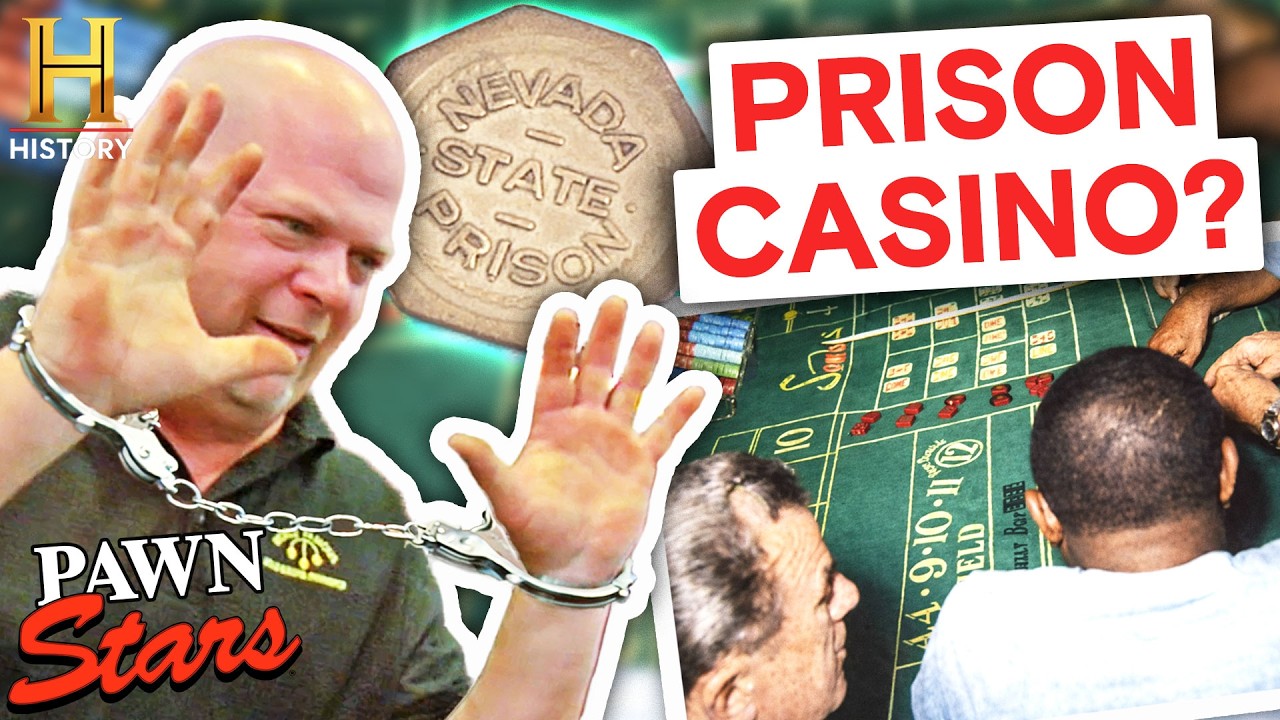
[police siren wailing] [Ed] What makes these prison tokens really special is that Nevada had a casino that operated inside the maximum security prison. To my knowledge, that didn’t happen anywhere else in the United States but Carson City, Nevada. I’m walking in with a $1.41 face value in old Nevada Prison tokens and I’m hoping to walk away with a lot more than that.
[Corey] They’re pretty rare, considering that you pretty much had to go to prison between the 1930s and ’60s…
-Right. Right. -…to have access to them.
The last thing they wanted you to have in there was cash.
But the funny thing is, in Nevada history, to operate a table game, you are not allowed to be a felon.
They somehow had a casino in the prison that was ran exclusively by felons. [laughs] And it worked.
And the guy who was operating the table, he could then take these and go spin them throughout the prison. Uh, chewing gum, or I’m sure somebody was taking these -for toilet wine he was making. -Right.
[toilet flushing] This is just a little documentation.
Just kind of shows, you know, what the inside of the casino looked like.
Wow. It looks like they actually even got one of the, uh, old craps tables out of the Sands, if you look at it. It says “Sands” on it.
You know, the inmates look like they’re having a good time.
Better than breaking rocks, jeez.
The casino at the Nevada State Prison is just legendary.
Where else in the world would a bunch of criminals get to run a legitimate gaming place? And they got away with it for over three decades.
How much money you want for them?
I’d like to get about 850 bucks for the stack.
I don’t have a doubt in my mind that I could sell them.
But I think $850 is just way off, man.
We’re way far apart -on what I’m willing to pay. -Okay, $900?
[laughs, inhales] I was thinking more around the range of four.
Ooh. Well, I’m gonna need you to do better than $400.
I mean, honestly, these are really tough to find.
This guy right here, there’s probably only five on the planet.
-Okay. -And these, I figure, are…
easily $100, $125 each.
I’ll go $450.
How about six and a half? I mean, your shop, being in Nevada, you would have a perfect place ’cause no one else is gonna have these.
Five hundred is the best I can do, buddy.
-Let’s go ahead and do it. -Alright, man. Deal.
-Alright. Thank you. -Meet me over there.
[Ed] I’m walking away today with $500 and I’m gonna put this in the vacation fund and take my wife to Maui.
Earlier today a guy called, said he’s got a ball and chain.
And since I’m not an expert in that field, I called my buddy, Mark, who is.
So this is the ball and chain you called me about?
-Yep. -I’m an expert in police memorabilia and restraints.
I’ve been collecting police memorabilia for about 25 years now.
[Rick] So why do you wanna get rid of it?
Well, actually, I just got married a couple weeks ago, and I don’t need it anymore.
-I got the real thing at home. -[laughs] [man] The reason I’m interested in selling this thing is, I have no use for it. Plus, it’s really heavy. I don’t wanna lug it around the country all my life. About a year ago, I was doing a remodel and the homeowner was gonna toss it out.
I thought it was pretty cool, uh, so I took it home and…
a year later, had nothing to do with it, nowhere to put it.
So, Mark, what do you think?
Well, this was pretty much used by the prison system.
So ball and chains are found mainly in the United States, typically in the South, where the chain gangs were prevalent. They’d attach them to their prisoners so they could let the prisoner get outside of the prison yard to do farming or road work or didn’t wanna take the chance of them escaping.
-This was good behavior? -[laughter] This thing is wild. I can just imagine those poor guys on the side of the road, wearing their striped uniforms, dragging around a pickaxe, and this thing on their leg. It must have been hell. When identifying a fake one, the first thing you wanna look at is the chain.
The chain will be modern, -welded. -[Rick] Okay.
Ninety percent of all ball and chains that you’ll see are faked. There’s very few examples that have existed, and most of them are in private collections. This one has the old heat and beat method.
Links were probably very hot and hammered into the shape and then hammered shut.
[Rick] This thing is incredible. There’s 40 or 50 links in this chain and every single one of them was hand-forged. Nowadays, you just walk into the hardware store…
“Give me three feet of that.” [laughs] So I can tell that this is an authentic piece.
I’m gonna date it somewhere between 1920 and 1940.
It was manufactured by a company called Tower which was the Ford of handcuffs and leg irons.
So how much is it worth?
I’d estimate somewhere between $650 and $750.
Okay. Thanks for coming in, Mark. Really appreciate it.
Alright. My pleasure. Thank you.
[Rick] Now that I know this is real, I really wanna try and buy it. It’s a really interesting item.
It’d look really cool in my shop.
And I can put it on Chumlee and make sure he stays at work. [laughs] You know what? I’m gonna make this real plain and easy and simple and– 400 bucks -and not a dime more. -400 bucks, uh…
-$450? -400 bucks.
How often do I have someone walking in here asking for a ball and chain?
-Not real often. -Alright, 400 bucks it is.
[man] I never thought this thing was gonna be, uh , worth that much money, or any money at all. So I’m pretty stoked that you know, I got 400 bucks out of it.
[Corey] What do we got? These are some vintage…
-[unzipping] -…hand restraints.
I have, uh, several pieces I want you guys to look at.
Wow. Are you just into some really kinky stuff, or…
-Yeah, man, I’m kinky, alright. -[Corey laughs] [whipping] [Gary] I’d like to sell my handcuff collection today to do some much-needed remodeling for my house. I bought my collection over the years because they were unique and now they’re highly collectible. I would like to get $12,500 for this collection.
Uh, my bottom line will be $7,500.
I was a corrections officer in my career.
I’ve just been picking them up for the last 20, 25 years.
These are single-hand restraints, or commonly called a come-along.
If you were handcuffed behind the back, and a prisoner was bucking, then you would use one of these devices to help him get to where you need him to go.
[Corey] Yeah, um, this was back when a handcuff was more of a, uh, torture device -than a hand restraint. -[Gary] Exactly.
Technically, they’re supposed to be used -so you can’t move your hands. -[Gary] Right.
[Corey] These, they put this on one hand, and if you move, they just snap your wrist.
-Exactly. -Right?
-So you just take this one… -Yeah, and just slap it on.
-Twist this thing. -No, don’t you dare do that.
Come here. Get over here right now.
-[laughs] -Get over here.
Just that little bit hurt, man.
How old are some of these?
[Gary] This one patented, uh, 1894.
Uh, the Pratt Combinations, the first model came out 1916.
They almost all kind of look like corkscrews.
[Gary] Almost. Yeah, that one hurt.
And then if you weren’t satisfied with the…
-You twist it. -[Corey] Yeah, I can see how that could be, uh, really effective there.
Oh, yeah. This was one of my favorites.
[Corey] These old handcuffs are pretty cool, and more than a little creepy.
Before modern handcuffs came out, there was all kinds of torture devices, and I certainly wouldn’t wanna be restrained in any of them.
How many do you have all together?
Uh, I would say there’s about 80 pieces in here.
Okay. How much are you looking to get out of them?
-I’m looking to get $12,500. -[Corey] Okay. Um…
You got a lot of pieces here, man.
Do you mind if I have a buddy of mine come down and just kind of take a look of them?
-Who you calling in? -He’s a magician.
-Magician? -And he has a humongous collection -of handcuffs. -[Gary] Oh, okay.
Why not? A second opinion is always welcome. They need to be informed on what these are -and how rare they are. -[register dings] [Chum] So here’s why we called you up here, Murray.
We wanna watch you get out of one.
-Really? -[laughter] [Murray] The reason they called me is because I’m a massive collector and these handcuffs are extremely collectible ’cause they don’t make them anymore.
-Oh, you got a whole bag full. -[Gary] Correct.
[Murray] Uh, this collection looks really cool.
-This is a policeman’s hook. -Correct.
-1884. -’84. Mm-hmm.
That’s a really rare item.
And then you have a Malcolm here.
These are basically the old version of a taser.
If you had these around someone’s wrist, you could take them down to their knees instantly.
-Mm-hmm. -It actually twists and actually puts pressure on the person’s wrist.
[Garry] Correct.
You know what I really wanna do is, I wanna have a look through the bag that you have all the stuff in.
-Is that okay? Alright. -Oh, absolutely, yeah. Sure.
[Murray] You really have a lot of stuff here, huh?
Oh, yeah.
[Murray] Wow.
Oh, we got all these, uh, chain nippers, and…
-Whoa. Alright. -[chains clinking] So what kind of weird dungeon do you have in your house?
No dungeon. Just a game room. Entertainment.
I’d hate to get “entertained” by you.
[Murray laughs] It’s definitely entertaining.
So give me an idea, what do you think all of it could be worth?
[Murray] These are very collectible.
I mean, this is the Pratt Model 1.
This one, Houdini did actually have in his collection.
There’s only 700 of these made in the world. That’s it.
-Wow. -[Murray] I mean, these alone are between $700 and $1,000 each.
I would say this collection would be worth very close to…
[tense music plays] $10,000.
I see at least $12,500, $13,000 in it.
That’s piecing it out one by one, though.
If you wanna sell this whole collection, -it takes a certain buyer. -Alright, Murray, man, -I appreciate it, buddy. -Alright, thanks a lot, guys.
Good luck. Pleasure meeting you.
This is an awesome collection.
[Corey] I’m glad Murray was able to tell us how rare these restraints actually are.
They’re definitely worth more than their weight in scrap metal, but selling them piece by piece can take a long time.
You’re asking $12,000, Murray says $10,000.
You know, who knows what I’m gonna get out of ’em selling each one of these one by one.
What’s the least amount of money you’re gonna take for it?
Nine. There’s some rare pieces in here.
You know, it took you 20 years to get this collection.
-Mm-hmm. -You know, I’d hate to see it -take me 20 years to sell this. -Sell it.
-[Corey laughs] -Oh, it won’t take you 20 years.
Would you go $7,500?
$8,100 with the keys.
[laughs, inhales] Alright, man, you got me, $8,100.
-$8,100. -Alright, deal.
-Thank you. -Chum, you wanna write it up?
-Alright. -[Gary] $8,100 is going to get me a new kitchen. And if I got the money, I’ll start all over.
I got something I think you might be interested in.
-A poster, right? -Yeah, you know, it’s something a little bit better and different than that.
This is the original blueprint of the electric chair from the Joliet State Prison in Stateville.
Okay. That’s definitely more interesting than a poster.
[electricity zapping] [Dave] This was a brand-new thing for the state of Illinois. So sometimes they had inmates help them do it, or they had their staff build that chair. I would like $5,000. If that’s not possible, maybe $1,800.
[Corey] So where in the world did you get this?
Well, back in the 1970s, I worked at the county jail for a few years.
One of the old-timers there who was retiring took a liking to me as a rookie and gave me this.
The Joliet State Prison was part of Cook County back then in 1925 when they opened up.
Okay, so there was some Chicago mob guys in there, right?
-Definitely. Definitely. -[Corey laughs] Over the past, you know, 120 years, the electric chair is probably one of the more interesting things to be invented.
You know, most places have switched out the electric chair for the gas chamber or lethal injections.
People seem to think it’s a little bit more humane, but how would you know unless you ever been put in one?
[Chum] Is this electric chair still at the prison?
It still exists, except it’s all bricked up.
August 24th, 1962 was the last time in the state of Illinois that they executed anybody.
And they bricked it up, hoping that maybe the state would change their mind and have it come back.
[Corey] Yeah, it’s been a controversial issue, whether, you know, the state has the right to actually kill somebody.
There’s people out there that’ll say if murder’s illegal, the state can’t murder you, no matter how bad of a guy you are.
And then there’s plenty of people out there that believe, you know, that some people that are such [bleep], they deserve to die.
I’m sure collectors would be all over these blueprints. If this is an original and not something that was mass-printed, it might be pretty special.
How much do you want for it?
-I’m looking at five. -Five hundred?
-Five thousand. -Five thousand.
[Chum] Whoa.
Okay, um…
Do you mind if I give a buddy of mine a call?
Who would that be?
It’s my buddy, Mark, Clark County Museum guy.
He’s a– Pretty much knows everything there is to know about everything.
-Sure. -Alright.
I have no problem with them calling in another person to look at ’em.
He’s gonna see that they are real -and they are the originals. -[register dings] [Chum] So what do you know about electric chairs?
I wouldn’t sit in one.
[laughter] Can you read the blueprints to one?
[Mark] Yes.
Oh, it’s Stateville. Okay.
There are only three electric chairs in the entire state.
One of them was at Stateville, which is the state penitentiary.
Joseph Ragen, he was the warden at that point.
He didn’t like to do executions. He didn’t believe in executions, so he always appointed one of his staff, a deputy, to actually turn on the juice, as it were.
The electric chair does still exist today. There are a few states that still have it as a primary means of execution.
There are a number of states where it is available if the criminal being executed asks for it. But in most cases throughout the United States, most states have gotten rid of it.
One of the things I think is kind of interesting about these, they tried to make them at least a little bit comfortable.
You had actually different ways of restraining you.
You have a padded seat that can be removed.
The back here can be moved so that you can lean back more or less.
There was an odd nod to comfort on that when it was going to be utilized.
[Corey] How common are these things?
[Mark] You can find blueprints in books, in histories of executions in the United States, things like that. They’ve been reproduced.
But to find a first-generation print, that’s unusual.
I can say that, looking at this, the paper is right. The age is right.
This is real. This would be a first-generation blueprint -for the electric chair. -[Corey] Okay.
Well, thanks, Mark.
-Not a problem. Chum. -Appreciate it.
-[Chum] See you later. -Thank you, sir.
You wouldn’t think that there’d be a collector’s market for devices like the electric chair, but there are. It’s kind of nice to see a single design that’s original to the time period.
[Corey] So how much were you looking to get out of it?
I would like to get about $5,000 for it.
Um… [sighs] That’s a little much.
If it said “Edison” anywhere on here, you’d be looking at $5,000 all day long.
The fact that it doesn’t, makes it worth a little bit less.
So I’d like to offer you around 800 bucks for it.
-Nah. -Are you willing to come down at all?
Um, I’m willing to come down to about $2,200.
Realistically, after I spend some money on it, I could probably get $3,000.
Could you go $1,000?
[exhales] Sixteen.
Fifteen hundred.
-Got a deal. -Alright.
-Chum, you wanna write him up? -Sure.
Grab the plans and I’ll meet you at the front.
His offer for $800 was just out of the question.
It just didn’t seem reasonable, especially when they’re authentic.
It’s less than I was hoping for, but it’s better than nothing, and I’m happy with that.
So, what do we got here?
[Vincent] This is a death row solitary jail door.
This came out of, uh, I was told, the old Ely jail in northern Nevada.
I bought it from a Western collector about 20 years ago.
Okay, not easy to carry around.
You’ve been moving this thing around with you?
-I do. [laughs] -Oh, man, what’s this weigh?
It feels like about 500 pounds if you’re moving it by yourself.
-Okay. -[metal clanks] [Vincent] I have a death row door that I’d like to try to sell today. This door sits in my living room. It’s a little bit of a conversation piece. Friends come over, look at it, and I’m hoping to sell the door for $2,000.
[Corey] It’s definitely interesting.
In the 1860s, you had a huge silver rush in Nevada, where that kind of money came, that kind of crime.
So they had to build Nevada State Prison in 1862.
And that’s where we had put our death row for a long time.
They ended up closing it in 2012, basically ’cause it was so old.
And the only thing that remained there was the death row, till about 2016.
That’s when it was brought to Ely.
That’s our supermax prison now.
So, what makes you think it was a death row door?
That’s what the gentleman I bought it from said it came out of.
He said, uh, a death row door, a solitary confinement door.
And, um, that this, uh, was just pieces and portions of the, uh, the old Ely jail.
Did he give you any paperwork or anything like that -with it at all, or? -No.
I just had to go by his word.
I’m looking at it, and it…
Yeah, we got a lot of weird things here.
I mean, did you paint it? Did he paint it?
What happened with it?
Uh, when I got it, this side -was, uh, the natural patina. -Mm-hmm.
And I just, um, tried to replicate it to the original hammer coat that would have been on it back then.
And I left the other side with the original patina.
So what are you looking to do with it?
I was thinking about possibly selling it.
Any idea what you’re looking to get out of it?
It’s something that you don’t quite see on the market often.
I’d like to get about $2,000 for it.
Okay. I mean, as interesting as it is, man, I have to tell you, I really don’t think I have a use for it.
[chuckles] I mean, it’s big, it’s heavy, it’s bulky, and I really don’t know where you got it or what it was used for.
I mean, for all we know, it could have been used to dispense medication out of– inside a jail.
I mean, it’s a big, heavy, metal door.
And I really don’t wanna have to keep moving this thing around the shop.
-[chuckles] -Uh…
Unfortunately, I’m just gonna have to pass.
I appreciate you bringing it down, though.
-Absolutely. -Thank you.
Thank you, sir.
Well, did not get an offer today on the door, which is fine. I’ll keep it in the collection and we’ll put it back in the living room.
– Hey, how’s it going? – Hi.
– What do we have here?
– [Dave] I have the original jail cell Keys to Al Capone’s cell.
– [Rick] At Alcatraz?
– No, Cook County Jail.
– All right, you should have brought ’em in at like in birthday cake or something like that.
[both laughing] – There was quite a few stories about Al Capone being housed there, being the mob boss of Chicago.
I’d like to get anywhere from 1,500 to 2,000.
Not much less than that, you know.
– [Rick] I gotta admit, these looks like some really difficult locks to pick [laughs] – Can’t do it, can’t do it.
– [Rick] Which key went to his cell?
– This is the main jailhouse key.
There were two outer doors that this would open up and then you went into the cell with the big door.
– [Rick] And where did you get ’em?
– I had worked with an officer who was retiring.
Al Capone was housed in a Cook County Jail and he was Al Capone’s personal jail guard.
And he was there only for a few weeks because then he went to trial and then moved on to Atlanta Federal State Penitentiary.
– [Rick] Okay.
– Back in the late ’20s and the ’30s, Al Capone ran Chicago.
– Yeah, the only thing they could get him on was income tax evasion and he killed a lot of people.
But fact was, he was Al Capone, no witness would come forward to convict him or anything like that, you wouldn’t make it home that night.
Al Capone was straight up nuts but for some reason people like him and artifacts connected to him can be worth a lot of money.
And how much did you want for ’em?
– You know I have like 1,500 in my mind.
– They’re really interesting.
So you don’t have any actual paperwork proving they’re his keys?
– [Dave] No, I don’t.
– Okay.
– I truly believe this person, he showed me where the cell was but I have no– – Okay if there’s a way to prove that they were to his cell, we have no problem.
If we can’t, we’re like 15 bucks a piece so.
– Nah, it’s not gonna happen.
– When we sell stuff, we have to certify what it is.
I agree with you, these are probably from his cell but we can’t prove it so we just can’t take ’em, I’m sorry.
– [Rick] Thanks for coming in man, I really appreciate it.
– Appreciate your time, thank you. – Thank you.
– I was a little disappointed but I do understand, you know they have to be authenticated with paperwork, so I’m a little down on it.
– [Corey] Hey, how’s it going?
– [Woman] Good, how are you?
– [Corey] What is that?
– It’s actually an old-school antique police baton.
But the plus side is, in case that’s not working for you, it can hold a whole canister of tear gas.
– [Corey] Well that’s different.
Is it legal?
– [Lisa] I believe so.
– [Corey] I’m afraid to touch it.
– Really?
– I don’t even want my fingerprints on it.
(laughs) (siren blares) – This baton is special because it has so much history.
They used it in all the police departments.
They used them in the prisons.
I feel an antique collector would love this piece.
I’m selling the baton today for $1,000.
The least I will take is 600.
– [Corey] This is interesting.
Where’d you get it?
– At an army surplus store.
– [Corey] You’ve never fired it, have you?
– [Lisa] No.
– Okay, some of these shoot shotgun shells, some of them do tear gas.
Are you for sure this is just for tear gas?
– Did a little bit of research on it, but yeah.
I mean it’s what they used in the prisons and whatnot.
It’s pretty cool.
– Now, I am a little hesitant because the ones that shoot shotgun shells are completely illegal and you never, ever want to get caught with them because it’s like 20 years in prison.
If it’s a tear gas one?
People actually collect them.
But I’m still not sure those are legal in this state.
– [Lisa] Okay.
– The baton or billy club has been used by police since there was police.
They’ve made all kinds of different versions of it.
Some that shoot tear gas, some that have stun guns at the end of ’em.
But, the original baton is tried and true and always will work.
So, if it is legal, what are you looking to sell it for?
– Kinda thinking about $1,000.
– Let me have a friend of mine come down and take a look at it, ’cause I don’t even know if this is legal.
– Do I look like I’d bring you something illegal?
– No, but you might have bought something that you didn’t know was really, really illegal.
So let me make a phone call real quick and see if I can get a buddy down here.
– Okay.
Kinda nervous what the expert’s gonna say.
I don’t understand exactly why there’s so much hesitancy?
I’m nervous.
Touch at your own risk.
(laughing) – [Lisa] He’s scared.
– [Alex] You’re worried about this thing?
– [Corey] Um, it doesn’t seem legit.
I know they made two different types.
– They did, I think the concern is some were easily converted to shoot shotgun shells.
(gun fires) So this was actually made by a company called Federal Laboratories.
They were in Pennsylvania and it’s a tear gas billy club, so it’s two weapons at once.
So, in order to load it you’d break it in half.
You’d insert the tear gun canister on this side and it would be held in back here.
You’d screw it back on, and now it’s loaded and ready to go with tear gas.
Now it has a safety, so you could use it as a baton or a billy club, and this was very popular.
They made this for law enforcement.
Used in prisons, asylums, even military police.
– [Corey] Absolutely.
– This tear gas billy club is historically significant because it’s one of the first examples of a non-lethal weapon.
Tear gas is much friendlier to people than bullets, so if you can use that to subdue them and the baton as a last resort, then that’s better than shooting someone.
– [Corey] I’m really afraid to even touch this thing.
Is it legal?
– I-I’m not an attorney.
I have not had one myself or tried to sell one.
– [Corey] So just for argument’s sake, it could be used as a shotgun, right?
– Could you get a shotgun shell in that, and actually fire it?
Maybe.
And if you can get off one round, ATF says it’s a sawed off shotgun essentially, which is so, so illegal.
– [Corey] Yeah.
– [Alex] I just wouldn’t take the risk.
– Okay.
– [Alex] Sorry.
I appreciate you coming down.
– You’re welcome.
– [Corey] Thank you very much.
– I’m really sorry.
– Fingerprints off this.
– Yeah, get mine off too, man.
– Yeah, unfortunately it’s just, it’s too gray of an area to deal with and I’m gonna have to pass.
– All right, I could debate it ’til I’m blue, but I understand your point of view, so.
– Just don’t get pulled over on the way home.
– Thank you.
I don’t really want to be carrying around something that’s illegal, so I’m going to take it to the police department, have them evaluate it.
If I find out that it is legal, then I’m gonna bring it back and I’m gonna try to sell it again.
What do we have here?
Oh, we got a Wells Fargo strongbox and some antique ball and chain.
OK.
You do have a ball and chain and a few old handcuffs.
I’ve had a ball and chain for 50-something years, son.
RICK: Don’t talk about my mother that way.
[laugh] BILL: I come to the pawn shop today to sell my strongbox, ball and chain, and handcuffs.
I do a lot of treasure hunting.
I’m looking to get around $2,000 for everything.
The least I would take is probably around 18.
RICK: All right, well, tell me about these things.
BILL: This ball and chain right here actually comes from the Yuma Prison.
It’s the oldest prison in state of Arizona.
Yeah, opened in the 1870s.
Originally, it was a territorial prison.
Arizona wasn’t even a state when it opened up.
BILL: Right.
This one right here, it comes from Folsom Prison, from around the late 1800s to 1900s.
RICK: I know California did their hangings there.
BILL: Right.
But a pretty notorious prison.
Same with Yuma.
They had all the bad guys.
They were not a nice place to be, but if you went to jail, that’s where you went.
They didn’t have that many back then.
Back in the day, a ball and chain kept prisoners from making a break for it.
Dragging a big hunk of iron around would do that.
Here’s my concerns.
When they forged chains back in the 1800s, it was just hot welding together.
Get it hot, beat it together.
1800s, they didn’t have arc welding.
It was all done by a blacksmith.
That’s why I have a problem with these chains.
They’re electrically welded.
See how these have arcs from an arc welder?
BILL: Sure, OK.
OK.
And my other big concern– never in the history of any prison did they ever have their name put on the balls.
OK, so what are you trying to say?
It’s fake.
What makes you an expert on this stuff?
I’ve been buying and selling the stuff my entire life.
The manufacturers who made these things weren’t gonna change the dye for every prison.
It’s only fakes that have that, period.
OLD MAN: Yeah.
RICK: But the box might be real.
The handles, I mean, that’s classic American cast iron, probably from Chicago.
My big problem is we have a box full of fake stuff, gives me real doubt about the box.
This stuff was not inside the box.
I actually just bought it all, and I put it in the box.
All right, so that makes a lot more sense.
This makes me feel a lot better about the box.
Wells Fargo started off back in the 1850s as an express company that shipped valuables.
You always see a Wells Fargo strongbox in an old Hollywood Western, so this will definitely get a lot of interest from collectors.
Box I’ll give you 400 bucks for.
I want $1,200 for it.
No, you don’t.
I’ll give you 400 bucks for the box, and I will get one of my guys to help you carry all this stuff out.
Uh.
800.
I just don’t see me getting that kind of money out of it.
I see me getting 600 bucks, maybe.
I’d like to at least get $500 for it.
I’ll meet you in the middle at 450.
All right.
All right.
Here. BILL: All right.
They’re a little filthy.
Thank you, sir.
BILL: All right, thank you very much.
It sucks that his ball and chain and his handcuffs were fake, but at least he’s got the strongbox.
And as soon as I can get it authenticated, it should be a quick score for me too.
OLD MAN: Hey, Mark.
Hey, Richard.
Rick called me down today to look at a Wells Fargo strongbox he just bought.
These things are rare.
They’re wonderful pieces.
I’m really looking forward to getting a chance to see this.
OK.
19th century strongbox.
Wells Fargo.
They were necessary because you were handling currency, you were handling gold, you’re handling silver.
You couldn’t ship that unless it shipped in a strongbox.
Let’s take a look here.
So first things first, have you already bought this?
That sounds bad.
I’ve already bought it.
I don’t have good news for you.
This is a complete fantasy piece.
It’s a complete fake.
[bleep] damn it, Rick.
It’s one of the most faked items out there.
Wells Fargo was always “Wells Fargo and Company Express.” RICK: OK.
MARK: Never “Wells Fargo Express.” Even the lock is a modern one.
This is a type that they never had.
I was looking at it, it’s put together so well.
We have cast iron handles.
MARK: Oh, yeah.
RICK: The hardware looks good.
It’s riveted in there.
Yeah.
It’s a well-made box, there’s no question about that.
But it ain’t a $450 box.
I thought it was fake to start with.
Well then, why didn’t you say anything?
I didn’t want to bust your bubble.
What?
So you’d rather let me spend the money instead?
Now I can holler at you.
RICK: OK, well, thanks, Mark. I appreciate it.
Not a problem. OLD MAN: Thanks, Mark.
Good to see you, Richard.
At least I know what you’re gonna get for Christmas now.
I figured that he would have run into these before.
I would have expected Rick to know better than that.
But he’s got a really expensive doorstop.
OLD MAN: Some people children.
RICK: I’m your child.
OLD MAN: The milk man.
How can I help you, man?
I’ve got this pair of antique handcuffs I’d like to sell.
Oh.
You and your girlfriend got tired of ’em or something?
[laughs] No.
[music playing] Coming into the pawn shop today to try to sell my antique handcuffs.
I believe the handcuffs are valuable because the age of them, and they seem like they’re going to have a good bit of history behind them.
RICK: How did you get this thing?
GEORGE: I was working for a roofing crew on an old farmhouse– came down through the roof into a small room that had been concealed over.
And I got to rummaging around a little bit and pulled those up out of the floorboards.
These were actually called British Plug 8’s, because when you lock them, they look like a figure 8.
GEORGE: All right.
And there’s a nut right down here that would attach to a key.
So you put a key in there, you tied them up, and the plug part comes because there’s a plug that went in right here after you locked them, so you couldn’t even mess with the nut.
Oh, wow.
Pretty complex.
Actually, it’s pretty simple, but highly effective.
I really like these handcuffs.
When you think about them, the story is amazing.
Just try to imagine who it was.
Was it a British soldier or was it an American patriot?
And why were they being handcuffed?
The possibilities are endless.
These are unique and I would love to have them in my shop.
So what do you want to do with them?
Pawn ’em? Sell ’em?
I honestly think I just want to sell ’em, man.
How much you want for ’em?
As old as I feel they are, I really feel like they should bring in several hundred dollars.
Uh, yeah.
Several hundreds bucks ain’t gonna happen.
Basically, what I could give you is like $100, man.
Oh, wow.
Yeah, that’s definitely not what I was expecting to hear.
I would say if they were in better condition and had the key, that price would be no problem.
I’d give you $300.
All right.
But unfortunately, they don’t have a key, and they’re in lousy shape.
So– They’re kinda worth more than $100 to me personally.
OK.
Well, yeah, just keep ’em.
Maybe give ’em to your kids one day.
Collectors who buy these want them in much better condition, and they want them complete.
And this pair is missing its key and its plug.
It’s just not worth as much.
Hey, how’s it going? – Good, how are you, sir?
– Pretty good. What do we have here?
– We have some old handcuffs from Folsom Prison.
♪ – All right. Where’d you get ’em?
– They were in my dad’s workshop, and I think one of my great uncles had something to do with this.
– Prison guard, or he was in prison?
– He was in prison.
[both laugh] [gate slamming] ♪ – I have handcuffs from Folsom Prison I’m hoping to sell today. I’ve had them on display at my barbershop.
I believe these handcuffs to be 70, 80 years old. I’d like to sell them for about 3,000. ♪ – This is interesting.
Yeah, Folsom Prison– I guess it was made famous by Johnny Cash.
He had a lot of songs about Folsom Prison.
It was, like, the late 1870s, early 1880s, right around that, when it opened up, and they just needed a modern maximum security prison, and if you were a bad guy, that’s where they sent you.
Back in the day, if you got sent to Folsom Prison, you were gonna be there a long, long time.
– My great-great-uncle was.
[both laugh] – They’re really odd handcuffs for Folsom Prison.
♪ The workmanship is not great on them, and when Folsom Prison opened up, they would’ve had newer stuff than this.
More modern handcuffs.
– In the 1870s? Really?
– Believe it or not, it was pretty advanced by then, the way handcuffs were made.
– Mm-hmm.
– But, then again, it might have been like, why buy something new?
We already got these hanging around.
So they work? – Yeah.
– They should–it’s pretty sure they would screw in like this– yep.
Kay, and then you just go unscrew ’em.
– Mm-hmm.
– They appear to work.
How much you want for them? – 3 grand.
– $3,000. Okay.
♪ They just look a little odd to me.
They just don’t look the time period of Folsom Prison, so do you mind if I have someone look at them?
– No, no problem. – Okay.
– Not at all. – All right, I will be right back.
If anyone will know about them, this guy will.
– Okay.
– I would’ve made an offer, but my hands are just tied.
[laughs] This gentleman has some handcuffs that say Folsom Prison on them.
– Folsom Prison, obviously, very well known.
First maximum security prison in California.
It’s one of those prisons that, if you were a really bad guy, that’s where they sent you.
I mean, when they picked up Charlie Manson, he went to Folsom Prison.
It’s where Suge Knight went.
Plus, that’s where Johnny Cash did his concerts.
I mean, that was the prison.
If you can get something that is actually from Folsom Prison, yeah, that would be highly collectible.
The problem is, a lot of people fake those things.
♪ These cuffs–do you mind if I pick them up?
– No, please, yeah.
– These cuffs are of a style that would date, if they were original– – Mm-hmm.
– From the late 18th century.
– Okay.
– Not from the late 19th century.
♪ Couple of ways that you can tell.
One, the style. The style is completely wrong.
This style of cuff wasn’t used.
Two, prisons never mark their handcuffs.
Once in a while, you’ll find handcuffs that are marked by sheriff’s departments or police departments, but nobody got this fancy.
You see something like this, it’s a souvenir piece.
– You’re not gonna believe this, but they’ve been in my family for 70 years.
My great uncle was in Folsom Prison.
– On the inside, or on the outside?
– Oh, no. He was on the inside.
– On the inside. Well, I’m sorry.
It may have been something he picked up almost as a joke or something.
So they’re a cool piece, but they’re not a type that would’ve ever been used there.
♪ – I’m really surprised.
Really, really surprised. – Okay.
Well, thanks, man.
I appreciate it. – Not a problem.
Thanks for letting me see ’em. – Thank you, sir.
You bet, you take care. Thank you.
– They’re modern reproductions, and a modern reproduction doesn’t mean it was made yesterday, it could’ve been made 50 years ago, but it’s a reproduction.
– All right.
– So unfortunately, they’re not for me.
– Kay, thank you so much for trying.
– Have a good one. – You bet.
– I don’t believe what the experts say, because he doesn’t know everything about them. Somebody will want them one day, and I really believe that, so I’m okay with it.