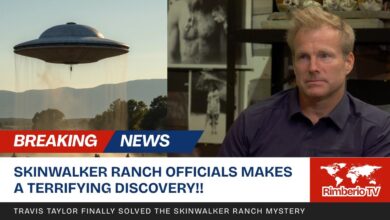
Brandon Fugal Breaks His SILENCE – The SHOCKING Truth That Halted Season 7 of Skinwalker Ranch!
Brandon Fugal Breaks His SILENCE – The SHOCKING Truth That Halted Season 7 of Skinwalker Ranch!

For six seasons, The Secret of Skinwalker Ranch held viewers in a rare place. Somewhere between disciplined science and the unexplained. It wasn’t just another paranormal series built on dramatic music and night vision cameras.
It was presented as a methodical investigation led by credentialed experts, funded by serious money, and backed by repeated promises of transparency. So, when season 7 suddenly stopped airing after episode 7, no preview, no explanation, no follow-up, longtime viewers were left asking a simple but deeply unsettling question.
What happened? Was it a programming decision, a production dispute, a safety review behind the scenes, or did something occur beneath that Utah soil that no one was prepared to confront publicly? Today, we’ll walk carefully through what reportedly unfolded, adding context, perspective, and the kind of reflection that matters to those of us who have lived long enough to understand that truth is rarely simple and almost never comfortable. A show built on credentials, not gimmicks. When The Secret of Skinwalker Ranch premiered on History Channel on March 31st, 2020, it quickly became one of the network’s highest rated investigative series. That alone wasn’t surprising. The ranch itself had decades of strange reports attached to it. But what made this show different was tone, measured, controlled, professional. At the center of it all stood Brandon Fugal, a Utah real estate magnate who had quietly purchased the 512 acre property in 2016 for $4.5 million. Unlike previous owners who had flirted with secrecy or mystique, Fugal insisted on something else. Credibility. He did not frame himself as a believer chasing folklore.
He presented himself as a businessman funding a legitimate scientific inquiry.
And he assembled a team that looked on paper impossible to dismiss. Travis Taylor, astrophysicist and defense consultant with experience in classified aerospace and UAP research. Eric Bard, serving as principal investigator and systems engineer. Thomas Winterton, who lived and worked on site and experienced many of the ranch’s phenomena firsthand.
Caleb Bench, responsible for heavy equipment and drilling logistics, later joined by radiation specialist Jim Seagala. These were not hobbyists with handheld gadgets purchased online. They brought calibrated radiation detectors, ground penetrating radar, LAR scans, GPS tracking systems, spectrum analyzers, and structured protocols. Data was logged. Anomalies were cross-cheed.
Measurements were repeated. For many viewers in their 40s, 50s, and 60s, that mattered. We’ve seen enough sensationalism in our time. We’ve lived through exaggerated headlines and breathless predictions. This felt different. It felt restrained. But here’s the question that lingered beneath every episode. When serious science collides with something it cannot fully explain, what gives first?
The data or the people collecting it?
Escalation across the seasons. The early seasons established baselines. Radiation readings were taken in multiple locations. Airspace anomalies were documented. Equipment malfunctions were noted but not dramatized. Then the escalation began. Season by season, the team moved from observation to intervention. They launched rockets to measure electromagnetic disturbances.
They introduced laser mapping. They conducted controlled explosions. They drilled. Always the drilling. By season 6, attention had narrowed to a specific underground anomaly detected roughly 150 ft below the surface near an area known as Homestead 2. Ground penetrating radar repeatedly suggested a dense object or cavity. Drilling attempts encountered unusual resistance. Bits failed prematurely. Metallic fragments were brought up in core samples. Radiation levels in certain areas reportedly trended upward during intrusive testing.
Equipment failures increased.
Communication systems glitched. On screen, these were presented calmly, but the pattern was unmistakable. Some team members reported physical symptoms.
Sudden headaches, skin irritation, nausea, disorientation. Was it coincidence, environmental contamination, psychological suggestion, or the predictable risks of pushing into the unknown without fully understanding the variables. By this point, Fugal had invested more than $12 million into research and operations. He repeated a consistent message. We’ll show everything we find. But here’s a harder question. What happens when what you find becomes dangerous? The season 7 excavation. In early 2024, the team prepared for their most aggressive excavation yet. Ground penetrating radar data indicated what appeared to be a metallic anomaly approximately 150 ft beneath Homestead 2. Previous drilling attempts had been inconclusive. This time they brought in larger commercial drilling rigs. Reinforced steel casings, expanded safety protocols, radiation badges were issued to personnel.
Realtime monitors were positioned at the drill site. Drilling began on May 2nd, 2024. Morning passed without incident.
By midday, they had reached 80 feet.
Soil composition was consistent. No alarming readings. By late afternoon, they crossed 100 ft. Tension rose, not dramatic, but focused. The anomaly lay somewhere below. At approximately 147 ft, the drill reportedly broke into what felt like a cavity. Resistance changed abruptly. The torque dropped and then the alarms began. Radiation readings, previously slightly elevated but manageable, spiked dramatically.
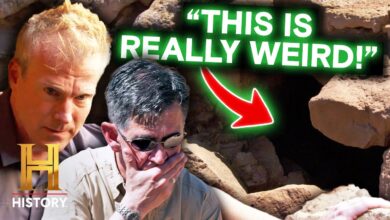
Monitors moved from fractions of a milliseceiver to significantly higher readings within seconds. Dr. Sagala’s devices reportedly began registering values far beyond baseline environmental levels. The team pulled back, but before a full evacuation was complete, a camera probe was lowered into the shaft. What it captured, according to later descriptions, was a chamberlike void, smooth surfaces, unusual geometry, and at the center something denser, possibly metallic, emitting radiation. Was it truly a constructed chamber? A geological cavity lined with mineral deposits, a natural uranium concentration amplified by drilling disturbance, or instrumentation misinterpretation under stress. The feed cut out abruptly as radiation levels surged again. And then something else happened. The medical emergency. Shortly after the spike, Dr. Travis Taylor reportedly began experiencing acute symptoms. Severe headache, nausea, dizziness, confusion, visual disturbances. Those of us who grew up during the Cold War understand what radiation exposure implies. Ionizing radiation is not cinematic. It is cellular, invisible, cumulative. Taylor was evacuated and transported to a hospital under suspected radiation exposure protocol. Radiation badges reportedly indicated exposure above routine occupational limits. Blood tests showed changes consistent with acute stress to the body. White blood cell counts reportedly dropped. He remained hospitalized for observation and treatment. Now, pause. This was no scripted twist. This was a scientist, someone with a family, a long-standing career, and decades of defense consulting being treated for possible radiation exposure acquired during a televised investigation. After nearly a week, Taylor was discharged with recommendations for long-term monitoring. If you were Brandon Fugal at that moment, what would you prioritize?
Ratings, footage, or people? Production halts? That evening, production reportedly ceased. The drill site was sealed. The shaft was filled reportedly with concrete to contain whatever had been disturbed. Equipment was removed or abandoned. The immediate area was restricted under US regulations involving radiation events. Relevant authorities were notified. Soil and water samples were collected.
Documentation began. Reports suggested that radiation appeared localized to the drill area. Some accounts referenced artificial isotopes, though detailed public reports remain limited. A quarantine perimeter was established and then silence. No new episode aired the following week. No extended explanation.
4 months passed without additional content. For a show built on promises of transparency, the absence felt conspicuous. questions that don’t fade easily. Viewers who had invested six seasons into following the investigation did not react with hysteria. They reacted with questions. Was the chamber technological in origin? Could deep geological formations concentrate radioactive materials naturally? Was there a historical industrial presence beneath the property unknown to current owners? Did drilling itself destabilize a naturally occurring radioactive pocket? or did the team encounter something entirely unprecedented?
Brandon Fugal later acknowledged that a serious safety incident had occurred and that halting production was necessary.
He emphasized that safety must outweigh spectacle. That statement resonates differently with a mature audience. When we are younger, discovery feels like conquest. When we are older, responsibility feels heavier. The human cost of curiosity. We often romanticize exploration. From deep sea dives to lunar missions, risk accompanies discovery. But exploration always carries a human cost. Travis Taylor is not a fictional character. Radiation exposure, even below lethal thresholds, can increase long-term cancer risk. Can affect organ systems. It can introduce uncertainty that lingers for years. How much risk is acceptable in the pursuit of knowledge? At what point does curiosity become recklessness? The team had escalated their methods each season.
Rockets, explosives, deep drilling. Were safeguards sufficient or were they learning in real time? One experiment ahead of understanding. Why the silence?
Television production involves contracts, insurance investigations, regulatory compliance, liability reviews. Radiation related incidents amplify every layer of scrutiny. Legal counsel often advises restraint, but silence invites speculation. Speculation fills voids faster than facts. Was season 7 permanently halted? Will the unreleased footage surface? Was the anomaly sealed and abandoned? Or is the truth far less dramatic, but equally sobering? Perhaps what they encountered was geological, not extraterrestrial.
Perhaps a previously undetected radioactive deposit was destabilized by drilling. Would that explanation satisfy viewers? Or does the absence of spectacle feel more unsettling than any extraordinary claim? A broader reflection. Over six seasons, viewers watched experiments escalate. We watched drilling deepen. We watched anomalies intensify. Some felt the team was edging closer to something historic. Others believed they were pressing boundaries too aggressively. History shows us that major scientific breakthroughs, whether in nuclear physics, space exploration, or medicine, often emerge from risk. But they also emerge from institutional safeguards, peer review, and incremental caution. The skinwalker investigation existed in a unique space. Frontier science conducted within a public entertainment format. That tension may be the real story. When research becomes television, does the pressure to deliver results subtly influence risk tolerance?
When millions are watching, does silence feel like failure? And when something dangerous happens, truly dangerous? How does a production company balance transparency with responsibility? The unanswered question. Perhaps the most unsettling element isn’t what may have been found beneath 150 ft of Utah soil.
It’s what we do not know. Did the anomaly represent natural geology amplified by human intrusion? Was it a relic of unknown industrial activity?
Was it misinterpreted data under extreme conditions? Or was it something that challenges conventional categories entirely? Until full documentation is released, we are left with inference.
and sometimes inference is heavier than evidence. Season 7 began airing in April 2024. After episode 7, broadcasts stopped. Production was paused following a medical emergency involving radiation exposure. The drill site was sealed.
Federal regulators were notified.
Monitoring continued. Public updates have been limited. And viewers are left asking, “Was this the cost of uncovering something extraordinary or a cautionary tale about ambition overtaking prudence?” For six seasons, the narrative had been straightforward.
Gritty perseverance, careful excavation, the slow accumulation of evidence that suggested the ranch, an ordinary spread of scrub and sandstone in the American interior, was anything but ordinary.
Viewers tuned in to watch a team of professionals and dreamers pry away at the layers of the land. They watched friendships form and fracture, watched funding secured and squandered, watched families stake a claim in pursuit of answers. They watched the cameras stay on even when what they found made the hair on their arms stand up. Then in May 2024, everything changed. The moment that broke the run. On May 2nd, a routine shift turned into a life-changing event. The crew had been working all night. Nights were quieter, easier to film without traffic and radio chatter, and the geology respected those hours by revealing its secrets more slowly under fluorescent lamps and headlamps. Caleb Bench had the drill under control. He was young, precise, a man with steady hands and hair that never seemed to stay under his hard hat.
The sort of person who went home and studied schematics for fun. Travis had been the one to push for the final 30 ft. He’d walked the property for years, slept under star-littered skies, and developed a tether with the land that was almost devotional. The fans knew him as the bald-headed, loudvoiced, stubborn heart of the operation, capable of both tenderness and recklessness. He believed in the project the way people believe in a person. And when belief fills the space logic, once occupied, decisions become weighty. They breached a chamber.
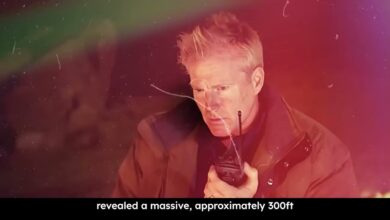
8 minutes of footage was all they had before alarms and pain forced everything to stop. From his hospital bed later, Travis watched the footage with Eric and Brandon. He had tubes and colorless drips and a patients vulnerability, but his eyes were the eyes of the man who had spent his life under open skies and in the dirt. What they saw did not fit tidy narratives. A circular chamber roughly 40 ft across beneath layers of Triacic Age straighta. Its dome 15 ft hung like an inverted sky. The walls were smooth and metallic, not stone, not anything the geologists could match to modern techniques. Geometric patterns marched across every surface in minute, repeating sequences arranged with such mathematical precision that the mind wanted to compute them as if they were a message. A central 8-oot cylinder rotated, or seemed to, depending on where you focused, an impossible object that subtly hummed with a glow not unlike the idea of lightning trapped in a bell jar. The radiation signature recorded later by Dr. Sagala did not match anything in common sources. Soil suggested antiquity. The chamber sat within a layer of rock formed 200 million years ago. The paradox lodged in their throats. How could something so apparently engineered be embedded in time like a fossil? Who made it? When?
Why? And more immediately, how could it still be active? Faces and stories. To tell what happened next is to tell a host of smaller stories. Human in their texture and messy in their overlaps.
Brandon had been the public face of the show for years. producer, negotiator, sometimes untrusting businessman, sometimes reckless poet when the budget was good and the stakes were cultural relevance rather than a mortgage. He had put more than $14 million into the enterprise over time. That investment was not only capital, it was reputation, identity, and a ledger of favors and obligations. He had a daughter who called him after every episode with a voice that was equal parts pride and worry. He had watched his own hair recede over the years and learned to joke about it on camera. He had always told himself responsibility was the price of success. In May, that claim was put to a brutal test. Travis was a man of contradictions. At 34, he had a chest of scars and the blunt humor of people who had mended more than their pride.
His family lived in Alabama. They visited the ranch during the filming season. The day the chamber was breached, they slept at Homestead One and stared at the new radiation monitors with the same thin-faced anxiety any parent has when their child is learning to drive. Is my family safe? Thomas Winterton, who lived on the property with his own family, kept asking. He was a farmer by trade and a philosopher by accident. He could tell you the weight of soil in a shovel full and the price of a calf, and he knew the cost of uprooting a life and starting over.
Caleb Bench, the young drill operator whose badge read 75 millisevers, had a future that suddenly felt fragile. He sat in the brake trailer and watched his hands as if they were other people’s. He had dreams: marriage, children, a life that did not begin and end with a respirator. When the badge reading came back elevated, he asked the question that people ask at the edge of long run risk. Would you risk your future for a job? His quietness answered that question. He loved the work, but he loved potential children more. Eric was the cautious mind on the team. Level practical, a man who had been at boundary conditions of many projects and had not been broken by them. Where Travis saw destiny, Eric saw procedure, he proposed remote investigations, he insisted on protocols. Yet, he was also the one who looked at the footage and felt the awe that drowned out calculation, the first rule of people who work on mysteries. They are perishable in the face of wonder. And then there was Dr. Sagala who had come in as a consultant. A physicist with a dry laugh and the patience of someone who had watched colleagues talk in circles about discoveries that turned out to be misplaced enthusiasm. He did the readings, ran the isotopic analyses, and called the levels anomalous with a severity that made Brandon’s cigarette taste wrong. This doesn’t match our library. He had said this signature is not textbook. It’s not industrial. It’s not natural decay either, or at least not what we know. He pressed his palms together like a man holding a delicate cup. We don’t know what this is sustaining, and that is a problem. These people were not only characters in a documentary. They were household names for viewers who had invested emotion across seasons. They were also humans negotiating the messy border between heroism and culpability. the legal and financial crunch. The week after the event was a spreadsheet of crisis.
Within 24 hours of the exposure, Brandon filed a mandatory report to the insurance company. The paperwork read like a confession. Radiation exposure, pending workers compensation, the first hospitalizations.
Travis’s medical bills were projected to exceed $500,000 almost immediately. An investigator arrived on May 5th.
Interviews were conducted, footage reviewed, safety protocols examined and re-examined. The question that kept surfacing in legal briefing rooms and late night calls was simple and damning.
Who authorized continuing after warnings? Dr. Sagala had advised stopping. Travis had pushed forward.
Brandon had allowed it. The liability picture wasn’t favorable. On May 8th, the insurance company suspended coverage pending investigation. The phrase reckless endangerment was used. The company’s letter was clinical and cold.
Coverage suspended pending investigation. It read, “Suddenly, the show had no policy to cover catastrophic bodily harm. The prospect of a negligence lawsuit, potentially in the millions, was no longer theoretical.
Suddenly, Travis’s medical bills were Brandon’s personal problem.” The History Channel called Daily. They were frightened by the same calculus as Brandon, but from a different angle.
Reputational risk and business continuity. When can filming resume?
They asked. Brandon answered with facts.
Insurance suspended. EPA quarantine.
OSHA involvement. Hospitalized team member. Their tone changed when he said that. The network paused production.
OSHA inspectors came on May 10th. They reviewed monitors, emergency protocols, medical readiness. Fines were cited $1.7500 for violations. The paperwork stacked up, a testament to oversight and negligence, and rushed judgment. On May 12th, Travis filed a worker’s compensation claim for $2.3 million. The figure included medical expenses, lost wages, projected ongoing treatment, and the possibility of long-term disability.
It read less like a bill than like a ledger of a life interrupted. How quickly can success turn into crisis?
How thin is the paper between triumph and disaster? Brandon found himself in a loop. Without insurance, filming could not proceed. Without filming, investors would pull back. Employees would be laid off. Reputations would erode. He had invested $14 million over seasons.
Season 7 alone had a $3 million budget and $1.2 million already spent. Halting production meant absorbing heavy losses, continuing risked lawsuits, possible criminal charges, and the very real possibility of someone else, another crew member, another contractor dying.
He convened a meeting on May 12th that still carried the smell of hospital antiseptic and the hollowess of a man who had to choose between a job and lives. Travis dialed in from his hospital bed. He said stoic and raw.
This is why we’re here. It may be the most important discovery in paranormal history. We can’t stop. He also confessed. I almost died. My family is terrified. The room listened and argued.
Eric recommended remote investigations aided by robotics, distance, and time.
Dr. Sagala told them to wait to gather the right instrumentation that could take months to obtain. Rush this, he said through clenched teeth in a facility where patients had become moral posture and someone dies.
Thomas Winterton asked the question everyone on the property had been privately asking. Should they leave?
Should they evacuate their families? The monitors at Homestead 1 now had hourly readings. Evacuation was a possibility that moved from hypothetical to realistic. Meanwhile, the public had been left with 8 minutes of footage and a thousand comments. Conspiracy theorists leaned into the idea of suppression. Skeptics lined up with demands for proof and chemical charts and chain of custody records. Social media amplified everything and made nuance hard to come by. the chamber and the eight minutes. The footage itself became a sacred artifact of sorts, raw, imperfect, and hauntingly alluring.
People would later replay those 8 minutes like a talisman, searching for a frame or a clue that would resolve the paradox. Within that footage, you could see the play of light across surfaces that should not exist on a ranch. The metallic walls, the recurring glyphs, the cylinder at the center with a finish that swallowed and then returned light.
The camera, shaky human, lingered where the structure seemed to rotate.
Sometimes what looked like rotation was a trick of illumination, a psychological wobble that made minds reach for a cause. Eric, who watched it with a scientist’s eye and a poet’s heart, noted that the patterns resembled crop circle geometry, but transposed into three-dimensional relief. There’s intent here, he said. This is not random. Dr.
Sagala logged the radiation signature and it did not match modern isotopes. It was an outlier, a blend, a frequency that suggested ongoing low energy processes that defied the usual decay curves. He ran tests in triplicate, then in quadruplicate. The soil layers above the chamber corresponded with straighta dated to the triacic, and the chamber’s embedding suggested it had been present for a time longer than human memory. How to reconcile an engineered object with the slow indifferent heel of geological time? Was it an intrusion from something that originated before recorded history?
Was it seated later through unknown means that left no trace between the object and the ancient rock? Or was it a structure that had been placed there by hands that are not ours? An idea both thrilling and terrifying. The chamber was too contaminated for further study.
The EPA insisted the site be sealed under 147 ft of concrete. The idea that human curiosity had been answered by a scientific stonewall, literally was grim. The footage remained, a video relic that carried all the moral weight and none of the closure. Decisions and the halt. Between May 10th and May 15th, Brandon wrestled with decisions that would shape not only his career, but the lives of people he had long considered his second family. The arguments to continue were strong. Six seasons invested, millions of dollars, perhaps the most extraordinary discovery ever made on the ranch. Fans demanded answers, journalists wanted exclusives, and advertisers had to be briefed. But the counterarguments were heavier.
Travis nearly died. Insurance was suspended. Legal risks were severe. The EPA restricted access. Crew morale was fragile. The union involvement began appearing in conversation as a possible lever to secure protections. On May 15th, Brandon made the only decision that would not risk more human lives.
Halt production indefinitely. “I cannot in good conscience put my team at risk for a television show,” he said in the statement he prepared with legal counsel pressed in between. “Money isn’t worth lives,” he called the network. When asked how long, he replied, “Until it’s safe.” I don’t know when the word indefinitely fell like a gavvel. Episode 7 aired May 21st, the last new episode.
Reruns followed. Legal council required silence. Brandon stopped posting publicly. Speculation exploded online.
In the absence of narrative, people built their own. Travis was released from the hospital on May 8th and returned to Alabama. He was not whole.
Fatigue lingered. Headaches shadowed his days and doctors warned about elevated lifetime cancer risk. By August, medical bills had reached $680,000, much of it paid by Brandon personally while insurance negotiations dragged on.
The EPA extended quarantine to 90 days.
Season 7 officially ended at episode 7.
Season 8 was approved for January 2025, but under new mandatory safety protocols, medical personnel on site, strict radiation limits, and no drilling without permits. The show would be back, but the terms had changed. The question that lingered, would anyone watch the same way after such a