Why This Mesa Discovery Left Travis Taylor Speechless | Skinwalker Ranch
Why This Mesa Discovery Left Travis Taylor Speechless | Skinwalker Ranch

In the remote Uinta Basin of northeastern Utah, Skinwalker Ranch has earned a reputation as one of the most enigmatic locations on Earth. For over two centuries, the 512-acre property has been a hotspot for reported UFO sightings, cattle mutilations, poltergeist-like activity, cryptid encounters, and unexplained electromagnetic phenomena. What began as local folklore and Native American legends of shape-shifting entities has evolved into a modern scientific investigation under the ownership of real estate tycoon Brandon Fugal.
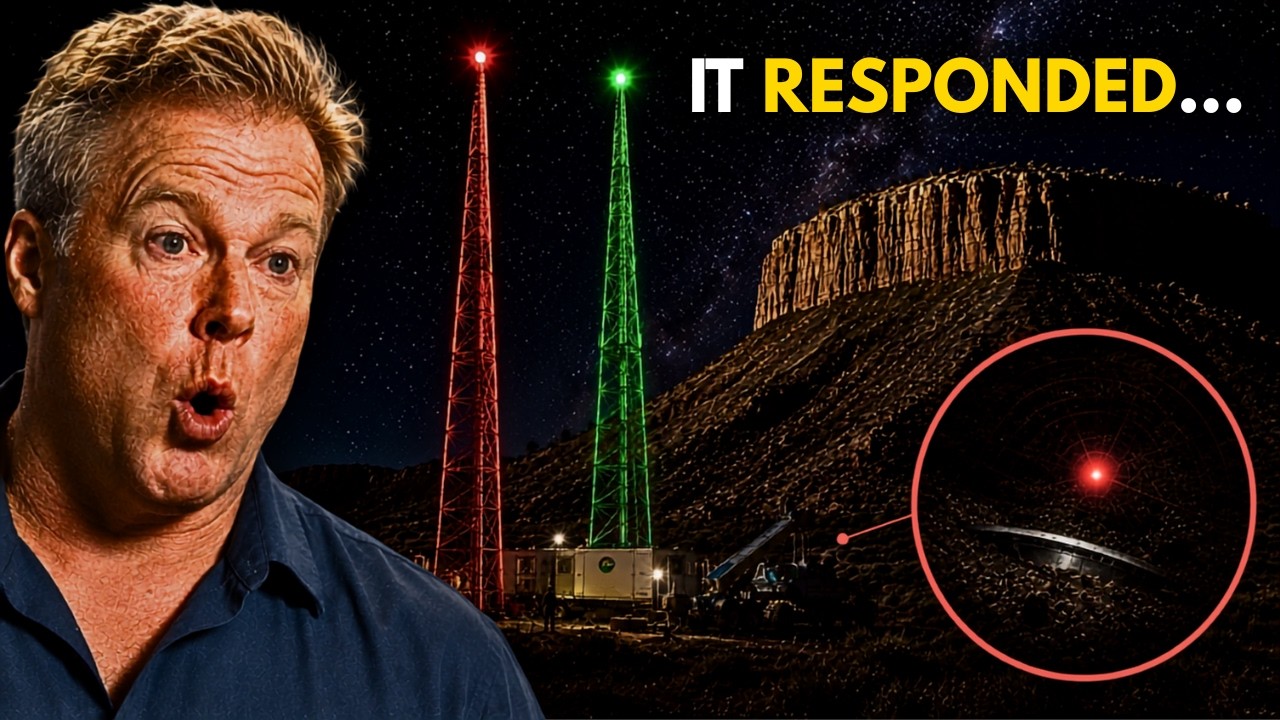
At the center of many recent breakthroughs stands the Ranch’s imposing Mesa—a massive rocky formation that has repeatedly drawn the attention of the investigative team. Leading the scientific efforts is Dr. Travis Taylor, an astrophysicist, aerospace engineer, and optical scientist with multiple advanced degrees and prior involvement in U.S. government UAP (Unidentified Aerial Phenomena) task forces. Taylor, known for his rigorous, data-driven approach, has documented countless anomalies across the property. Yet, one recent discovery beneath the Mesa reportedly left even this seasoned expert momentarily speechless.
The fascination with the Mesa dates back several seasons of The Secret of Skinwalker Ranch. Ground-penetrating radar, magnetometers, and drilling operations have consistently hinted at something extraordinary hidden underground. Early investigations revealed a massive dome-shaped anomaly buried deep within the rock—described as potentially hundreds of feet across and resistant to conventional penetration. Drills would hit impenetrable layers, slide off, or encounter voids and metallic signatures that defied easy geological explanation. One operation suggested a large, possibly metallic or engineered structure that seemed to “react” to external stimuli.
During drilling efforts, the team recovered fragments of mysterious ceramic-like material. These were not ordinary rocks or pottery shards. Laboratory analysis revealed a composition including carbon, oxygen, silicon, magnesium, and aluminum—elements that align with advanced stealth materials or heat-shield tiles used in spacecraft. But the real shock came under closer scrutiny.




In episodes focusing on the Mesa (such as those involving detailed SEM—scanning electron microscope—examinations), the ceramic samples exhibited bizarre behaviors. Under the electron beam, the material appeared to “self-heal” or change structure, with pores closing or surface features altering in real time. One side displayed magnetic properties while the other seemed repulsive, prompting speculation about room-temperature superconductor-like qualities or metamaterial engineering far beyond known conventional ceramics. Travis Taylor, reviewing the data alongside principal investigator Erik Bard, noted the material’s layered construction and unusual durability, comparing it to high-tech aerospace applications while acknowledging its anomalies defied standard explanations.
“Why This Mesa Discovery Left Travis Taylor Speechless” captures a pivotal moment in the ongoing series. According to recaps and fan discussions, Taylor’s reaction stemmed from the repeatability and consistency of the findings. Multiple independent scans, recalibrated instruments, and cross-verified data sets pointed to a stable underground signal or structure—not random interference. The anomaly wasn’t fleeting; it responded in predictable ways to experiments, including laser scans, rockets, and electromagnetic tests. This level of repeatability in a field rife with elusive phenomena elevated the discovery from “interesting” to potentially paradigm-shifting.
The broader context amplifies the significance. Skinwalker Ranch’s history includes government interest, such as the National Institute for Discovery Science (NIDS) studies in the 1990s and rumored Pentagon connections. Ancient petroglyphs on the Mesa depict star maps and serpent constellations like Draco, interpreted by some as indicators of portals or celestial gateways. Modern observations—UAPs appearing near the Mesa, radiation spikes, and equipment failures—suggest the site may function as a focal point for unknown energies or technologies.
Skeptics argue many findings could stem from natural geological quirks, old mining remnants, or experimental military hardware. The Uinta Basin has a history of oil and gas exploration, and unusual mineral formations or piezoelectric effects in quartz-rich rock could explain some electromagnetic anomalies. However, the team’s use of rigorous protocols—calibrating instruments, deploying redundant sensors, and consulting external labs—makes outright dismissal challenging. The ceramic’s response under microscopy, for instance, was described as unlike anything standard ceramics exhibit.
What could lie beneath the Mesa? Theories range from a buried extraterrestrial craft or ancient advanced civilization artifact to a natural but poorly understood geological formation acting as an energy conduit. Some speculate an underground base or “portal” technology, aligning with Navajo traditions of the area as a site where skinwalkers (yee naaldlooshii) and other entities cross between worlds. The dome-shaped object, impenetrable layers, and engineered ceramics fuel ideas of non-human intelligence—whether extraterrestrial, interdimensional, or time-displaced.
Taylor’s “speechless” moment underscores a key tension in the investigation: the boundary between known science and the unknown. As a scientist with deep credentials, he approaches claims cautiously, emphasizing data over speculation. His visible astonishment—captured in episodes and interviews—signals findings that strain even his extensive toolkit. It echoes reactions from other team members when UAPs materialized during experiments or when sensors detected responses seemingly tied to human activity.
Recent seasons have intensified efforts: deeper drilling, advanced lidar, magnetometry, and rocket launches aimed at provoking or mapping responses. One experiment involved a high-powered laser scan of the Mesa, while others focused on the “Triangle” area nearby, often yielding correlated anomalies. The ceramics continue to be tested for potential applications in stealth, aerospace, or energy technologies, though ethical and safety concerns (given the Ranch’s reputation for affecting personnel) temper enthusiasm.
The implications extend far beyond one Utah ranch. If verified, such discoveries could challenge our understanding of materials science, propulsion, and even consciousness or reality itself. They intersect with the global UAP disclosure conversation, where government reports acknowledge unexplained aerial phenomena but offer few answers. Skinwalker Ranch serves as a unique, accessible laboratory—private land with full owner cooperation—where science can confront the paranormal head-on.
Critics of the show point to its reality-TV format, dramatic editing, and potential for confirmation bias. Not every anomaly yields peer-reviewed papers, and some experiments remain inconclusive. Yet the persistence of the Mesa findings across seasons, witnessed by multiple experts and documented with instrumentation, demands attention. Brandon Fugal has invested significantly, viewing the Ranch as a quest for truth rather than mere entertainment.
As investigations continue into Season 7 and beyond, the team plans further excavation, non-invasive imaging, and interdisciplinary analysis. The goal remains uncovering “what” is there, “why” it behaves as it does, and its connection to the Ranch’s larger mysteries. For Travis Taylor, the Mesa discovery represents more than data points—it embodies the thrill and humility of confronting the unknown.
In a world increasingly shaped by technology and empirical certainty, Skinwalker Ranch reminds us that some secrets endure. Whether the Mesa hides an ancient relic, extraterrestrial probe, natural wonder, or something entirely new, its revelations continue to captivate. As Taylor and the team press forward, one thing is clear: the ground beneath our feet may hold answers to questions humanity has pondered for millennia. The next drill core, scan, or lab result could change everything.