Across the Pond Picks: Best British Artifacts | Pawn Stars
Across the Pond Picks: Best British Artifacts | Pawn Stars

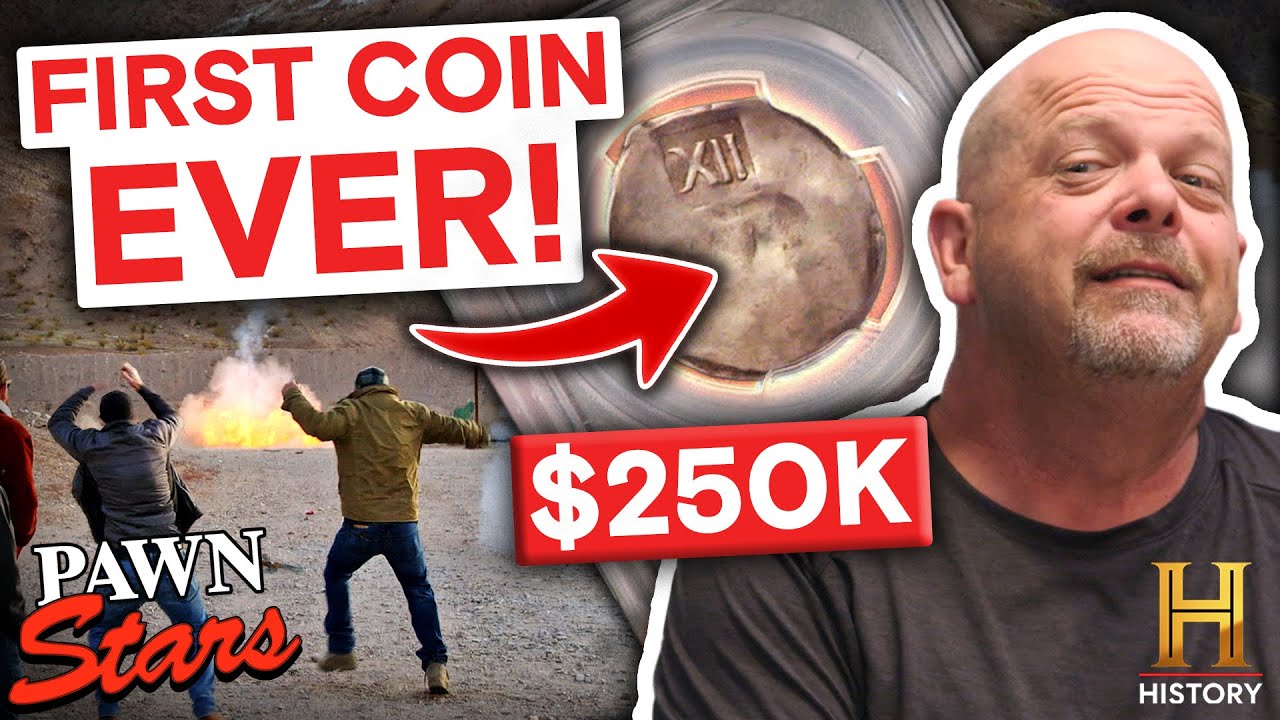
So, I’m here in Boston because [music] I found this person who has a 1652 New England shilling. Literally [music] the first coin ever minted in the colonies.
So, if I could pick this thing up, I could make my own serious coinage.
[music] You must be Ed. Great. And that is it of colonial coins. That’s the holy grail. These were the first coins struck in the colonies. They were really, really proud of it, even though it’s possibly the plainest coin ever made.
[laughter] I have a 1652 New England silver shilling. I found the coin about 30 years ago in the Boston area, and recently I found out that it was a very valuable and rare coin. I’ve had it for a period of time, and I just want to be able to share it with somebody [music] else who has the same interest that I do.
>> It’s super super cool. In the 1650s, the colonies still considered [music] themselves British subjects.
>> They just wanted a little bit more autonomy. And this was sort of like saying, you know, we’re not completely independent from England, but kind of independent from England. So, this was sort of another step towards pissing off the English. [laughter] >> All right. Yeah. I mean, it’s pretty amazing. It hasn’t been clipped. You never see old coins complete like this because people would go and they would clip a [music] teeny bit off and next one file a little bit off, next one file a little bit off and next thing you know they have two shillings worth of silver. But the problem was is that eventually there’d be next to no coin [music] left.
That’s why Sir Isaac Newton invented the readed edge on a coin.
>> It’s in awfully good shape.
We got NE there for New England.
And we have a 12 on the back of it.
What’s the 12 for?
>> I would say 12 p.
>> Okay, that’s what a shilling is. Yeah.
All right. I’m just shocked to see it.
God, it’s in great shape. In the coin collecting world, it’s one of the big ones.
So, here’s the big question. What do you want for this thing?
>> Well, I’ve seen it at auction. anywhere between 250,000 upwards of $400,000. So, I think that’s a good starting point.
>> Yeah, but you didn’t give me a starting point. [laughter] >> So, how about $300,000?
>> Okay. Um, what about two and a quarter?
>> I don’t know if I’d want to go that low.
Can we meet at 250?
It’s just in really great shape. And at 250, I still make some money. So, we got a deal. All right. Appreciate you coming in.
>> So, I was very happy to make the sale today. And with the money, my wife’s been pestering me to get out of the cold New England winters. [music] So, maybe I’ll buy a second home in a warmer climate.
>> Hey, how’s it going?
>> Hey, how you doing?
>> All right.
>> Got this thing.
>> I don’t take brown folders, do you?
>> Well, I don’t know much about it. I think it has something to do with the uh Revolutionary War.
Decided to come [music] to the pawn shop today to sell this old piece of paper that my grandfather had from the Revolutionary War. I don’t know what this thing’s worth, but basically I want a new guitar to be honest. So, if I can get that, I’ll be happy.
>> I’ve seen continental currency before.
I’ve never really seen anything like this before, though.
>> It appears to be um a bond. He loans the colony of Massachusetts 5 pounds. And this is right after the Revolutionary War started. Sorry, just a few months.
1775. [music] This is really interesting and something I haven’t seen before. You have to remember in 1775 [music] was a lot of money. So, the person making this loan was extremely well off. The reason it’s cut weird on the side right here is cuz when you went to pay, they lined it up with the original. So, that way they knew it wasn’t a fake.
>> Oh, right. Right. I don’t know if this was like Massachusetts and revolt giving out um bonds or was it still the English crown giving out bonds. So, it’s another weird thing I need to know about.
>> You know, it’s worth something.
The question is what? I’m not exactly sure. I don’t know how common these are.
Um and the other thing is these signatures on it right here. I don’t know if they’re anybody important from the Revolutionary War or not. If this is real, this bond helped raise money so our founding fathers could put together an army and fight for our independence.
That’s an incredible piece of history and value. It’s going to be substantial to say the least.
>> What were you looking to do? Pon it or sell it?
>> Uh, I I think I’d like to sell it.
>> All right.
>> I want a new guitar. I know it sounds a little uh shallow, but I love I love guitars.
>> Well, let’s have someone check it out first. I don’t want you getting ripped off. I don’t want me getting ripped off.
I mean, you don’t know what you have here. I mean, you might have a Chinese bender or you might have a Gibson Les Paul. So, let’s find out exactly what it is first. Okay.
>> All right.
>> All right, guys. Thanks. Thank you.
I’m Dana, president of Early American History Auctions. And whenever Rick has a Revolutionary War Arab artifact, he knows how [music] to reach me and I can come over and help him out. It appears to be on the correct paper. It’s handsigned as a bond. It’s a very, very early one. Uh, right at the beginning of the Revolutionary War, the 24th day of August, 1775, because April 19th was the Battle of Lexington and Concord. The shot heard around the world. Now, would that be for like the rebel or was this still the crown?
>> Well, this was kind of a confusing time in early American history. As a matter of fact, you could see that it says American paper, but if you hold it up to a strong light, you’d see that there’s actually a watermark within the paper with GR and the crown. So, it’s actually printed on British paper, although it says American paper.
>> Okay, >> this is incredible. If you can imagine, this is just a few months after the first shots of the Revolutionary War in Boston. They needed the money [music] to fund an army and the people united together to buy these bonds and pay for it. This document was instrumental [music] in the founding of our country.
It’s in really nice condition.
Everything is very well printed. [music] You can even see the plate impression still within the paper. And this bond was actually engraved. and it was a copper plate that was engraved. And uh in this particular instance, it’s not uh um this is a fairly rare bond. It’s incredibly historic.
A fabulous thing about this particular bond is that well, you may have heard of this fellow who did the engraving. Uh his name is Paul Revier.
Wow. Paul Rivere, who’s absolutely famous for his midnight ride and was uh also famous for being a silver smith, engraved copper plates that were used for currency, maps, and in this case, a bond for the state of Massachusetts.
It’s got a lot of history going for it.
It’s engraved by Paul Rivere. It’s 1775, right after [music] the outbreak of the Revolutionary War. Um, any other questions that you might have about it?
>> Yeah. What’s it worth?
>> Yeah. [laughter] Somehow I I thought we might get to that. Uh but uh bond of this rarity by Paul Rivere in this condition with so much of the indent uh still there. Um I would say that this would easily be estimated in one of my early American history auctions at between 20 and $25,000.
And you might not be [music] surprised if you ever saw another one of these listed in somebody’s retail price list at upwards of 30 or $35,000 [music] retail. All right. Thanks a lot, Dana.
Rick, wind up with that. Okay. After hearing everything Dana said, I want it.
I mean, it’s engraved by Paul Rivere and it’s from the dawn of our nation. It’s an unbelievable piece of history.
>> What do you want to do?
>> Honestly, I may actually want to keep this thing.
>> I can’t let you leave with it. Let me let’s let me make an offer. I mean, um, how’s 12 grand out?
>> 15.
>> 12.
>> 12. I mean, that’s got all kinds of $100 bills in the back, man. We’ll make a nice little trade right now.
>> 12.
>> I know this guy wants a guitar, and I have a nice collection of Fender Stratacasters. I just hope this sweetens the pot enough so he doesn’t walk away.
Bender guitars come in here all the time. Revolutionary war bonds don’t.
Tell you what, 12 grand in American Strat.
>> All right, I’ll do it.
>> Okay, >> I’ll do it.
>> It’s a deal. Go write them up for All right, buddy. Let’s write it up. This turned [music] out great. Even though I had to part with a ton of money and a guitar, I got a fantastic [music] piece of early American history. This is why I love what I do.
Hey, how’s it going?
>> Hey, what’s up, man? How you doing? Uh, >> what [snorts] do we got here?
>> It’s a Baker rifle. It’s a hand-me-down from my grandpa.
>> You mind if I take a look at it?
>> Yeah, absolutely.
>> All right. Ezekiel Baker London gun maker to his majesty. Wow. Um, and it’s breach loading. So, instead of having to like pack it down like that like they [music] used to, you would actually put the ball in there.
>> Oh, wow. Okay. Um, buddy, I got to tell you, you got something here I’ve never even seen before.
>> That could be a good thing.
>> I’m here at the pawn shop today to sell my Ezekiel Baker rifle. It was from [music] a family member, so I’ve had it for a couple years. I don’t know that much about it. I know that it could be rare [music] and hoping it’s valuable.
>> That’s pretty cool. You Ezekiel Baker was really well known in the gun industry. Um, [music] he made guns late 1700s, early 1800s. Okay.
>> He was really well known for like a lot of innovations and like weird stuff that he would do to guns that made them more modern.
>> You know, this whole little mechanism here I’ve never really seen before, especially with a flint lock and stuff like that. Um, it’s pretty interesting to say the least.
>> Okay. Uh, what are you looking to do with it?
>> I want to sell it.
>> Okay. Any idea what you think it might be worth? Cuz I have I I truly have no idea. Yeah, I’m kind of thinking like 12,500.
>> Uh, like I said, I have no idea. Um, do you mind if I have a buddy of mine come down and take a look at it?
>> That’d be great.
>> Okay. Uh, hang out, man. I’ll be right back. Um, go make a few phone calls real quick.
>> I have no problem with an expert coming in and hopefully he’ll tell me more about it. I’m excited to see what it’s worth.
>> Alex, what’s up, buddy?
>> Hey, Cory. How you doing, man?
>> Doing good, man. Good to see you. I’m Alex.
>> Jason, how you doing?
>> Nice to meet you.
>> Ezekiel Baker. Nothing I’ve ever seen before.
>> Can I [music] pick it up?
>> Absolutely.
>> And that’s about all I know.
>> It This is awesome. That’s a good sign, right?
>> Holy.
>> I hope so. [clears throat] >> Oh, yeah. This is crazy.
Well, this is a one-of-a-kind piece.
>> Oh, wow.
>> And that’s why I called you.
>> So, what can you tell me about it?
>> So, it’s breach loading. Um, I’ve never seen [music] this little lever type device that Baker made. So, my best guess is that [music] this is probably some type of prototype or it was a customordered gun.
>> Oh, wow. That’s cool.
>> Ezekiel Baker was a gun maker in London.
>> He worked sort of from the latter half of the 18th century and into the 19th century. [music] Baker worked many, many years. And in fact, his Baker rifle was also developed by other gunsmiths. So, banker rifles are highly collectible.
>> Okay. Um, explain to me how it works exactly. So, you would >> So, you open up the lever.
>> Okay.
>> And it and there’s a cavity [music] here. You put in a ball.
>> Okay.
>> You push the lever down. Probably in here there is a little chamber that’s a slightly bigger than the barrel. So, the ball will roll forward, but it won’t roll out. Once the ball is clear of the door, you open it back up, put your powder in, push it down. So now you have powder ball, and it’s ready to go. And then you prime it. Okay?
>> So once you prime it, you pull it back, and then you [music] would fire it. And you do the same process again. So not only would this be more accurate, but it would be faster to load.
>> That’s pretty cool. [snorts] I have a slight concern about this lever. You see, it’s really pretty loose. So, firing it um would be a good idea only because [music] if this lever doesn’t really work, then you have a cool gun and it’s a prototype, but it’s not really practical.
>> So, what’s it worth if it fires? What’s it worth if it doesn’t? I think if it’s nonfunctional, I think it’s in the the sort of 15,000 range. Uh I think if it functions and this thing can [music] actually shoot and perform as it should and be reloadable, I would be very comfortable saying it’s $25,000.
Okay. Um so we got to go shoot it. Do you mind meeting me out there tomorrow?
>> It’ be really fun. Yeah, let’s do that.
>> All right. Uh, come with me. I’ll give you the directions and Alex, I’ll meet you out there tomorrow.
>> All right. Appreciate [music] it.
>> Thanks, man.
>> Thank you.
>> Appreciate.
>> So, I’m really excited to go to the gun range. If this thing fires, it’s worth 25 grand.
>> So, I’m pretty sure your dad’s going to be pissed that you brought me out here instead of him.
>> You know what? He just would have made everything more complicated and annoying.
>> What’s up, Alex?
>> How you doing, man?
>> I’m well.
>> Hey, what’s up, buddy? What’s going on, guys? I’m excited to see this.
>> Yeah. So, this is one of England’s finest gun makers from the 19th century.
This is a prototype or it was custom made for a specific customer at the time.
>> Wait, wait, wait. He said prototype. So, what do you mean it’s not real?
>> I mean, Baker made this either [music] as a prototype, like a one-off in order to try to sell it as mass market, or he just made it as a custom order.
>> [music] >> So, a guy came in and said, “I want a really good hunting rifle, but I want a breach loader.” >> Oh, this is why you should have brought your dad.
>> So, uh, we ready to fire this thing or?
>> Yeah, we’re ready to go. So, the first thing we do is we use this little lever.
We insert the ball to push the lever forward. Now, that ball rolls forward into a little chamber. And now, [music] see, the ball is gone. So then I take the black powder, dump that into the little chamber, push it forward, and now it is loaded. [music] Okay, eyes and ears.
Here comes the bang.
Woo!
>> [laughter] >> So, at least it didn’t blow up and it works. So, >> no, it didn’t blow up at all.
>> That was cool.
>> The lever stayed down. That actually worked pretty well.
>> Um, so what are we thinking it’s worth?
>> I think based on the fact that it works as designed.
>> Mhm.
>> Um, you know, there’s not another [music] example out there. It’s a prototype. It’s super rare, Cory. And it’s a really nice looking gun. I think you get 25,000 [music] for it.
>> Wow. Whoa.
>> Okay. Um, well, I appreciate it, man.
Thanks a lot.
>> Thank you very much. Appreciate it.
>> Uh, you still want 125 for it?
>> Well, he said it’s worth 25, so >> would you do 15?
>> Uh, I know you got to make some money. How about 22?
>> How about 18?
It’s going to be the most I can do.
All >> right, I can do 18.
>> All right, cool. Appreciate it. Um, you want to meet me back at my shop? Uh, I’ll get you a check and get you paid.
All right, >> sounds good. Thank you.
>> I was super happy I he was able to make a deal today. It wasn’t the 25 grand that he said it was worth, but $18,000.
Super happy. My wife’s going to be really happy.
>> Dude, the guy’s wearing a Rolex. I never thought he was going to go that low.
>> So, I got a call from a guy with an antique cannon that he [music] doesn’t know a lot about. So Cory and I are meeting him out here at a local shooting range. And since this is in Alex’s wheelhouse, he’s going to meet us out here and check it out. So that’s the cannon.
>> Yes, sir.
>> It’s a little bigger than I imagined.
>> Right. So this is what you brought me out here to see.
>> Um, yeah. It’s a mountain cannon, which means that it’s designed to be put on a bunch of mules.
>> So basically, it’s a cannon you can disassemble.
>> Uh, yeah. So you could literally like take it to the top of that mountain [music] up there and just rain down terror and hell and damnation. You know what I mean? [laughter] >> I called the guys from Ponab [music] down to see if they were interested in buying my British cannon. I don’t really know too much other than it’s old and expensive. Condition-wise, it’s great.
It stays in the storage unit and it’s been oiled, so it’s should be good to go. I’m trying to sell the can for $50,000.
>> Look at that thing. So, where’d you get this thing? So, back in the 70s, my dad uh picked it up from a private dealer and he ended up willing it to me. So, I’ve just been hanging on to it.
>> Okay. You know, it’s um obviously British because it has all this Latin on it and the crown. We have 1902 on the carriage. Do you have any paperwork with it?
>> I have the ATF paperwork that came with it, but that’s about it.
>> Can I open up the brereech?
>> Yeah, go for it.
>> Uh I should Maybe I’m doing it wrong.
>> You know, we have a guy coming down here to do all this stuff.
>> You know what, son? You know, I’m having a good time here, right?
>> Well, here here’s a few things we’re going to have to know if it works. Um, if it fires and it works, that’s one thing. If it doesn’t, then it’s just redneck lawn art to me.
>> Did you say redneck lawn art?
>> Yeah.
>> That’s the only person that puts a cannon in their front yard, man. I’m sorry.
>> I keep a storage unit, so we’re good.
[laughter] >> Okay. Um, how much you looking to get out of it? So, I kind of did some homework and they’re kind of expensive.
So, maybe about 50,000.
>> How much?
>> 50,000.
>> 50.
>> 50.
>> Okay. Um, to tell you the truth, I have no idea.
Um, [music] if we just hang out for a little bit. I got my buddy coming down.
He’ll look at it. And if there’s a deal to be made, there’s a deal to be made.
>> Cool. Well, I’m going to go sit in the truck and wait for Alex cuz it’s cold.
>> Wow. That is good looking. [music] Sort of the nickname for these are called screw guns because this big collar here, this part comes off and the whole thing unscrews. So the muzzle and the brereech become two pieces. [music] So you could put them on mule trains and get them up into the mountains and set up the gun in under 10 minutes and be firing.
Now these are really rare. Fewer than 200 of these were made. They had a very short window about 1901 1902 and then they were obsolete [music] because this whole system back here is friction primed which was an archaic way of making this gun fire that developed in 1863 [music] but I mean this is a beautiful beautifully maintained cannon. Here is the the original data plate. So yeah it is dated 1902. [music] So, um, the way the law is in the United States, if it’s made after 1898, typically a [music] cannon would be considered an explosive device and would be regulated. This is not because of that friction prime system. Because it’s such an archaic system, [music] this is still considered an antique. Um, and so you can certainly buy it if you like it.
Um, [music] there’s nothing legally stopping you from doing that. Do you mind if I open up the breach door and take a look?
>> Go for it.
[clears throat] >> Yeah.
Oh, look at that. I mean, the [music] board’s really nice. It’s maintained well. There is pitting, but you can still see all the lands and grooves quite crisply. [music] I don’t see any reason why we couldn’t fire it. If you’re up for it, >> let’s do it. I’m down.
>> I’d love to shoot it.
>> Yeah, I think it would be really fun.
And if you want to sell this, you need to show collectors that it can fire because these [music] things are really fun to shoot. Let’s do it.
>> All right, I’ll go back to my shop and start getting ready.
>> You grab some stuff for it. We’ll go have [music] lunch. Meet you back here in two hours.
>> Sounds good to me.
>> All right.
>> I’m hoping it’s going to fire. It’s maintained well, so [music] we’ll see how it goes.
>> So, we’re going to fire this thing.
>> We are going to fire it. I got supplies for it. And I even found this old antique shell, which has an original copper ring on it. The copper ring is softer than the rifling inside the barrel, and it’ll spin it better, so it’s more accurate. to that end. I set up a an old wine barrel and I put some special stuff inside. So, if I hit it, you’ll get to see what’s in there.
>> Okay. So, load the thing up. I can’t wait.
>> All right.
So, I put the projectile in. Now, I made some powder packs. [music] This is filled with black powder.
I’m going to close the brereech.
This is a friction primer. This is exactly what they would have used in 1902 and they would have done this exact [music] process with a lanyard.
All right, it’s loaded. Okay, so at this point it’ll shoot or blow up, right?
>> Exactly.
>> Fire in the hole.
[laughter] >> Oh my god. What? That >> wa >> awesome right there.
>> Oh my gosh.
>> Oh man, >> that was awesome.
>> Well, we got like 15 20. Yeah, >> we had at least 20 ft. Rick, that was safe.
>> Well, it works. [laughter] >> That is called [music] shrapnel.
[laughter] I got to admit, mega cool.
>> Mega cool.
>> So tell me, what is this thing worth? I >> I think in this condition doing what it can do and and how beautifully restored it is anywhere 3540,000.
>> Okay.
So will you take 20 grand for it?
>> Can you can you do 25?
>> Yes, absolutely. We could do 25.
[laughter] >> He let us blow something up with this cannon. Give the guy the 25, man.
>> Okay. 25 grand.
>> All right, man. Can we blow up one more thing? As [music] long as I get to pull the trigger.
>> Well, you guys don’t know if we have another barrel.
>> I know you and I know we do.
>> We absolutely do.
>> Yes. [laughter] >> I’m totally happy with the 25. It was just sitting in the storage unit collecting dust. So, if these guys can take it and start shooting it, you know, that’s totally okay.
[laughter] >> I am a warrior. Thanks so much for selling me this thing, man.
>> Buddy, [music] >> thanks, Alex. This is great.
>> You’re welcome. I’m going to take the money from the sale and just put it into savings and hang on to it.
>> I got this uh old pocket watch I’d like for you to look at. See if you might be interested in.
>> Okay. That’s really really cool. Do [music] you want a fuse?
>> No. Okay. Uh really interesting watch.
>> Can you teach me about watches not in front of the customer? [laughter] >> I come down to the pawn shop today to sell my old antique [music] fus pocket watch. This watch is awesome because it was all handmade, the complete thing.
I’d like to sell [music] today because it’s my hobby. I buy and sell watches.
>> So, do you know much about it?
>> So, Fusez from late 1700s. Isaac Rogers is a maker. It name is on the dial and also on the back. When they wind it up, instead of using gears, it looks like a miniature little bicycle chain. Okay. A matter of fact, these chains are so small. They used to [music] have little kids put them together because their eyesight was good enough and their hands were so small.
And it’s running and the movement is pretty. It was probably one of the most complicated miniature machines made because every gear in old UZ’s is hand cut. Literally a guy had a little piece of metal and had with a little file had to cut every gear. Back in the 1700s, they didn’t mass-produce watch parts like they do today. Almost every single piece had to be meticulously [music] handmade. So watches were extremely expensive. Definitely a status symbol.
You know, with antiques [music] a lot of times it’s really hard to date them. But the great thing is it was the law in England that they had to have the date on them. This mark right [music] here, the lion, tells me that it’s sterling silver. This one right here, which is a crowned leopard, [snorts] means it was made in London.
And this date code right here tells me it was made in I actually have an app that tells me the date code because the [music] code’s really weird. Oh, really? Do you have an app?
>> Yes, I have an app. I’m I’m getting technologically advanced like you kids.
And there it is. 1772. [music] Cool. A 240y old item like this is going to interest a lot of people. The problem is the watch movement, the whole system inside the watch is much prettier than the watch itself. How much you want for it?
>> I’d like to get a,000 bucks out of.
>> That’s not going to happen.
Old English watches like this really all depend on [music] the way the case is made. It’s how pretty it is. And this is a pretty plain case.
Um, I’d give you like 400 bucks for it.
>> 400? Man, I can’t sell that for 400 bucks.
>> I don’t understand why they go for so little. You would think they would go for more.
>> How about 700?
I’ll go 450.
>> Tell you what, you make it five and it’s yours. All right. 500. All right. You want to write them up some paperwork, man.
>> I feel that I didn’t get what I really should have got out of the watch, but I understand they got to make money also.
So, I can live with it.
>> Hey, Rick. Remember me? How’s it going, man? How you doing, Rick? Doing good, man. This is um this is cool. Check out this boy. [laughter] Yeah, this is a 1920s uh English Channel buoy light. [music] It’s all solid brass.
>> I’m like super nerding out on this thing, dude.
>> It is a red buoy because it [music] marks the red side of the channel. So when you’re entering from sea, what sailors [music] always said was red right returning from sea. So you want to pass the red buoy on your right side.
I’m looking to get $2,500 because I like to help my daughter out with the college.
>> Things like this were so important. Um, you know, it wasn’t until after World War II that there was like a commercial [music] radio guidance system for ships.
You know, before that, I mean, when you navigated, if it was cloudy, where you couldn’t see the stars or the sun, you navigated [music] by the seat of your pants, basically. You know, you could be to a point where I don’t know if I’m 100 miles from [music] the shore or I’m 2 miles from the shore. That’s what these things did. This fog horns and lighouses and that’s how they navigated everything. These things saved, you know, countless lives, countless amounts of money. [music] We can open it up.
>> Yeah. Yeah, we can.
>> So, let’s see here.
>> Basically, it’s just a really simple torch.
And um this right here, I guess this is the limestone right here that it blasts against that gets red hot. It’s It’s [music] a weird system. You take the acetylene gas which burns really hot.
You burn that against a piece of limestone and limestone when it gets really really hot [music] suddenly starts blowing out all kinds of light.
You know that’s why they say in old movies. You’ve heard the expression in the limelight.
>> Yes, I [music] have.
>> Cuz that’s way back in the day. That’s what they used to light the stages with cuz it was so bright. I mean this thing is really really cool, man. Let’s uh let’s get the thing back together.
>> Okay.
>> I absolutely love [music] stuff like this. I mean, it’s a great design and it’s an incredible shape. Remember, this thing was in the ocean for [music] years and years. I’ve dealt with Gus before and he’s pretty tough on his prices sometimes, but [music] I really like this, so I’m hoping he comes to terms.
How much you want for it?
I’d like to get $2,500 for this piece.
And that’s what you would like to get for it. And what would you take for it?
[laughter] Well, make me an offer. Make me an offer I can’t resist. It It’s deeply cool. I’ll give you 1,500 bucks for it.
Can you do 22?
Can we compromise it like 1,700?
18850 and we got a deal. So 1,800.
1,800 is >> all right. Cool, man. This is uh this is great. I um I love this thing. Let’s go do some paperwork.
>> Okay. Just leave it here. All right. Be cool. I’m happy with $1,800. [music] I’m going to give my daughter the whole $1,800 cuz I’m such a good dad.
>> I have some antique pictures. I believe that these are teaching aids that teachers use to teach children English.
>> You could buy them for Chumley. You know, he needs all the help he can get.
>> You just like them because they had those on the wall when you were in school, right?
>> Right. [laughter] I bought these items [music] in Tucson about 30 years ago at an estate sale.
Our daughter has grown up. [music] We’ve remodeled her room and we don’t have any use for them anymore. I’m hoping to get maybe $75. [music] >> Yeah, that’s what they’re used for.
They’re uh a teaching guide. The pictures really help people learn uh especially kids, [music] probably elementary school.
From the way the pictures are drawn, they look early 1800s. [music] You can date them just by what the clothes they’re wearing, the type of fonts they’re using. I’m probably thinking they’re from England in this time period. The American printing was a little crudder. So, is this all you got at the um estate sale?
>> No, actually these plaques were hung with another piece.
>> Okay. Now, this is cool.
[music] Do you know what this is?
>> I don’t know what it is.
>> Okay. This is a hookbook. A school would have this hanging on the wall. It’s an economic solution to paper. Okay.
Something brass, hang it on the wall, hand it out to the kids. [music] They use these to do their letters. At the end of the day, turn it back in. Do you know how much these things go for?
[music] >> I don’t have a clue.
>> Okay. Um, like a few thousand.
The illustrations are cool and people do collect them, but they’re actually pretty common, so they’re not worth my time. The brass plate, on the other hand, is really rare and definitely worth picking up if it’s a bonafide piece from the 19th century.
>> Rick, the white stuff concerns me. It’s some sort of oxidation and I really don’t know.
>> Well, it’s not oxidation because brass doesn’t oxidize white.
All right. Um I mean the white stuff looks like jeweler’s investment. Do you know what that is?
>> Yeah. Um, it’s sort of like plaster of Paris. It’s what they use modern day to cast things with.
>> Oh, >> okay.
>> So, you’re thinking it might be a reproduction.
>> Um, this is my problem. Without looking at an original one [music] that I know for a fact is the real deal, and comparing the two, I couldn’t tell you.
If you get something that says it’s real, I’ll give you $1,500 for it. And these I would hang back in your bathroom. [laughter] Have a nice day.
>> Thank you very much.
>> Thanks for coming by, young lady.
>> You’re welcome. Thank [music] you. Now that I’m told this plate has some value, I think that I’m going to do a little bit more research [music] and uh if it’s authenticated, I’m going to be back.