Inside the Batcave: Iconic Batman Collectibles Revealed | Pawn Stars
Inside the Batcave: Iconic Batman Collectibles Revealed | Pawn Stars

– Hey, how’s it going? – Good, how are you doing?
– So what do we got? – Batman Number 1, 1940.
♪ – Okay, um… forgive me, you’ve kind of brought me one of the holy grails of comic books here and I’m just–almost speechless.
[chuckles] – It’s a fantastic book.
– You’re not Batman? – Not today.
I’m at the pawn shop today to sell my Batman Number 1 comic. I picked it up about a year ago at auction. It’s one of the most iconic comic books of all time. It has one of those covers that everybody recognizes. The minute you see it, there’s just an affinity to it. So I’m hoping to get $250,000 for this comic book.
I think in today’s market, that’s what it’s worth.
– This is definitely cool. He’s always been my favorite superhero.
Typically, one of the biggest reasons people like Batman is he didn’t come from outer space, he wasn’t bitten by a radioactive spider.
This was just a rich guy that wanted to fight crime, which kind of makes it plausible that anybody could be Batman, and I think that’s kind of why people relate to him quite a bit.
So Batman was around prior to this, back when DC was “Detective Comics,” but this was his actual first comic book where it was just all about Batman.
I mean, they even introduced the Joker and Catwoman in this issue, two pretty iconic characters. This is a big deal, man.
I’ve never had something like this get brought in before. – You know, it’s a great book.
It came out of a… original owner collection.
It was already graded. It’s 5.5 condition. Which for a Batman Number 1 is an extremely high grade. – I guess I gotta ask you what you want to do with it.
– You know, if I sell it at a profit now, I’d like to do some good with the money.
– Okay, what are you looking to get?
– 250,000.
– Whoa! Okay, um…
♪ That’s, uh…
it’s just out of my wheelhouse, I mean…
♪ It is a Number 1.
I’ve seen comic books go for that amount of money.
Do you mind if I have a buddy of mine come down and take a look at it?
– Not at all. – Give me a minute, okay?
– No problem.
Hey, Steve. How’s it going?
– Real good. Hey, how you doing?
And what have we got here? Ooh.
– A little bit out of my wheelhouse, man. Batman Number 1. – Phew, all right.
♪ As you know, this is a big book.
This is one of the top five big books in the entire collecting industry. The beautiful thing about this is that CGC has already done its work and this has not been restored because it has a blue label.
– So tell me more about the blue label ’cause I don’t know much about comic book grading.
– Generally speaking, a lot of golden age books have been played with.
Restored, someone’s done some coloring, replacing of staples.
If it’s been restored, it’s gonna have a purple label.
If it is unrestored, it’s gonna have a blue label.
So as soon as you see blue label, you know this book has not been played with.
Now, the important question is…
what are you asking for on this book?
– 250,000.
– 250,000.
We all know about Batman 1s. We all do our research.
This is one of the strangest books in collecting right now, this Batman 1. For some strange reason, this book actually went down in value.
In 2016, it sold for $239,000.
In 2018, it sold for $227,000.
The last purchase was for $210,000.
That’s you, right? – That’s me.
– It makes no sense whatsoever for a Batman Number 1 to be going down.
♪ In my opinion, when this book was seen in the catalogs, people didn’t like the way the “5.5” looked.
They probably looked and said, “Oh, it’s a little dirty, and I don’t want to pay all that money for this book.” So it hung there for a while.
And then someone came in and was able to get it for $210,000.
That’s crucial information for you.
♪ – So what would you pay for it?
– This is a huge book.
It’s the first Joker. It’s the first Catwoman.
It’s Batman Number 1. $210,000 to me would be good.
– All right, well, I appreciate that you gave me all the info I could use.
– Beautiful book, thank you very much.
– Thank you. – It’s a pleasure.
– Appreciate it.
– Okay, um…
Realistically, what would you take for it?
– 250,000.
– Okay, um…
I believe it’s worth every bit of what you’re asking for it. But it’s just not really my business model.
I’m not a comic book investor.
I don’t have the time to sit on it.
For me to make money on this, I’d have to offer you, like, 100 grand. And then jump up and down and shout when I sold it for 150.
So, unfortunately, it’s just a little too rich for my blood.
– I completely understand.
– Thank you for bringing it in.
– My pleasure.
I’m not at all disappointed that I didn’t make a sale. As a golden age comic collector, this is one of my dream books.
I’ll sit on it as long as I need to.
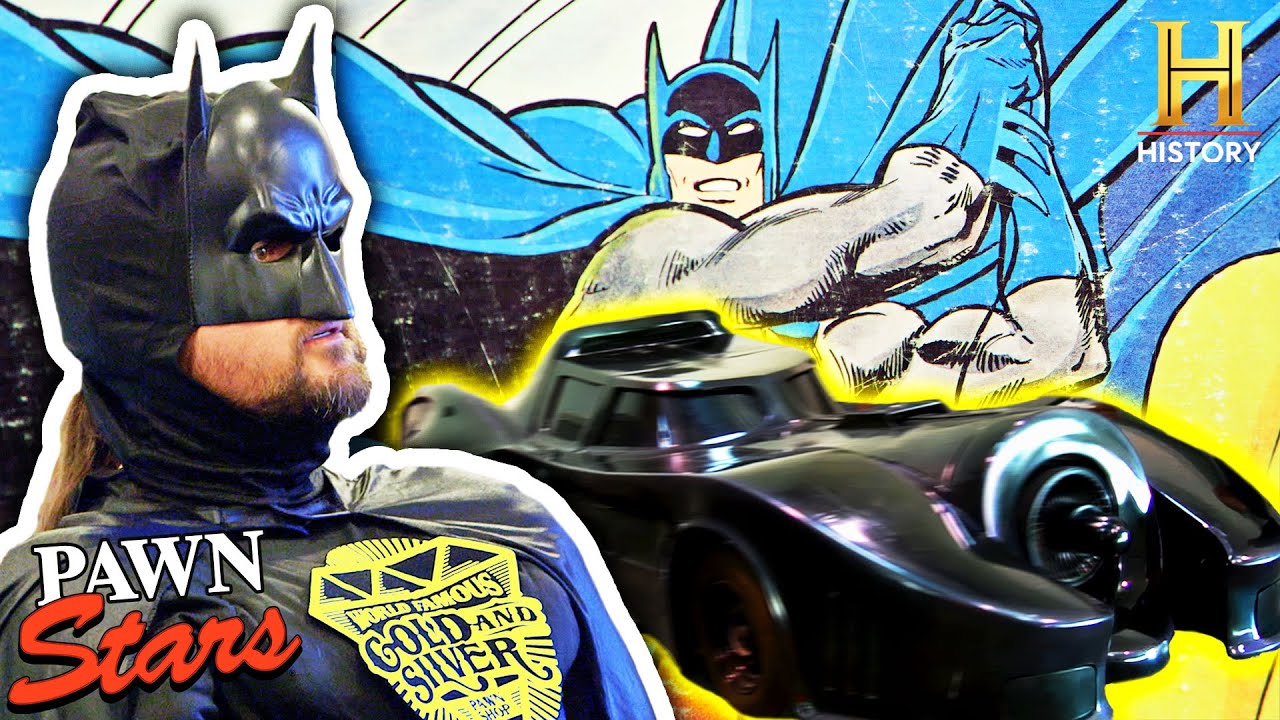
Yesterday I got a call from a guy who wants to sell me the Batmobile.
So Corey and I are on our way to go check it out.
Oh, man.
This thing looks sick.
[music playing] I called the guys from the pawn shop down to come take a look at the Batmobile that I’ve got for sale.
I’m hoping to get at least $20,000 for it.
I think the lowest I’ll go is $15,000.
I mean, it’s the Batmobile.
So do you know anything about it?
WAYNE: It’s a replica of the one that was in the movie with Michael Keaton.
A friend of mine got it on the internet and he asked me to fix it up for him.
I said, I don’t know what you expect me to do with it but let me take a look at it.
So he brings it over to me and I said, well, I can– I can make it run.
So it runs.
Then he didn’t have any money to pay me for it, so I decided, you know, to say, well, hey just give me the car.
RICK: [laughs] Batman is one of the few superheroes with no special powers.
He just uses his wits and his gadgets.
And his coolest gadget, by far, is the Batmobile.
So what kind of chassis does this have?
Well, it’s a– CHUMLEE: Rick, here are your sunglasses.
Those aren’t my sunglasses.
Are you sure?
RICK: Chum always finds new ways to surprise me.
But I can’t be too upset with him.
It is the Batmobile, after all.
Whatever. He’s already here.
Chum, go stand over there. – Yeah.
I’ll just stand over here.
COREY: So can we see the inside of it?
WAYNE: Yeah.
RICK: So do any of these switches or gauges or buttons work?
Do they have any function, at all?
Well, a couple of the gauges work.
But most of the switches are– RICK: Just dummy switches?
This is an amazing replica.
Someone obviously spent a lot of time getting all the details right.
But because it’s not the original Batmobile, I have no idea what it’s worth.
Can I look at the engine?
WAYNE: Yeah, sure.
RICK: Ooh.
WAYNE: It’s got a 327 in it, a single carb.
Because you can’t fit too much underneath there.
I thought the Batmobile had a rocket engine.
RICK: This thing is really cool, but I got a few concerns with it.
I don’t even know what kind of car was built out of, so I really need someone to come down and take a look.
But I’m already thinking, how cool would it be to drive this up and down the Vegas strip?
Let me call my buddy.
He deals in a lot of exotic cars and stuff like that.
Maybe there’s something we can do with this.
OK?
All right.
Hey, Danny, what’s up?
I own Count’s Kustoms here in Las Vegas, where we build wicked hot rods and way cool choppers.
Kind of looks like a Batmobile to me.
[laughter] CHUMLEE: Can’t slide one past you, Count.
Yeah. [laughter] I don’t know.
I mean, I know you deal in a lot of weird cars.
DANNY: Sure.
So I figured you could help me out here.
DANNY: Sure. Absolutely.
You know, cars like this always will carry a value because they’re so recognizable.
You know, you’ve got so many famous movie cars and TV cars– the General Lee, “Dukes of Hazzard,” you got KITT from “Knight Rider.” Now the original Batmobile, that was a ’57 Lincoln Futura.
But this one– this was a total concept from scratch.
This car was an original design from the get-go, and it’s a really wicked body style, extremely cool looking car.
This one is a replica. Right?
WAYNE: Right.
DANNY: Do you know anything about, like, what the chassis is, anything like that?
WAYNE: No.
I don’t know where the chassis came from.
OK.
CHUMLEE: How’s it looking down there?
DANNY: Well, it looks like what we’ve got here is probably a early ’80s GM chassis, like, you know, something, like, maybe on a Caprice or a big Buick or something like that.
That’s what the frame and chassis looks like.
What– what’s– what do we got under the hood?
Can we take a look at that?
All right.
We got a small block Chevy 327.
Looks like you’ve got, like, a turbo 350 trans behind it, automatic trans.
Can we fire this thing up?
I want to hear what it sounds like.
Yeah. We– we can start it.
All right.
Cool.
[engine revving] CHUMLEE: Yeah.
Listen to her purr.
Sounds all right.
DANNY: Somebody put endless amount of hours into making this.
This car was all hand made.
It was a labor of love.
They put so much effort into getting it this far.
You know, guys, this is a really tough one, here, to be honest with you, man.
This is a hard call.
To get it to a level where it’s, like, show worthy, you’re going to be weeks, frankly, in bodywork.
To flip this over, you’re going to find somebody that really just wants it for themselves.
This is a catch-22, as far as I’m concerned.
There’s a ton of work to be done to it, but where are you going to find another one?
That’s the other side of it. RICK: Yeah.
You know what I’m saying? RICK: I mean– DANNY: You’re not going to find one of these for sale, so it’s– You know, I mean, Danny’s got a lot of valid points.
It’s not the original Batmobile.
There’s a lot of work to be done.
It’d be really difficult to sell in this kind of shape.
There’s just nothing I can do with it.
I mean, I’m– I’m sorry for taking up your time.
Nothing I– CHUMLEE: Why?
Let’s test drive it first.
We don’t know that.
– Chum, it– it’s not for me. – Can we test drive it?
Yeah. You can test drive it.
Sure. – You got to love Chum.
There’s no way I’m going to make a deal on this thing, but who wouldn’t want to see the Batmobile run?
If you want to take him for a test drive, it’s up to you.
Sure.
Let’s do this.
To the Batcave.
[music playing] This is the best day of my life.
♪ – Hello.
– Hello.
I brought in my official Batman Utility Belt from 1966.
– Pretty amazing.
Where did you get this?
– Obviously Bruce Wayne, you idiot.
– [chuckles] – I came to the pawn shop today to sell my Batman Utility Belt from 1966. I got the belt in the ’70s at an antique mall. I’m looking to get $17,000 for my belt. If I sell my belt, I’m gonna buy a new car. [laughs] I really need a new car.
♪ – Okay, I’m intrigued. Batman has been a pretty amazing brand since the 1930s, ’cause there’s everything, from the cartoons to the comic books to the movies, and it never seems to end.
The TV show came out in 1966. It was really, really fun. It was cheesy. People watched it with their kids.
It was one of those shows that sort of rocketed straight to the top and went straight back down, so it was only on for three seasons.
But Burt Ward and Adam West made entire careers.
It was because they did this for three years.
– Right. – I mean, I watched the reruns when I was a kid, and I loved it, and I think it was mostly because of the Batman Utility Belt.
See we have the Batarang there, the Bat-Cuffs, the Bat-Gun, the Bat-Rocket Grenade.
– It’s all there. – I just find it amazing. Do you like Batman?
– Yeah, he’s not the best superhero, but he’s all right.
– What’s your favorite superhero?
– The greatest superhero of all time, Superman. – [sighs] – Uh-oh. – I’m not with you on Superman.
– Superman is what Batman pays millions of dollars to be, and guess what, Superman was born that way.
– Batman, all he needs is a little Kryptonite, and Superman’s nothing.
♪ So what do you want for this?
– 17,000.
– Holy something, that’s a lot of money.
– Gee willikers is the proper terminology.
– Gee willikers? – Yeah.
– All right. My toy guy is just one block away.
I’m gonna give him a call, and we’ll get it figured out from there. – That sounds good. – Well, I’ll be right back.
Batman, way better than superman, hands down.
– Superman can make your hair grow again.
– I’m not saying that Batman is not cool.
I’m just saying Superman’s better.
Batman’s like a super-cop, at best.
– Super-cop? – Yeah.
– Batman was pretty cool, man. – Yeah, he’s pretty cool, but he’s not a better superhero than Superman.
– I mean, Superman kind of was the reason that the Batman show even got made.
The Superman show was running more for, like, little kids, and they decided to do this Batman show, which was geared towards teenagers, but it fell back to little kids. – So the Batman Utility Belt.
– This thing is amazing. Can I take a look at it? – Yes.
– I would’ve been so cool when I was six year old if I had this. – I’ll tell you what, to Batman collectors, guys, this is the holy grail.
It was a toy, so it wasn’t necessarily meant to hold up, and a lot of these didn’t, because what happened is, you opened it up on the way out the store, you ripped the belt out of the box, you put it on before you even got in the car.
But this is in incredible shape.
It has not been removed. It has not been played with. There’s no stress marks on it. The only one thing that I see here is there’s a little bit of paper tear right there off the box.
– Yeah, it’s pretty neat, but the thing is, she is asking $17,000 for this.
– I’ve seen the belts just by themselves, the most common pieces to find, sell for thousands of dollars.
In the case of this, I think you’ve got an absolutely great piece.
You have tons of Batman collectors, tons of superhero collectors, and so you can’t miss on the market.
I think you have no problem getting… ♪ $16,000 for this.
– Yes. [chuckles] – Thanks, dude. – Yeah, thank you.
Wow, amazing.
Chum. – All right.
– Have a good one. This thing is incredible.
All of the toys are immaculate. Everything pops. So I think the shop’s gonna have no problem getting $16,000 for this.
♪ – I’ll give you 10 grand for it.
– Oh, no, no, no.
I would consider 15,000.
– [sighs] – You’d still make $1,000.
– No, I wouldn’t make any money.
If I worked on margins like that, I would be out of business.
I will give you $11,000.
– 12,000. – No.
– 11,500? – No.
$11,000. Anything more than that, it’s not gonna make any sense to me.
– Okay.
– All right, deal! Sweet!
Chum will meet you right over there, and do some paperwork with you and get you paid.
And–no, don’t touch– you’re not gonna touch it.
– It’s not gonna fit you. It says “32 waist.” – Can I help you? – Yeah.
I’ve got the Batman Wayne Foundation house.
– Hey, Corey, check this out. Batman Foundation dollhouse.
That’s what this is, right, a dollhouse?
– Yeah, absolutely.
– I think, you know, part of the appeal of Batman was, he was just a normal guy.
He wasn’t born with superhero powers or bitten by a radioactive spider. – A normal guy. A billionaire?
That’s a normal guy?
– Who had a sexy voice.
[deep voice] Robin, come in please.
– [chuckles] – I’m at the pawn shop today to sell my Batman Foundation. It’s a toy house. Anybody that is a true Batman aficionado, they’re gonna go, “This is too cool.
This is the only one I’ve ever seen.” Today, I’d be happy if I got 700 bucks. – This is pretty cool. So where’d you get it?
– I picked this up at a tag sale about ten years ago, and I actually saw this box in the corner.
And being a Batman fan, I said, “You know what? This is awesome.” – I think Batman’s first appearance was in the late ’30s in a comic, and the character kind of just took off like a rocket.
It was one of their most successful characters that they had.
– Yeah, they’ve had movies, multiple television shows, cartoons. People love Batman. I mean, Superman’s obviously way cooler, way stronger, way smarter, and a lot better looking than Batman, so he’s my superhero of choice.
I mean, it’s cool that you have the box, but it looks kind of in rough shape.
What do you think?
– I mean, it’s seen better days, but it’s not bad.
I mean, do we have any idea how old it is?
– It’s got a copyright date of 1977, so it’s at least not newer than that.
“Includes three-story building with penthouse, “working bat elevator, trophy case, computer console with two chairs.” It looks like it’s missing one piece.
I’m not exactly sure what.
– Other than that, I mean, it seems like it’s in pretty good shape.
Any idea what you’re looking to get out of it?
– I’m thinking 700 bucks.
– [exhales] – Okay.
– I don’t know.
700 bucks for a Batman dollhouse?
– Yeah, but it comes with the box.
– I don’t know, Big Hoss.
I think–I think you need to call in Steve for this one. – I believe he’s at a toy convention.
– Well, I’m sorry, my man. We’re gonna have to pass.
– We’re not gonna pass. – We’re gonna have to pass.
Steve’s not– – No, we’re not gonna pass.
I’ll give you 500 for it. – I bet you it’s not worth that.
Guaranteed you’re gonna lose on that. – Can you do 6? – I can do 5.
– Take it and run, buddy.
Take it and run.
♪ – You got a deal. – All right, deal.
I’ll tell you what.
We’re gonna bring Steve in when he gets back, and if it’s more than $500, you’re gonna wear a costume that I choose.
– And if it’s worth less– you see Robin right there?
You’re gonna be wearing green underwears and a red dress just like that.
– Sure, buddy, okay.
Write him up.
– Let’s go.
He’s my boss, but you got over on him today.
♪ – This is pretty cool, man.
– I don’t know if I’d say “cool.” – Well, you know, it’s funny.
You know, I know you don’t like Batman, but in the ’70s, Batman ruled.
Batman was so popular that you had companies like Mego trying to kind of produce whatever they could. Mego, when they had started producing these play sets, they started with, like, the “Planet of the Apes,” and they produced, like, the big play set with the tree house.
So then in ’74, the Batcave came out, and unique from the fact that you didn’t have anything that was, like, this big of a play set for boys.
You had the Barbie Dream House, you had those type play sets, but for boys, you hadn’t really gotten to something that was this big.
– I think that’s why Corey likes it so much, ’cause he loves dollhouses. – [laughs] – So what do you think it’s worth?
– You know, so I noticed that you’re missing the rope, which would actually pull up the elevator here, and then there was a little Bat Shield that attached to the end of it that would hang off this piece.
And then when you’d pull it up to a floor, you would hook it over the front to be able to place the elevator on different levels.
– That’s got to affect the price drastically, right?
– It is one of the harder pieces to find.
– Yeah. – It is commonly missing.
However, because it is so commonly missing, most collectors would be more than satisfied with this because you have all of the clips.
Those are always missing or broken.
You have all of the furniture pieces.
It’s a very nice box, and you’ve got the instruction sheet for it as well, which is really cool, so, obviously, you’ve got almost everything that you would need here for someone that would want a Wayne Foundation.
If you’re a Mego collector, it’s not gonna take long for you to sell.
– Okay, so I got a bet riding on this.
I paid 500 bucks for it. What do you think?
– Well, you know, a lot of times, Chum is right when it comes to this type of stuff.
He knows quite a bit about it.
– When you know, you know.
– However, I think in this point, I think Chum’s wrong, and the reason being is ’cause I think you guys have no problem getting $1,100 for this.
– Sweet. [laughs] – So, sorry, but you lost your bet, bud.
– Oh, it’s gonna be fun. Get ready for it.
– You know what? I’ve got some stuff to do.
– [laughs] – [laughing] – [deep voice] Welcome to the Gold & Silver Pawn Shop.
– He’s never looked better.
I like the belt.
I like the pawn shop advertising.
You’re not gonna make him do this all day, are you?
– For at least a while.
He’s really embracing the character.
– [deep voice] Welcome to the Gold & Silver Pawn Shop.
– That’s funny. I will give you that.
But you’re gonna freak the customers out, all right?
– Why? – Because it’s weird.
– Come on. It’s great. Look at him.
– [deep voice] Welcome to the Gold & Silver Pawn Shop.
– Chum, you’re done.
– [deep voice] That’s it today, Big Hoss.
– [laughs] – Hi. – What do we got here?
– This is “Batman Forever” the video game for Super Nintendo and the prototype for the “Batman Forever” game.
– I’m not a video game guy.
Maybe I don’t play them because I’m really bad at ’em every time I’ve tried.
I like pinball, but– [both laugh] – I’m here at the pawn shop today to sell my “Batman Forever” Super Nintendo prototype with the original game. This prototype shows several stages of development that were used in production of the final Super Nintendo game. The prototype has actually been in my collection for about five years, and I was able to pick up the production copy about two years ago. I’m looking to get $5,000 today for both. If I make a sale today, I think I’ll take my family on vacation somewhere fun.
– It is kind of cool.
The “Batman Forever” movie had Jim Carrey in it, Nicole Kidman in it.
So this was a mid-’90s, so ’95?
– Yeah, 1995.
– I’m trying to think, who played Batman?
– Val Kilmer. – Val Kilmer, that’s right.
And he was actually a pretty good Batman.
Jim Carrey did an amazing job. – Amazing job.
– He was basically the movie. – Yeah.
– How well did the video game do?
– The video game had its ups and downs.
The Super Nintendo version, which you’re looking at right here, is a much harder game to find.
So, for Batman enthusiasts, this is definitely a staple for their collection.
– OK, explain the prototype for me, ’cause, like, that’s a lot for a video game.
– So this is the development circuit board that was used to develop the game.
And each of these exposed EPROMs actually has a different version of the game that was used in the development of this final product right here.
– OK, all right.
You’re talking to a history nerd, not a tech nerd.
[both laugh] I’ve never even seen one of these.
I know nothing about one of these, OK?
I mean, where’d you get these?
– I won this at an auction several years ago, and it was just something that I couldn’t pass up.
Because there’s different versions on this, it’s a really cool early-stage prototype.
– I mean, I’m interested in it.
I mean, how much do you want for these?
– I was looking for 5,000 for the pair.
– OK.
♪ I really wish Chumlee was here.
[both laugh] OK, but I do have a guy I can call.
– OK.
– And we’ll go from there. – Sounds like a plan.
– All right. Be right back. – Thanks.
– What’s up, Rick? – What’s up, man?
– Good to see you.
– Deniz, how you doing, buddy? – Good.
– All right. You guys know each other?
– Yeah. – I know this guy.
– All right, well, this guy has got these.
– That’s cool.
So this is a prototype. This is how they build a game.
Typically, this stuff shouldn’t get out to the public.
As far as in terms of how rare video game prototypes are, how hard they are to acquire, when you’re talking about older cartridge-based prototypes, typically those were in-house.
And especially ones that have differences, that means it wasn’t a final version. That’s really unique to find. So you don’t see them often.
And it’s cool when you do.
Prototypes were usually kept internally or destroyed…
– Destroyed. – By Nintendo.
– But you’ve seen them before?
– Yeah, I mean, prototypes are technically “one of one,” right?
They’re unique.
Is there still an existing prototype for every game out there?
Probably not.
But I’d say a majority of them do have it.
But if you’re talking about, like, really popular games and early prototypes, that stuff–like Zelda and Mario– that stuff’s not out there.
That stuff’s really tough to find.
Sometimes prototypes were sent out as, like– especially once disks were cheaper, they would make a lot of them, and they’d send them out to, like, game reviewers or people that they wanted to try it out.
But, typically, by that point, they were more, like, final versions of the game.
So it’s pretty rare to find an earlier prototype.
– OK.
So was this game a big seller?
– This game is the “Batman & Robin” equivalent of the video games.
– [laughs] All right, so did not sell well.
– It didn’t do well. It might have sold OK– – It sold OK. – Just because of the tie-in.
– Yeah.
– But the reviews and the reception were atrocious.
– All right, so the big question–what’s it worth?
– As a set, I would say it’s probably worth, you know, you have 300 here, 1,600, 1,700 here– two grand for the set.
– I understand where he’s coming from.
But my feeling on it is that it’s so unique, it is hard to value.
– I mean, I deal in unique things all the time.
– It’s got a cool history.
How many people care about that, given the fact that it’s an unpopular game?
That’s how you land on it. – OK.
Thanks, man. I appreciate it.
– Anytime. – Thank you.
– You got it. – Appreciate you.
– Good luck. – Yep.
– All right, so we’re really far off with the price.
– It would seem so. – Yeah.
I’ll give you, like, 1,200 bucks.
– I don’t think I could do 1,200 on it.
I’d never be able to find something like this again.
I appreciate the offer.
I don’t think I could do 1,200.
– You know, I got my guy, and he says that’s what they’re worth, and that’s what I can do.
– I hear you. I appreciate your time, though.
– All right, thanks for stopping in.
– Yeah, thank you. – There we go.
– I don’t want to be two-faced, and I know Rick liked the Riddler, but I think his offer was more of a Joker.
GERRY: I have some movie memorabilia from “Batman Forever.” COREY: What have we got?
GERRY: I have one of the Batarangs made for the movie itself.
COREY: That’s cool.
GERRY: This is one of the riddles that Jim Carrey gave to Val Kilmer.
This was used on the screen.
There was one of them made.
This is it.
OK.
That is cool.
God, I was probably 12 years old when this movie came out.
GERRY: You’re making me feel old.
COREY: [laughs] Thank you.
I came to the pawn shop today to sell two props from the movie, “Batman Forever.” The Batarang alone– I would probably sell that one for about $1,000.
The Riddle prop– since it comes with a certificate of authenticity, I’m looking for $5,000.
I’d probably go down to $3,000.
COREY: So how did you come about acquiring this stuff?
GERRY: I have a room in my house that I used as a prop museum.
I have switched themes, so I’m liquidating all the memorabilia from the room.
That’s cool.
So what is this?
GERRY: Each of the riddles in the movie gave a number.
And when you put all the numbers together, they corresponded to the letters of the alphabet, which spelled out Mr. E, which was Edward Nygma, who was the Riddler.
OK.
GERRY: This I got at the Warner Brothers Batman store in New York City.
This was in the movie, held by the actors, and I have a certificate of authenticity from Warner Brothers.
COREY: OK.
GERRY: This I got in an auction online from Warner Brothers themselves.
COREY: There’s a good market for movie props and comic-related stuff.
And since these appeal to both kinds of collectors, these could go for a lot more.
But we’re not talking about the Batmobile here, so the price kinda has to be right.
What do you want for it?
GERRY: This one, $1,000.
This one, $5,000.
COREY: I can tell you right now, $1,000 for that– there’s nothing I can do with it.
This right here, it’s gonna be a long, long time before I get the collector in here that just has to have it.
I mean, I’m more into the $2,000 range.
GERRY: It’s something very unique that nobody else in the world has.
Could you do $4,000?
No.
I’ll go up to $2,200.
But I mean, other than that, there’s nothing else I can do.
$3,000 is my bottom price.
COREY: There’s a very select few people out there that are willing to spend five figures on a Batman prop.
It looks like $800 is gonna keep us from making a deal.
I appreciate you coming in.
Thank you.
COREY: Batman’s cool and all, but I just can’t shell out $3,000 for a prop from a movie people didn’t even like that much.
– [Corey] What do we got?
– Got a couple of guitars for ya.
D.C. Comics, John Bolin, Batman and Joker guitars.
A set. – [Corey] Oh, wow.
– [Man] This one is even more impressive.
The Joker.
– I didn’t know the Joker played guitar.
(laughs) (Joker laugh box cackle) – I came to the Pawn Shop today with a Batman and Joker D.C. Comic, John Bolin set of guitars.
I’m trying to sell the guitars to, just get premium dollar for them and rotate my inventory.
They have a very low number.
The matching set’s a 25, that’s very rare.
There’s a very small run of them.
They’re owned by a lot of celebrities, and this is a low set that you just don’t find.
– Cool.
John Bolin, I mean, he basically became the guy, if you wanted a bad-ass custom guitar, that you went to.
And this guy’s got a really interesting story.
He went down an apprentice to, I think it was Gibson, or one of them, and decided that that’s what he wanted to do with his life, and he started making custom-made acoustics for his friends and friends of friends, and then, one day he ended up making one for some folk singer.
And then Billy Gibbons from ZZ Top is what really, really put him on the map and then I think he made them for just about everybody that wanted a really high-end custom guitar.
When it comes to making custom guitars, Bolin is the guy you go to.
And everybody from Joe Perry to Steve Miller have had this guy make ’em for them.
So if this is legit, we’re not lookin’ at your average guitar, here.
The Batman and Joker.
I didn’t know that he made ’em, though.
– The cool thing about the Joker is it also has this little chip in it.
And if you push this button when it’s all hooked up to an amplifier, you push that and the Joker laughs.
It’s like, ha-ha-ha-ha-ha.
Really cool.
– [Corey] That is cool.
– Yeah, that’s unique.
– Yeah, ever since the success of the Star Wars, and how much money they made from licensing stuff, every movie they could license out stuff, did.
And, with the Batman stuff, there was no exception there.
I just didn’t know that they would be Bolin guitars.
– Kind of unique, right?
– [Corey] Yeah.
So what are you lookin’ to get for them?
– I want to get 15,000 for ’em.
– Okay, for the pair?
– [Man] For the pair.
– Okay.
This is a little out of my realm, I gotta tell ya, man.
We’re talking about really high-end guitars in a really niche market and it just, it would make me a little more comfortable if I called a buddy of mine to come down and take a look at ’em.
– Understood.
– [Corey] All right.
Why don’t you hang out and I’ll be back in a little bit.
– Sounds good.
When he called for an expert I thought it was great because I think that these guitars speak for themselves.
I know I have all my paperwork done and the guitars are solid.
– Jesse sent me, John Bolin.
– Oh wow, John Bolin, okay, um.
– [Terry] The John Bolin?
– I am. – [Terry] (chuckles) Wow!
– [John] Looks like a couple of my guitars here.
– [Terry] (chuckles) What a treat!
– Well, I guess you’d be the guy to talk to about these, then, wouldn’t ya?
– Yeah.
I made these 26 years ago. – [Corey] Wow.
– My name is John Bolin, and I’m the owner of Bolin Guitars, and I’m a guitar-maker, known as a luthier.
My buddy Jesse knew I was in town, gave me a call, and he said, “Hey, you won’t believe this.
“They’ve got a pair of your Batman and Joker “at a pawn shop.
“You gotta go down and see ’em.” They are absolutely beautiful.
My Lord.
Pretty much, looks to me like they’re unplayed.
– [Corey] So, how’d this all come about?
– Well, it started with the Batman.
This was to celebrate the Batman movie.
And, we did the prototype, and at that point, we make a lot of guitars for ZZ Top and the word got out to Billy that we were doin’ this, and he’s like, “Oh, I have got “the perfect design for the Joker.” – So, Billy Gibbons from ZZ Top designed this?
– [John] He did.
– That’s awesome, man.
I brought an amp out.
I’m kind of curious to hear the Joker laugh.
(Joker cackle) – [John] It’s a seven-second loop, so…
(Joker cackle) – Okay, that’s pretty cool.
So, I mean, you’re the guy to ask.
Are they legit?
– Oh yeah, absolutely.
– [Corey] (chuckles) Okay.
– Yeah, absolutely.
I think my fingernail marks are on there somewhere.
(all laugh) – I really appreciate you coming down, thank you very much.
– You’re welcome, thank you.
– [Terry] Thank you, sir. – Terry, nice to meet you.
Nice to meet you, Corey.
This experience was really cool.
It was really great to see my guitars.
I’m really hoping that maybe the store ends up with them.
And they go off to a collector, or somebody that really appreciates them.
– So, you wanted 15,000.
Bad news is, I can’t have uh, John Bolin give me the price of the guitars ’cause he built ’em and I’m sure, to him, they’re priceless.
– [Terry] Okay.
– So, I did talk to my buddy on the phone and he told me that they’d probably retail for about 7,500 for the pair.
We’re so far off, I mean, you want 15,000, I mean, I’ll go 7,500 for ’em.
– I know a Batman sold for 7,500 by itself once.
I definitely would not sell them for $7,500.
– Yeah, and that’s gonna be the most I can pay.
But, I really appreciate it man, it was fun!
– Yeah it was, thanks so much. – [Corey] Thank you.
Um, if you hurry up, you might be able to catch him and get him to sign them for you out there, if you want.
– Thank you. – [Corey] Take care.
– There’s no way I could take 7,500.
I’ve seen one alone sell for 7,500.
I’m gonna hop in the Batmobile and head outta here.