Roaring Twenties Relics: 1920s Treasures Hit the Counter | Pawn Stars
Roaring Twenties Relics: 1920s Treasures Hit the Counter | Pawn Stars

This is a ukulele banjo.
RICK HARRISON: Do you know anything about it?
Uh, it was from my grandfather.
And he claims it was from Hawaii.
He liked Hawaiian music, and Hawaiian girls for that matter.
Well, who doesn’t?
JOE 2 (VOICEOVER): This ukulele clearly belonged to my grandfather.
He passed away.
And my grandmother gave it to us.
And my wife and I, you know, we’re not musical people.
I have no musical abilities at all.
And so I figured, you know, it has no sentimental value to me.
So it would be nice to just get some money for it.
– I know a lot about guitars. – All right.
And I have never seen one of these.
It’s a ukulele style.
But, um, it’s a Gibson.
So it’s not from Hawaii.
JOE 2: Oh, do you know where it would be from?
Kalamazoo, Michigan.
Mm, that’s a long way from Hawaii, isn’t it?
I mean, it is from the early 1900s.
They have signatures on there from 1925.
This is really neat.
I mean, it looks like– I don’t know– he played places, and people just signed it for him.
JOE 2: A lot of people signed it too.
RICK HARRISON (VOICEOVER): I got to admit, I’m intrigued.
It’s extremely rare to come across a banjo ukulele, much less one made by Gibson.
And you throw in the signatures from the 1920s, you’ve got a piece with some very interesting history.
So you want to pawn it or sell it?
I’d like to sell it.
OK, what do you want for it?
I would go for about 500.
That’s what I– you know?
Dollars?
Hopefully.
I mean, it’s super cool.
I mean, I really, really like the thing.
It’s intriguing.
It’s neat.
The problem is, I don’t know a lot about it.
So that’s why you’re going to get 200 bucks.
200 bucks.
You know, I just hope I don’t go home, and find out this thing is worth $10,000, you know?
I hope you do.
I mean, I don’t think it’s going to happen though.
But I do know it’s going to cost me 100 or 200 bucks to fix it up.
The plywood lamination is coming apart.
It’s split right there.
And the split keeps on going around.
200 bucks.
Yeah, sounds about right. All right, cool.
OK, now let’s go do some paperwork.
All right.
JOE 2 (VOICEOVER): You know, it wasn’t what I wanted.
But it’s pretty good.
And I can use the money to buy an MP3 player, and, you know, download a lot of songs on it, no ukulele music.
But, you know, certainly have some fun.
This is what I called you about.
This is awesome.
I work at Cowtown Guitars here in Las Vegas.
Anytime the guys have any kind of questions about musical instruments, they give me a call.
Back in the ’20s and ’30s, these were really popular because of Hawaiian music.
It looks like most of the hardware and everything’s original on it, calf skin head.
And it’s really neat with all these signatures and stuff on it.
So do you think it’ll be worth it, getting the thing fixed up?
Or just sell it like it is?
No, it’s worth getting fixed up.
Yeah, there’s a couple of little splits here.
Get all that cleaned up, all the hardware cleaned up.
Probably get this straightened out, a couple hundred bucks, make it look like new. – OK.
RICK HARRISON (VOICEOVER): I’m excited to get the thing restored, but what I’m really looking forward to is hear this thing played.
That thing is definitely going to sound nice.
RICK HARRISON: Hey, Jesse, how’s it going?
Hey, man. How are you doing?
– Oh, pretty good, man. – Pretty good.
You got that ukulele for me?
Yeah, I actually do.
We finished it up just the other night.
Oh, this thing is great, man.
You were able to keep the skin?
– Yeah, kept that on there. – Bitchin, man.
So what all did you do to it?
First thing we had to do, we had to make a bridge out of a regular banjo bridge because finding a bridge for a ukulele banjo is not all that easy.
OK Then we fixed all those splits in this little piece of plywood on the back of it that was delaminating.
OK.
Remember all the cracks that were on this side of it where it was pulling apart from itself?
RICK HARRISON: Yeah.
JESSE: We fixed all those.
We had to humidify it to get everything to swell back up, so you could actually get a syringe in there to inject some glue.
We clamped it all back down.
We made a new bone nut for it.
OK, because you couldn’t find one of those even?
No, couldn’t find one of those either.
We leveled all the frets, polished them all up, restrung it, tuned it up.
OK.
It actually came out really good.
So what’s the damage?
Um, 200 bucks.
All right, so what do you think I can get out of it now?
You can probably get a grand out of it.
OK.
Jesse did a great job with this thing.
It’s real important, when you’re refinishing an old instrument like this, is not to damage the wood.
You don’t want it to lose its character.
You just want to clean it up, and protect it.
You want it to be playable.
He did an amazing job.
And I can probably make 600 bucks on it.
So can you play this thing?
Um, yeah, I think I know two chords.
Let’s hear it.
All right, here you go.
RICK HARRISON (VOICEOVER): Jesse, great expert on guitars, not great ukulele player.
No?
You better stick to guitars.
Yeah.
– [Corey] What’ve we got?
– I got this old Black & Decker drill.
– [Corey] Do you know when it was made?
– [William] It was made in 1926.
– [Corey] That’s pretty cool.
Really interesting company, they invented this style of drill which is pretty much the basis for every drill that came along after that.
Now, I think if you showed up on a job site with this, you’d get laughed at and sent home.
– [William] I got this drill when I used to work for Black & Decker in Spain.
It’s in working condition.
It’s very rare to find one of those.
I used to collect antiques, and I kept it for a long time.
– [Corey] These things are really cool.
Black & Decker’s a really interesting story.
Two guys here in the states had a small machine shop together.
I think they started making hand tools, and they came up with the idea for the first pistol-grip electric drill.
They were actually able to get the patent for the handle and the trigger mechanism to make it work.
And, people do collect stuff like this.
– Yeah.
– Black & Decker has been around for over a century.
Not only have the invented some of the world’s most used power tools, but they also made probably the most recognized hand-held vacuum on the planet: The DustBuster.
I just hope his asking price doesn’t suck.
How much are you looking to get out of it?
– $850, that’s what I’m asking for.
– $150 or $850?
– $850? – 8-5-0.
It is a very unique piece, was very difficult to get it in working condition.
– [Corey] That number is just so high.
I could give you a hundred bucks for it.
Really I can get online and buy them all day long.
– I wouldn’t sell it for a $100.
– Are you willing to come off that at all or…
– What about $500?
– I couldn’t pay $500, I really couldn’t.
I’ll go $150, that’s the best I can do.
– I won’t sell it for $150.
– Alright, well, I appreciate you coming down man.
If you change your mind, we’re here okay?
– Thank you.
You know, $100 is what it takes to fill my gas tank.
So, I knew that he was going to take the price down.
I did not expect it to be that down, but you know, I’m not going to give it away for $100.
Hey, what do we got here?
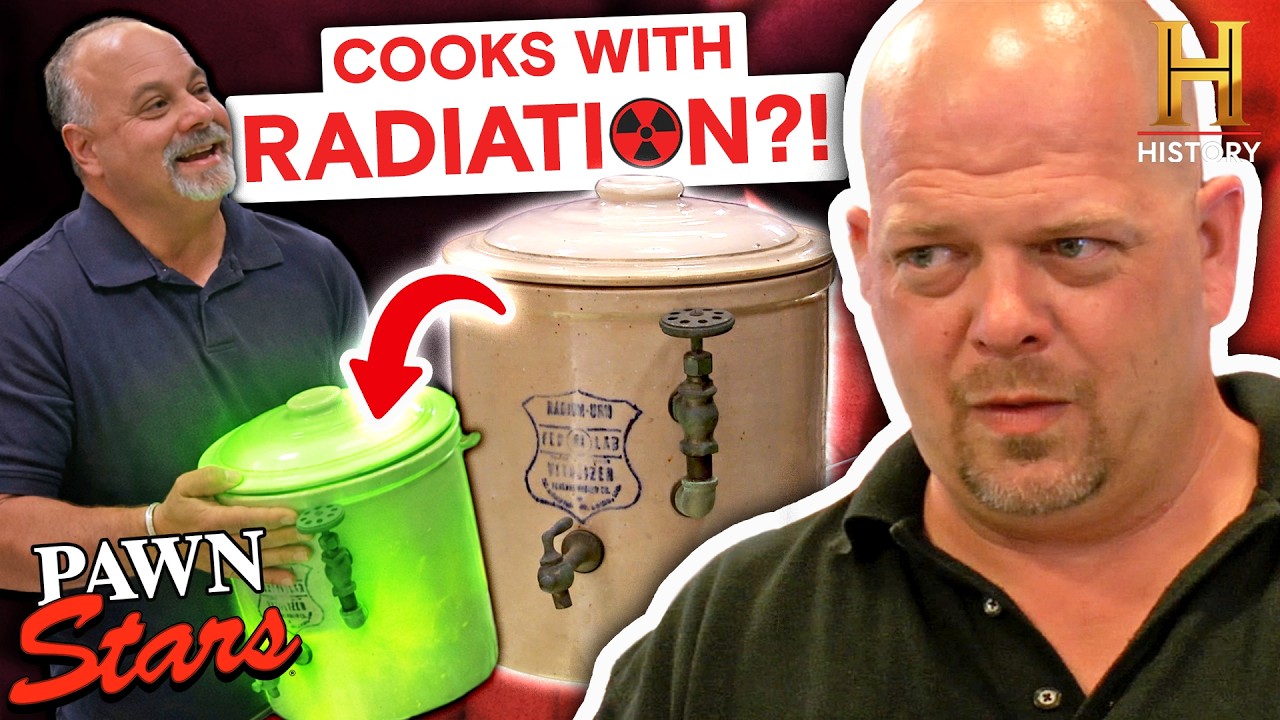
– We have a 1920s radium crock.
– [Rick] (laughs) OK.
– Back in the 1920s, they would put radium in this with water, and it has a little centrifuge that would spin around, you turn this, and turn it on…
– And then you just made yourself a delicious radium cocktail.
(both laugh) (water pouring) – I got the crock from a friend of mine, it’s a really interesting piece and hoping to be able to sell it.
I want to sell the crock for $900, it was thought to cure cancer, high blood pressure, and even thought to increase the sex libido.
– This is really interesting, radium releases alpha particles, which are really, really super dangerous, but it’s hard for them to penetrate things, they’re not like x-rays, so some of these things, probably no radium ever got in the water, because it got absorbed by the metal, and then there was other ones where you could buy packets of radium and just pour it in the water, which was just like oh my God, I don’t see how you didn’t die from the first drink, – Right.
but by the 1930s, ’40s, and ’50s, they began to realize this radioactive stuff is really, really dangerous.
People have been coming up with these quack medicine things ever since they invented money.
But finally in 1938, the federal government came along and said, enough is enough, if you’re going to make a medical claim, it’s got to be real, and they outlawed things like this.
How much you want for it?
– $900.
– OK.
I’ll go $400.
– How about $450?
– I will go four and a quarter, it’s a limited market, it’s going to sit for a while.
♪ suspenseful music – Alright, sold.
– [Rick] Sweet. – [Customer] Awesome.
– The nerdness in me just loves this stuff, OK, let’s go do some paperwork.
– Alright.
I’m going to spend the $425, I’m helping my friend out, he’s a little short on cash, so we’re gonna help a friend out.
COREY: Earlier, we got a call from a guy looking to sell a vintage cash register, so Chum and I are headed out to take a look.
This is it– fully restored 1923 National Cash Register.
It doesn’t tell you how to make change though.
Well, you know, in those days, you actually had to know basic arithmetic.
I’m no mathlete.
That’s for sure.
[cash register chiming] RICH: I called the guys down from the pawn shop today to see if they wanted to buy my 1923 cash register.
Like everybody in this economy, I need a little extra cash right now.
I’d like to get $750 for it.
COREY: So where’d you get it?
I used to go to Reno all the time.
They got a lot of antique stores.
I saw this, and they originally priced it $2,000.
And I paid $900 for it.
This was early ’90s.
That was a real good deal in the early ’90s.
These things were so hot, you couldn’t keep them on the shelves.
The National Cash Register was actually started by a guy named Ritty, who was actually in the bar business.
And he got tired of bartenders stealing from him, so he actually called them the Ritty’s Incorruptible Cashier.
RICH: Wow.
Before computerized cash registers and debit cards, everything was cash and carry.
That made it really hard to know if your employee was stuffing cash in his pocket.
So there was a big demand for machines like this.
So how does this thing work?
RICH: Oh, let me show you.
Let’s say you have a barbershop.
Your haircut is like $8 and– what should we say– 56 cents.
Here you go. Then you just go like this.
[cash register chiming] Pop it open, and you’ve got room for your large bills.
Remember, in the ’20s, they didn’t have the size of bills we had then. COREY: Yeah, they were bigger.
RICH: They had larger-sized bills.
One thing I’ve always liked about these things is they were actually built with style back then– Exactly.
–instead of today, everything’s just built for, you know, the cheapest way possible.
Stuff from the ’20s and ’30s is always going to be collectible, because stuff was just designed so well back then.
They paid a lot of attention to detail and made sure things looked really cool.
Tell me what you wanted to do with it, my man.
Well, obviously, you know, I’d like to sell it at a fair price.
OK.
What do you think a fair price is?
I actually had it for a little bit of a loss at $750.
I’d offer you about $500.
And the reason I’m going to do that is because it’s just not a hot item at the moment.
Shoot me another number, man, ’cause $750 is just a little too much for me.
How about $625?
How about $550?
I mean, I’m taking a little bit of a loss here, you know?
Most I can go is $600.
Pretty nice, and it works.
I can do that, man.
RICH: You’ve got a deal.
COREY: All right.
RICH: Well, the collectibles market has really gone down now.
And I feel that $600 was a fair price for today’s market.
How much does this thing weigh?
I’m guessing about 150 pounds.
All right.
We’re going to have somebody else come back and pick it up.
Is that OK? – That’s fine.
COREY: All right, awesome.
See you later.
RICH: Thank you.
– How you doing? – Good. How are you?
– I’m good. What do you have here?
– Some, uh, 1920s Paris Metro train car seats.
Not from Paris, Paris down the street.
[laughs] – Pretty cool.
Yeah, that’s our Paris down the street.
– Yeah. [laughs] I’m coming to the pawn shop today to hopefully sell a 1920s Paris Metro train car seat that I have. I’ve had it for about two years now, and I love unique antiques, but we’re remodeling, and at this point we could probably use a little extra money, so we thought, “Well, maybe somebody else would enjoy them.” – Well, where did you get this?
– I picked it up at a little antique shop, and I originally thought they were San Francisco trolley car seats, but then just looking at the back enamel panel, I found out they were actually from Paris from the ’20s.
– Yeah, these do look like they’re from the 1920s, but the Paris Metro had been around for a long time at that point.
The underground transportations had kind of surfaced around 1845 when they first started talking about building them, and then in July of 1900, the first line was created.
It was known as “Line 1,” and it still runs today.
– Oh, I didn’t know that. – Um, this looks like it would’ve been from the second class because there was first class and second class up until 1991.
– Okay.
– And the first class were nice padded comfortable seats, and these don’t look padded to me.
– Or comfortable.
[both laughing] – Yeah. Let me see.
[quirky music] Yeah, I mean, they’re not bad, but if you had a long ride, that’s kind of like– It makes you sit– – Good posture.
– Yeah, it makes you sit very proper.
– Right.
– Let’s take a look at the back over here.
Yep, it has the number two on it which lets you know that this was not the first class. It was second class.
– [chuckles] Uh, this is kind of the coolest part about it I think.
– I agree.
– Um, it’s definitely got some wear and tear, but it’s in pretty good condition overall for as old as it is.
So how much are you looking for?
– Uh, I’d like to get 2,499 for it if I could.
– How about 700?
– Ooh, that was a little lower than I had hoped for.
Um…
Any way you can go a little bit higher on that?
– I could probably do 1,000, but it’s a specialized sale, and this could take a long time to get rid of.
– Um, could you do $1,300 by any chance?
♪ ♪ – How about 12? – [groans] – Um, if you could just do the 100 more, that would be great if there was just any room.
♪ ♪ – You know what?
I don’t see any point on passing on it over 100 dollars.
That sounds like a deal.
– Great. Thank you. – 1,300?
– Yes. – Let’s write it up.
– All right.
I was really happy to make the sale today. I didn’t get asking price that I wanted for the train seats, but I really feel the 1,300 dollars was a really fair price, and I’m excited to have that and put it toward the home improvements and a trip to see the grandkids.
(Gus) Hey, Rick. Remember me?
How’s it going, man?
– How you doing, Rick? – I’m good, man.
This is– this is cool.
Check out this buoy!
[laughing] Yeah, this is a 1920s English Channel buoy light.
It’s all solid brass.
I’m, like, super nerding out on this thing, dude.
(Gus) It is a red buoy, because it marks the red side of the channel, so when you’re entering from sea, what sailors always said was, “Red, right, returning,” from sea, so you want to pass a red buoy on your right side.
I’m looking to get $2,500, because I’d like to help my daughter out with her college.
Things like this were so important.
You know, it wasn’t till after World War II that there was, like, a commercial radio guidance system for ships.
You know, before that, I mean, when you navigated, if it was cloudy, where you couldn’t see the stars and the sun, you navigated by the seat of your pants, basically, you know?
You could be to a point where I don’t know if I’m 100 miles from the shore or I’m 2 miles from the shore.
That’s what these things did.
This, foghorns, and lighthouses, and that’s how they navigated everything.
These things saved, you know, countless lives, countless amounts of money.
– We can open it up? – Yeah. Yeah.
– We can open this up. Yeah. – Oh, cool.
So this here…
Basically, it’s just a really simple torch.
And this right here–I guess this is the limestone right here that it blasts against that gets red hot.
It’s a weird system.
You take the acetylene gas, which burns really hot, you burn that against a piece of limestone, and limestone, when it gets really, really hot, suddenly starts blowing out all kinds of light.
You know, that’s why they say, in the old movies–right, you’ve heard the expression, “in the limelight.” Yes, I have.
‘Cause that’s way back in the day.
That’s what they used to light the stages with, ’cause it was so bright.
I mean, this thing is really, really cool, man.
Let’s–let’s get the thing back together.
Okay.
(Rick) I absolutely love stuff like this.
I mean, it’s a great design, and it’s in incredible shape.
Remember, this thing was in the ocean for years and years.
I’ve dealt with Gus before, and he’s pretty tough on his prices sometimes, but I really like this, so I’m hoping he comes to terms.
How much you want for it?
I’d like to get $2,500 for this piece.
I know that’s what you would like to get for it.
Now, what would you take for it?
[laughs] Well, make me an offer.
Make me an offer I can’t resist.
It’s deeply cool.
I’ll give you 1,500 bucks for it.
Can you do 22?
Can we compromise at, like, 1,700?
1,850 and we got a deal.
So 1,800?
1,800 it is.
All right. Cool, man.
This is–this is great. I–I love this thing.
– Let’s go do some paperwork. – Okay.
Just leave it here.
(Gus) I’m happy with $1,800.
I’m gonna give my daughter the whole $1,800, ’cause I’m such a good dad.
– All right, I’m intrigued. What do we got here?
– [chuckles] I have here Schoenhut’s Indoor Golf Game from the 1920s.
– Oh, I’m probably the best golfer you ever met.
– Really? What’s your handicap?
– I’m scratch.
– Oof, that’s pretty good.
– Scratch mini golf. – [chuckles] – He fell out of a tree on his head.
That’s his handicap. – Oh.
I got the golf game from my grandmother. I inherited it when she passed away. I’d played with it once or twice before, but mainly I saw it on the wall or in its box.
If I end up making a sale today, I’m gonna buy an actual set of golf clubs. – These are pretty cool.
– Yeah, I know at one point Schoenhut’s was, like, the largest toy manufacturer in the world.
– Yeah.
– And they were the ones that actually invented indoor mini golf, where they have the big windmill you got to shoot through.
– Yeah.
– So when was it made?
– 1920s. – Okay.
So are these all the pieces here?
– Yeah, you got your golfers, some golf clubs, balls, some hazards, the tee, and, well, what’s left of the original box.
– Okay, do you know how to play it or…?
– Yeah, you take a club, put it on their hand, you lock it in there, and then you pull a trigger, and…it swings and hits the little ball off the tee.
– Makes sense.
– They look like they’ve been played with a lot.
They’re not in horrible condition, but looks like a family got many game nights out of this.
– Looks pretty good for being 100 years old about.
– So what are you looking to do with it?
– Looking to sell it.
– What are you looking to get out of it?
– Looking to get 500 bucks.
♪ – Okay, I mean, it’s possible.
As far as condition goes, obviously they’re not pristine, but does that matter if they’re 100 years old?
I don’t know.
So I’m gonna have to have a buddy of mine come down and take a look at it.
I’ll tell you what– I’ll give him a call.
You want to hang out, Chum? – Yeah.
– Don’t break anything.
– So you’re a scratch indoor mini-golf player, huh?
– Yeah.
I scratched it off my list. I don’t play it anymore.
– [laughs] Steve, how’s it going, man? – Hey, Corey, how you doing?
Chum. – How you doing?
– Schoenhut’s miniature golf set.
– This is really cool.
Schoenhut were really known for making kids’ pianos.
That’s really kind of how they came out, and the technology for this was actually pulled from that.
So is it cool if I take a look at it, if you don’t mind? – Yeah, please.
– So it looks like you’ve got the hazards.
Got the tee box.
That’s cool. And you got three golfers.
Now, the set initially only came with one golfer, and then you would add on pieces.
It was really the way where they continued to get you to buy things.
This is really neat– the scorecards here.
And you have quite a few of them.
This is something that, you know, as soon as you got this home, you burned through this.
You’d play as many rounds as you possibly could, and you’d use them all up, and they’d be gone, and then you’d have to make your own.
What’s really interesting here is this specific one.
So you have a female golfer.
Her name was Sissy Lofter.
Women weren’t golfing at the time, but when mini golf came out, women really got involved.
Early on, you would get her, but she wasn’t very popular.
So she kind of started to disappear a little bit, so she’s a little tougher to find than maybe some of the other golfers that they offered.
– All right, what do they go for?
– Well, you know, I’ve seen these things, pristine ones, go upwards of, like…
$3,000, $4,000.
Complete sets, nice boxes, great paint on your golfers.
It’s got a lot of the extra parts and pieces, and it does have the scorecards.
I think you’d have no problem getting…
900 bucks for it.
– Okay.
Steve, man, you’re always the best.
Appreciate you coming down. – Thank you.
Thanks. Chum, see you later. Good luck, man.
– See you on the golf course. – [laughs] ♪ – Well, you know, man, it doesn’t happen very often, but you came in asking for 500 bucks.
I think it’s fair that I make 400 bucks on it.
It’s gonna take me a year to sell it.
So I’ll give you the 500 bucks you asked for.
♪ – You know what? I’m not gonna press my luck.
500 sounds great. – Deal.
Chum’ll write you up over there.
– I’ll meet you at the counter over there.
What’s up, Sissy?
♪ I’m trying to sell my 1929 Remington portable typewriter.
I’ve had it at least 53 years.
Oh, I have it.
I’ve owned several portable typewriters over the years, but not one like this. – No?
Yeah.
His typewriter was a little chisel and a hammer.
Oh, you mean like “The Flintstones.” Yeah.
OK, son.
I want to sell the typewriter, because it’s been stuck in the closet for over 50 years now.
And I thought maybe somebody else could really appreciate it.
This is a 1923 to 1928 Remington model 2 portable typewriter.
MAXINE: OK.
This was the best portable typewriter you could buy.
– Oh, that’s good to know. – OK?
And it was also the lightest weight, and it came in the smallest case.
The cool thing about this typewriter was it was portable.
It was made for journalists. It was like the first laptop.
They’d be on a train, going from here to here and here, it was a lot easier to take this than a full-sized typewriter.
And since it was portable, they did things like that to save space.
You notice there’s no 1 on the keyboard?
They used the L.
RICK: Used the I.
MAXINE: The I? – Mhm.
For being 80 years old, this typewriter’s in unbelievable condition.
So you’re looking to sell it?
Yeah, for the right price.
I’m not just going to give it away.
I– you know.
It has a lot of sentimental value.
My parents bought it for me when I was a young teenager.
I used to do my homework in junior high on it.
RICK: So how much do you want for it?
$5,000.
$5,000?
are you talking pesos, or are you talking dollars?
I can’t pay that type of price for it.
There’s no collectors that will pay that for any typewriter.
The thing is about the typewriter is it’s probably pretty rare.
But on the other hand, there’s not a lot of people who collect portable typewriters from the ’20s.
OK.
I can give you like $100 for it.
No, I’ll just take it home, put it back in the closet then.
I– I– I don’t blame you. Yeah.
I mean, it’s just– I tell this to people a lot.
I mean, just because something is old, doesn’t mean it’s worth a lot of money. MAXINE: Right.
I understand.
And you know what? it– it’s just be really cool when you eventually get old enough to have grandkids to show it to them. – Oh, I have grandkids.
I was trying to compliment you.
MAXINE: Oh, OK.
Thank you.
[laughs] Unfortunately, this is one of those cases where the sentimental value was a lot more than the actual value, and she was right to hold onto it.
What are these?
Well, I know what they are, but what are these?
[laughs] DENNY: Well, well I got some old antique carousel horses I’d like to sell.
RICK: Cool.
DENNY: All I can tell you my man, my good friend Dynamite Dick Durbin, they call him the Tattooed Terror from Tulsa.
Uh-huh?
DENNY: He told me it was a two for a nickel, bicycle riding, incomprehensible, bonafide substantial fact without a doubt.
You’re not going to find any finer wood carved horses in the world today than what we got right here.
RICK: Were you in the carnival business or an auctioneer?
DENNY: I worked in the auction business for a long time.
I learned that from an old auctioneer.
I’m bringing in antique carved wooden carousel horses.
They’re intricately carved.
They need to be repainted, but they’re just hot looking.
I want $4,000 apiece, $8,000 for the pair.
RICK: Where did you get these?
DENNY: A friend of mine passed away and they were in an estate.
RICK: OK.
DENNY: He told me they were carved by a French carver in the 1920s, but he couldn’t think of the name, and that was shortly before he passed away, so I have no history.
RICK: There’s a great history with carousel horses.
One of the things they used them for was military training.
You know, they would mount a wooden horse on a merry-go-round like thing and they would practice shooting a spear, doing sword work.
Because you don’t want to take a real expensive horse and put a guy who has no idea what he’s doing on it.
That’s true.
RICK: By the late 1800s, the carousel had transformed into the carnival ride we know today.
They eventually made their way to the US, where emigrants start setting them up at fairs and carnivals.
There’s two basic styles of carousel horses.
Like this right here is more what you’d see on a European carousel– more prancing, dignified.
And then you have the American Mustang style that looks like it’s running through the desert of Nevada or something like that.
The European ones can go for a lot of money.
The American ones can be worth a fortune.
Some carousel horses have gone for over $100,000.
Oh.
RICK: Do you mind if I take a closer look?
DENNY: No, help yourself.
RICK: We have a new tail.
Someone started painting this thing, quite frankly, very badly.
This is where a kid would be holding on.
This stuff would been worn down.
We’ve got some weird stuff going on here.
Looks like there’s no hole for the pole to go up and down.
It was never actually on a carousel, I can tell you that.
It didn’t go up and down.
The more I look at this thing, the more problems I see with it.
So what do you want to do with them?
DENNY: I’d like to sell them, and I’m asking like $4,000 apiece for them.
RICK: This is my big problem with them though.
I’m damn near positive these are reproductions.
I think they were probably made in the ’80s, and they were probably sold as reproductions.
DENNY: Well, can you make me an offer on them?
Are you interested in them at all?
RICK: Unfortunately, these are new and they’re really great.
Someone will buy them off you, they’re just not my kind of merchandise.
Very good. That’s what we’re gonna do.
– Thank for coming in, man. – Thank you.
RICK: Carousel horses have always been collectible, and they really took off in the 1980s.
But once something gets popular, along come the fakes.
That’s why I always look closely before I put my money on a horse.
[laughs]