SUPER High Value Civil War Treasures | Pawn Stars
SUPER High Value Civil War Treasures | Pawn Stars

I’ve got is a 1861 Confederate coin that was from the shipwrecked SS Republic. [Richard] Oh, I do love coins.
[Rick] The SS Republic. Yeah, I know all about these.
Um… It’s really cool, ’cause he was actually a cabin boy on this ship.
-Oh, was he? -[laughs] What’s up with all the old jokes, Rick?
You’re old.
I’m not that old.
[Ray] My Confederate half dollar, it was part of the shipwreck that they found in 2003. I’m a coin collector and I’ve had it for a number of years. My interest is getting as much money as I can, but I’d like to have at least $800.
Really interesting coin.
These got a great history.
Basically what happened was, back in the day, there was a mint in New Orleans.
The US government’s minting coins down there.
All of a sudden, war breaks out, the rebels take over the mint, and proceeded to continue making coins.
England didn’t want to sell the South guns.
They didn’t wanna take paper money, they didn’t wanna take bonds, anything like that.
They wanted hard money. Gold or silver.
‘Cause they thought the South might lose.
So that’s why they needed these coins.
When the Civil War was finally over, the Union shipped all the coins made at the New Orleans mint up to New York so they could be inventoried. And when the South needed money for reconstruction efforts, they sent the coins back down to New Orleans on the USS Republic. [Richard] When the USS Republic was built, it was a revolutionary design.
[Rick] Yeah. This was literally one of the most high-tech ships in the world.
It was just sort of a coincidence that these Confederate coins were going back down to New Orleans.
They got caught up in a hurricane.
The ship just got so beat up. There was no saving it.
And it went down.
I believe they discovered it in 2003, started bringing the items up in 2005.
When they brought them up, they all had damage.
This thing was in salt water for a long time.
And there’s some corrosion on the coin.
I agree with you. But to me, that’s what gives it prominence.
The fact that it has that salt water interaction effect, so you know for sure that it was buried at sea.
[Rick] How much do you want for it?
Well, I’ve seen them go on the Internet anywhere from $1500 to $2500.
-Okay. -They go for.
[Rick] You mind me asking what you paid for it?
I paid, uh, right at $600.
[Rick] So you gotta ask yourself, someone sold it to you for 600 bucks, why didn’t they sell it on the Internet for $2,000?
I’ve seen these go for, like, 400-500 bucks.
The problem was, is there was 57,000 of them, I believe, recovered.
I can pay you 400 bucks for the coin.
It’s what it’s worth.
How about $425?
No. $400 is my best offer.
And the reason I’m going that high is they sell quick.
Well, you really hurt me.
My wife spends more than that at the casino.
-[Rick laughs] -You got a deal.
All right. Walk right over here and I’ll write you up.
[Rick] I’m okay with only making $100 off this coin. All I have to do is put it out in the showcase and my work is done.
-What do we got here? -An old Civil War pistol.
A Clark & Sherrard.
A Clark & Sherrard. That is, um…
It might be the rarest Civil War gun there is.
Uh… You just walked in here with Jimmy Hoffa.
[both laughing] [Arlan] I got the revolver at an estate sale in Houston, Texas. I believe, from what I have seen in my over 50 years of gun collecting, that it is an old Clark & Sherrard cap and ball revolver. I’ll be happy with $40,000. I know these folks have gotta make a living and I got a good price on it at the auction.
[Rick] You know how rare these are.
Just a handful of these in the world.
Absolutely. There’s one at the Gettysburg Museum, but, uh, it exploded during the battle.
Well, the story was, is that the state of Texas gave Clark & Sherrard thousands of dollars to start making their version of a Colt Dragoon. And they were having lots and lots of troubles with the guns.
They didn’t get delivered.
And the whole operation more or less fell apart, folded, and then one of the partners went in, took some of the parts, put them back together, and sold off a few of the guns.
And for every Clark & Sherrard real gun, there’s like a thousand fakes.
-Okay. Makes sense. -And, uh…
I don’t know if this is a bad fake where the casting came out terrible right here.
Was there any paperwork or anything with this?
No, sir. But the, you know, the fact that this one has no rifling leads me to believe that it was one of the ones that was put together from those parts like you were talking about.
If this thing is real, it’s one of the coolest things that’s ever walked in here.
I’m, like, in awe of this thing right now, but just…
They’re so rare, I have my doubts.
You understand why?
I can see where you’re coming from.
You basically walked in here with the Holy Grail.
So, how much you want for this thing?
Been several of them, ones that have sold at the big auction house, uh, and it went for, like, $60-70,000, something like that.
And I… I’d be happy with $40,000.
You’ve literally walked in here and told me, “When you go to the Louvre and you see the Mona Lisa, that one’s fake, I got the real one here.” -I got the real one. -[laughing] So, um, I’m gonna go make a phone call, get someone down here.
I’m not even gonna begin to figure out if this thing’s real or fake. I don’t know enough about it.
Let me call a friend who will know something.
-Okay? -Okay.
All right, I’ll be right back.
[Arlan] I’ve had a few gun shops look at it. Everybody thinks it’s real. I think it’s real. This thing is sort of like a time machine.
It’s… They don’t exist.
I’m hoping that the expert is going to finally be able to clear it up and authenticate the piece.
[Rick] Like I told you, the Mona Lisa, the one in France, is fake.
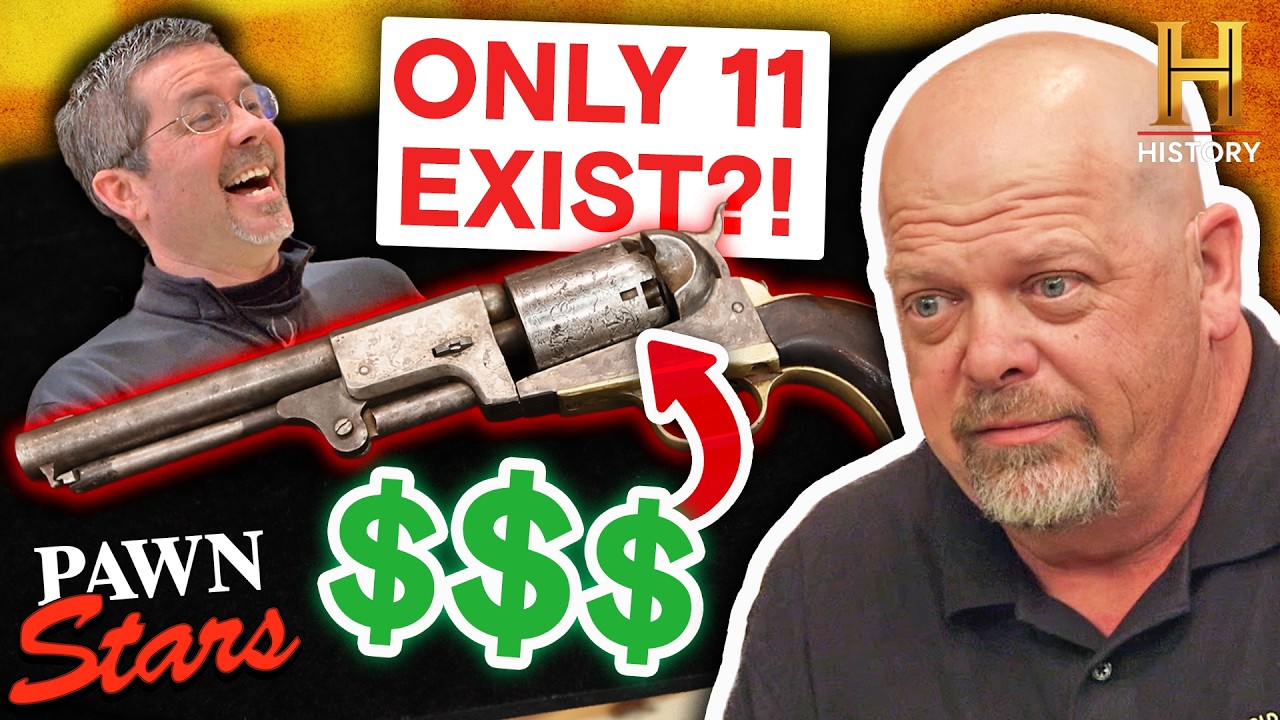
[laughing] [Alex] These are so rare.
Saying it’s like the Mona Lisa is not an understatement.
I’ve never seen one outside a museum.
So I’ve never actually touched one.
-Can I touch it? -Absolutely.
[sighs] Oh, wow.
There’s 11 known to exist.
Four have this etching, this design.
The last one came to market that was etched, and it was almost $80,000.
Okay.
The serial numbers of the etched ones were in the hundreds and 200 range.
This is in the range of the known etched guns, which is really good.
The problem is…
From the ones that I know that exist, and the ones I’ve been able to research, the serial number font does not match this.
It doesn’t mean that the gun is fake.
It does mean that the serial numbers are.
-Thanks, man. -Yeah.
-Thank you very much, sir. -Thank you very much.
-Very knowledgeable. -[Alex] It could be legitimate. But the serial numbers have been tampered with. And once that happens, you’re not gonna spend $80,000.
Most collectors won’t spend anything because they’re too afraid to lose their investment.
I love stuff like this. I love crazy, weird history.
But we’re 99% sure someone’s tampered with that serial number.
It’s gonna be too difficult for me to sell. I mean…
When someone walks in my shop, I give a guarantee on every single thing I sell, and I can’t do it on this.
Good luck, dude. That’s all I can tell you.
[Corey] What do we got here? Uh, got this sword I wanna sell you.
-All right. -And there’s a mark on it that might be Tiffany’s.
[Corey] Tiffany’s, okay.
It’s not in as good of shape as it was new.
[Corey] I guarantee Tiffany never put anything this ugly out, no.
[both laugh] [John] When I first saw the sword, I thought it was so cool and I was quite surprised when somebody pointed me out the maker’s mark on it. Fingers crossed that it’ll bring in a lot of money. And, uh, that it is actually a Tiffany sword.
[Corey] All right, um… Where’d you get it?
[John] I got it in Walla Walla, Washington in a little antique shop.
I’m a commercial photographer, so I used it as a prop and forgot about it for 10 years.
Okay. It looks like a cavalry sword used during the Civil War.
You can always tell by the handle and the shape.
It’s got all the normal wear you would expect on it.
You have no amateur restorations here.
But, I mean, it’s got a good, you know, patina to it.
It looks nice.
It’s just the Tiffany thing is really, really throwing me off.
I mean, I’ve seen…
hundreds, if not thousands, of Civil War-era cavalry swords and none of them said Tiffany on it.
[John] I didn’t know they were a sword-maker.
Uh… Yeah, I mean, they’ll make pretty much anything, but if they did, they were generally presentation pieces.
Made of silver. Very, very ornate.
Very beautiful swords that you would never wanna take into battle.
They’re probably one of the most counterfeited jewelry companies in the world.
Um… That’s because most of their stuff is so nice.
Hell, even the Super Bowl trophy is made by Tiffany.
It’s not out of the question that a jewelry company would be asked to help aid in war efforts. So if this sword is made by Tiffany, it’s gotta be worth a pretty penny. I’m just not sure how many.
What are you looking to get out of it, my man?
A $500 check, that’s what I’d like.
[Corey] Um…
That doesn’t seem out of the ballpark if it’s made by Tiffany.
I just don’t know.
I’ve never seen one like it.
Tell you what, man, I got a sword guy that works for me.
Let me see what he knows about this stuff -and I’ll grab him for you. -All right.
Why don’t you, uh, hang out and take a look around.
-He should be here in a few. -Okay, fantastic.
It’s a cavalry sword.
Looks like Civil War era, but…
Never seen Tiffany make one.
-Tiffany? -Yeah.
For the fancy army.
Nothing but the best.
This is a Model 1840 heavy cavalry sword.
What’s called the “Wristbreaker.” Why’s it called a Wristbreaker?
The predecessor swords would bend and flex and the soldiers said they were good for cutting nothing but butter.
[laughs] So when they designed the Model 1840, they put a lot of extra steel on the back side.
It made the sword a lot heavier.
[Corey] And you’re using that to just lop heads off -or whatever you’re doing? -Lop heads, slash.
Poke sometimes, but as you’re hacking and slashing through with all your arm’s momentum and the horse’s momentum, sometimes it’d snap your wrist.
Giving it the nickname “The Old Wristbreaker.” Sounds like a design flaw.
Uh… It was loved and hated.
But a lot of people don’t realize that Tiffany did make swords for the Civil War.
The presentation sword, which you would expect from Tiffany, that were all real pretty, and you really didn’t wanna wear them into battle.
But they wanted officers to have really good functioning swords too.
So they outsourced the blades from a really high-end German company.
It’s, uh, PDL, right here. It’s Paul D Luenenschloss.
[Corey] Okay.
[Rocco] And they made functional swords for the officers.
I can tell you right now, stamping “Tiffany & Co.” on something isn’t that hard to do.
So, question is, is it definitely Tiffany?
-Absolutely. -Well, the Tiffany mark’s almost gone on this side.
Anything Tiffany is usually reproduced and faked out there.
So when you go over a piece of Tiffany, you have to do a lot of detailed inspection to make sure that it is Tiffany and not a reproduction.
You know, Tiffany’s a little more sought-after than your standard…
-Absolutely. -…US swords.
One of the things Tiffany did, instead of using a brass guard, they would use an iron guard.
And… Yep, that’s definitely iron and not brass.
And then the PDL mark…
They did have a die that was broken and a lot of them do look like a lower-case “R” instead of a big “P.” [Corey] So is it real, man?
-Yeah, it’s real. -Yes.
All right. That’s why I hired you. [laughs] If someone sells it in the shop, it’s gonna be you.
What do you think you can get out of it?
[sighs] This one, you know…
it does have some issues here with, uh, the leather strap missing.
It’s actually coming off in my hands.
[John laughs] And that would make it a little more valuable, but…
-$1500. -Excellent. Very good.
All right, man. Well, get back to work.
-Yes, sir. -Thanks, man.
[Rocco] The Wristbreaker swords, something every Civil War collector wants. But to have one made by Tiffany, that’s like the highlight of anyone’s collection, is to show off their Tiffany sword.
All right, so you said you wanted $500 for it.
[John] Yep.
But you brought the expert in. [laughs] Yeah, that doesn’t always work out that well for me, does it?
Now, you’ve just educated me.
Let’s go eight.
You know, man, I really don’t have to have it. It’s…
You don’t have one.
It’s a Tiffany’s.
[Corey sighs] You know, I am gonna have to get it re-wrapped.
It’s gonna have to be cleaned up a little bit.
I’ll do $650.
$675, you got a deal.
-All right. $675, man. Cool. -You got it.
Why don’t you go ahead and find Rocco back there, -he’ll write you up. -Great. Thank you.
Uh, $675. Now I have some money to go spend on something for the girlfriend at Tiffany’s. [chuckles] Well, I’ve got something for you here.
Two Civil War diaries from my great-great-grandfather.
-Okay. -He was in every major battle of the Civil War. He was at Gettysburg, he was at Chancellorsville.
He was at Sherman’s March to the Sea, burned Atlanta.
Uh, Hiram Otis Warren was his name.
He was a captain in the Union Army, 123rd New York Infantry.
[Rick] So were you ever in the military?
-Nope. -Me neither.
They wouldn’t take me. [laughs] [Tom] I came to the pawn shop today to sell my great-great-grandfather’s diaries from the Civil War. I’m not really that sentimental. I’d rather have the money at this point. I’m trying to get $20,000. The least amount I could take would be $3,000.
-Um, so these are from… -1864 and 1865.
-Have you ever read them? -Uh, I’ve tried to.
They’re really hard to read ’cause it’s all in script.
[Rick] You really have to be used to reading writing from this time period because it’s not really like we write today.
He mentioned being in Marietta in 1865 when he mentions Lincoln dying.
[Rick] I mean, this is the one thing you’d carry around because you really had to figure out ways to entertain yourself.
You could read a book, write a little bit.
Maybe there was a little campfire with someone playing the fiddle.
But that was, uh, about it.
US military now spends millions of dollars a year to entertain the troops.
It’s considered essential to keep up morale. Back during the Civil War, the soldiers basically had to entertain themselves. I bet a diary was a good distraction.
This one’s neat. It’s got just a little, teeny bit of an almanac on the front of it.
We got the moon phases for November, December.
We have rates of postage.
A table of stamp duties.
Back then, they had a stamp tax on a lot of different items.
To prove the tax was paid, you had to buy a stamp from the government and affix it to whatever was taxed.
I mean, this one’s in great shape right here.
I mean, considering how old it is.
-This one, eh… -Seen better days.
[Rick] Civil War stuff is super collectible. People actually started souvenir collecting during the war itself. And there’s been a high demand for Civil War collectibles ever since. If this diary is tied to someone important, it could be really valuable.
-What’d you wanna do with them? -Um, I wanna sell them.
Because they’ve been handed down to the male, you know, since this guy and I’m the last one. I’m an only child.
I don’t have kids. I could use the money for better things like getting my car fixed.
Mind if I have someone come take a look?
No, sure. I’d like to find out more about them myself.
Let me see if my one buddy knows about this captain.
If he finds something extraordinary about him, if there is, I can make an offer.
But they are one-of-a-kind.
Well, yeah, if I wrote a diary, it’d be one-of-a-kind.
You wrote a diary, it’d be one-of-a-kind.
Doesn’t necessarily mean it’s worth money.
Okay?
I’ll be right back.
-Let me go make that phone call. -Okay.
[Tom] I’ve looked at the diaries a bit to see what was in there, but I really don’t know the historical significance, and I’m hoping to find that out today, too.
-Mark, how’s it going? -Doing all right.
So what you got?
I have two diaries -from the Civil War. -Okay.
What was your great-great-grandfather’s name?
-Hiram Otis Warren. -Um…
I just wanna know if there’s anything special about him or maybe anything cool about the diaries?
The guys normally call me down here when they have something unusual or some historical artifact that they’d just like a little bit more information on.
Do you know what unit he was with?
[Tom] The 123rd New York Infantry.
[Mark] That’s an interesting unit.
They were at Chancellorsville, they were at, uh, Gettysburg.
You know, they were at Appomattox.
They didn’t lose very many men over the course of their enlistment.
Do you mind if I take a closer look at them?
No, help yourself.
I always enjoy looking at Civil War items, especially when somebody has a diary from that period. I have to take a look at it to see whether there’s anything spectacular in the diary. “I have a rubber coat.” [chuckles] Yeah, this is… It’s interesting, ’cause some of the comments in here are just sort of day-to-day life kinds of comments.
When you think of the Civil War, we tend to think of the battles.
Yet most of the time that you spent was downtime.
And so a lot of guys carried diaries.
[Rick] So is there anything that makes him extraordinary?
No.
You know, it’s wonderful.
It’s a diary from that time period.
[Rick] So this captain is nobody special?
I didn’t find anything that he stood out, you know.
He didn’t save Grant’s life or something like that.
Thanks, Mark. I really appreciate it.
[Mark] Not a problem. Thank you.
Even though they are from the Civil War, they’re not necessarily that rare. There were a lot of these diaries kept by different men.
[Rick] How much were you looking to get out of them?
You know, they’re historical documents.
I was thinking $20,000?
Oh, no, no, no.
For something to be worth, like, $20,000, we’re talking the sidearms off a major general.
-Uh… -Okay.
I’m thinking I would probably get $200 or $300 apiece out of them.
I’m thinking like 100 bucks apiece.
Well, that’s not nearly enough.
Um… I mean, unless it is a major historical figure, something like that, a buyer is not gonna be there for $20,000, ever.
Like $3,000. That’s what I would need to part with them.
-Um, it’s just not there. -Right.
I mean, I would literally go like 100 bucks apiece.
Yeah, if it were just a couple hundred bucks, I’d rather give them to a museum, than…
A lot of museums would really appreciate them, too.
I think that’s what I’ll probably do, then.
-Okay. Thanks for coming in. -All right, thanks.
The diaries are almost 150 years old.
I thought his offer was really, really low. It wasn’t for me.
I got an atlas from the Civil War period -I’d like for you to look at. -You do?
Wow.
Go grab me my book pillow.
Uh…
-This thing? -Yes, that thing.
-What’s it for? -It’s for looking at books.
Well…
[Gregory] I come down to the pawn shop today to try to sell my Civil War period atlas. Bought it from a guy that sets up at the flea market. I think it’s worth $1,000.
If I can’t get $1,000 out of it, I’ll take it back home, put it up, and keep it.
[Rick] Do you know much about this?
No, I know it’s from… It’s marked in the front, 1862.
[Rick] All right.
And Nevada didn’t become a state until 1864 -on Halloween. -[wolf howls] -Really? -Sort of appropriate for Nevada.
It’d be interesting to see what the map looks like of the state.
Um…
[Chumlee] It’s flat on the bottom.
[Rick] Well remember, at this point in history, we were still a territory, we weren’t a state.
Las Vegas would be right around in here.
And there we are, Vegas.
It doesn’t say “Las Vegas,” it says “Vegas.” The reason people would stop in Vegas on the trails going to California, there was a stream here that ran year-long.
Come and water your horses, water up and everything like that.
It wasn’t until 1905 when they built a railroad station that people started moving here.
But the population really boomed in the 1930s with Hoover Dam and the legalization of gambling. So when this map was made, Vegas was pretty much a one-horse town.
Is this just the United States?
No, it’s the world.
Okay. We have…
Prussia, Norway, Sweden.
These were taken off engraved plates.
The colorizing and everything like that, I imagine this was expensive back in the day.
What it’s worth today, I don’t know.
Atlases can be worth a lot of money.
There was one from the 15th century that sold for over four million dollars.
-And how much you want for it? -I’d like $1,000 for it.
Okay.
I mean, the way I look at it, this could be $10,000, this could be nothing.
[Chumlee] That’s a big difference.
[Rick] The cool thing is, we have these engravings.
This is really high-quality paper.
I see a degree of quality you just don’t normally see.
Do you mind if I have someone take a look at it?
-Not at all. Thanks. -Be right back.
I’m looking forward to having somebody come in and check it out, ’cause I actually do not have a clue what it’s worth myself.
-Hey, how’s it going? -Hi, Rick. Nice to see you.
-Chum. -Hey.
How you doing?
All right, let me take a look.
See, I’m using the book cradle?
I’m so proud of you, taking care of books for me.
Johnson’s New Illustrated Steel Plate Family Atlas. Compiled, drawn, engraved under the supervision of Colton.
Colton was the huge name for atlases in the Civil War period.
Something that’s created by Colton can be worth thousands of dollars.
We’re talking even $15,000 or more.
But the thing is, it can only be worth, you know, a little bit or nothing at all.
It depends on the details that we find within the atlas.
This atlas was published during the Civil War.
What I’m looking for is any sort of illustration that shows that the Civil War was happening, because that’s what a collector is going to want.
We’ve got the United States all pink.
And note that there’s no division between the Confederate states and the Union.
These publishers were based in New York, so they were definitely pro-Union and they weren’t interested in acknowledging the fact that the Confederate states existed. This is what I love, look.
“Arrizona” with two “R”s.
-All right? -[laughter] So, in the 1860s, this area right here was the New Mexico territory, and that was part of the Union.
There was a battle during the Civil War that happened all the way out here in the West, called the First Battle of Mesilla.
And the Confederate forces won and they took over this entire swath right here and renamed it the Confederate Territory of Arizona.
[Rick] Okay.
[Rebecca] So we actually do have evidence of the war happening here.
And the cool thing about this in particular, is this Confederate territory lasted less than a year.
You’re not going to see it in many atlases at all because it existed for nine months, maybe.
Um, so we actually have weird Confederate territory right here.
[Rebecca] Exactly.
Another thing that I’m noticing as I look at this…
These aren’t engravings.
One of the key things you always see with an engraved plate is a plate mark, a line that kind of borders everything.
Because when you’re creating an engraving, you have to press really, really hard to get the paper to soak up the ink, because the ink is actually in those divots that you’ve made.
-Right? -Yes.
And here, there’s no evidence of any plate marks.
It is beautiful, smooth lithograph.
It says still “engraved” on the title page.
You can’t trust a title page.
So that’s going to affect the value pretty dramatically.
Okay.
[Rick] All right, so, do you think it’s worth anything?
I place the value for this book at around $2,000, $2,500.
Wow.
It’s no Colton, but we’ll take it.
Thanks, Rebecca. I really appreciate it.
[Rebecca] No problem. Chum.
-All right, see you next time. -Good to see you.
Take care.
[Rick] When Rebecca started pointing out those short-lived Confederate territories, I thought we were gonna be close to that $15,000 mark. This thing is still pretty cool.
I think there’s something we can do with it.
All right, so, um…
what’s your best price?
I’d still like to get $1,000 out of it.
-Deal. -Thanks.
-Appreciate it. -Write him up, Chum.
-I’ll meet you at the counter. -All right.
I was excited when she told me the price. I got 1,000 bucks, I feel great, and I think I’m gonna go buy something else and add to my collection.
-[Corey] Hey, how you doing? -Good, how are you?
I have some Civil War Navy buttons that I wanna sell.
[Corey] Cool.
Did you tear apart a jacket or something?
[laughs] [Lauren] It’s a good possibility somebody in the Civil War, they were actually fighting in a battle and had those buttons on their uniform. I never had any piece of American history before, so it was kinda neat coming across that. Not something you find every day. I’m hoping to get $1300 for them. I really don’t have any use for them, um, and I could definitely use the money more than the buttons.
[Corey] So, you got any of the backstory on them, or…
Um, I found them in a house that I purchased and I found out that the previous owner’s grandfather was enlisted in the Navy during the Civil War.
-Okay. He was Union, right? -Yes, he was.
[Corey] The Navy was kinda like the unsung heroes of the Civil War.
The North just brought the ships down, blockaded all the ports, it crippled the South.
I mean, they couldn’t buy anything.
They couldn’t get bullets for their guns.
Everything was rationed.
[Lauren] I had no idea.
During the Civil War, the South had to get a lot of their supplies from Europe, because they didn’t have anywhere near the manufacturing that the North had. So a major part of the North’s strategy was to block southern ports, so they couldn’t get their shipments. Kinda hard to fight a war without guns and ammo.
It’s got the eagle, it’s holding the anchor.
Obviously it’s Navy.
So what exactly are you looking for?
I wanna make sure they don’t say -“Made in China” or something. -[chuckles] But they’re made by different people, so that kinda makes me wonder if they’re all from the same period.
Do you have any idea of what you might wanna get out of them?
I’m hoping $1300.
$1300.
Kind of in a predicament here. I know in the Navy, they kept some of their uniforms for almost 100 years.
-[Lauren] Oh, wow -So you might have something really cool here that could be worth a bunch of money, or…
nothing at all.
Well, hopefully it’s worth a bunch of money.
I need to get somebody down here and kinda tell me exactly what these buttons are and how long they’ve been around.
[Lauren] So who are you gonna call in to look at these buttons?
He’s the administrator of the Clark County Museum system.
Probably the smartest guy in the world.
All right, sounds good.
-I’ll be right back. -Okay, sounds good.
[Mark] Oh, interesting.
So the Navy played a big role in the Civil War, right?
Oh, yeah. If we hadn’t had the Union Navy, we wouldn’t have been able to blockade all the ports in the South.
That made a huge difference.
It intercepted a lot of the firearms that the South was trying to bring in.
So it was an effective force.
Most people, when they think of military in the Civil War, they think about the Army.
They tend to forget the Navy, and yet, the Union Navy had a huge part in helping to defeat the South by blockading the ports, by coming up the Mississippi River and attacking from the river. [Corey] Is there any way to actually tell for sure they’re Civil War? I mean, they do look like they’re made by different people.
[Mark] Yep. And that would make sense.
From 1850 to 1941, we didn’t change the design on these buttons.
Every time they needed another batch of them, different button companies would bid on them.
So what we have to look at in order to tell whether they’re Civil War is who made them and how they marked them.
Well, that’s nice.
That one was actually made in London.
Now, that’s a different one.
Interesting.
And some of these are not easy.
Of what I’m seeing of the back stamps, given who did them, you know, Scovill, and Horstmann and Sons, and some of these companies, these are all major manufacturers.
I think these are Civil War buttons.
-Wow. -They date right, they’re either 1850s or early 1860s.
They’re not real common.
And the nice thing about this group is that there are a number of different manufacturers.
And button collectors tend to want a button from everybody who put out that button.
-So, it’s a nice find. -That’s good to know.
Gave me everything I needed, buddy.
[Mark] It was interesting to see these buttons. You know these came off a uniform.
Somebody wore these during the battles.
They’re a tangible tie to that time period.
[Corey] You told me earlier $1300.
I’m sure there’s probably, like, a grading system for these.
Pristine ones like this one, I would say, -is in really good shape. -Mm-hmm.
Compared to this one, not so much.
That being said…
I’ll start off around 200 bucks.
I’ve seen these types of buttons sell for thousands.
And I’ve seen buttons sell for pennies.
It’s really a crap shoot depending on the buyer. So I gotta be cautious with my offer. How about $1,000?
Some had different values online than other ones.
[Corey] I think I can make some decent money off them.
It’s just, it’s gonna take me a long time to do it.
I’ll go up to $400. I’m not paying any more, though.
I’m really not.
$600 and you have a deal.
I’ll pay you five, that’s it.
-All right, you got a deal. -Deal? All right, cool.
-Pack these up and meet me? -All right.
I actually was expecting to be offered a lot less, so the $500 is definitely a good payoff.
It was worth a little bit of digging. -How’s it going? -What can I help you with?
Uh, yeah, I got a Civil War dog tag.
Okay, so it’s an identification tag for a soldier.
So the War of 1861, that’s the Civil War.
Generally, the wars get named afterwards.
This was just starting off and it didn’t have a name yet.
[laughs] [Joe] I collect and I sell Civil War memorabilia and I came across an 1861 Civil War dog tag. I checked some recent prices of these and I’m asking $1100 for the dog tag. [Rick] This is pretty cool. Where’d you get this thing?
Small antique show in New Hampshire.
Strangely, it’s marked “War of 1861.” Okay.
You know, the Civil War soldiers, sometimes they would camp out for months in just one location.
There was traveling salesmen all following these camps selling everything from guns to pots and pans and that’s how they made their money during the war.
-This is one of those things. -Yeah.
Originally, ID tags weren’t issued by the government.
But soldiers could purchase them on their own.
It was a really early version of a dog tag.
This could have been sold any time during the war.
[Joe] Probably during 1861, I would assume.
‘Cause I’ve seen some that said 1861, 2 and 3, which was interesting.
And, um, the mystery of it, was it uncirculated, not issued?
Or did a soldier buy it and, you know, never got it stamped?
Yeah, I’m assuming it wasn’t stamped, it might have been surplus or something like that.
There’s no name on it or anything like that.
-Mm-hmm. -How much you want for it?
I’m asking $1100.
Do you mind if I have someone look at it?
I just wanna make sure it’s real.
Just about everything from the Civil War has been remanufactured and, literally, they make a copy of everything.
So, that I wanna get checked out.
I also wanna see if there’s anything special about it.
[Joe] I’m glad an expert is gonna check out the item because I wanna make sure it is real.
Civil War dog tag, or whatever they called it back then.
Do you mind if I take a closer look?
By all means.
[Mark] Oh, okay. Nice.
The War of 1861, that’s the Civil War.
Of course, at that time, we didn’t have any ID for the troops on either side.
And if you died on the battlefield, your body might be found and we might not know who you were.
So something like this, even though it was privately issued, the idea was, maybe somebody would know who you were when your body was found.
[Rick] Okay.
[Mark] You bought these from sutlers.
The sutlers were basically the private storekeepers.
They would set up shop on the edge of wherever the troops were camped.
If you wanted one of these, you could buy it from a sutler, he would then stamp your name in it, and you could put it on your clothes, you could sew it into your clothes.
You could wear it on a strap around your neck if you wanted to.
The idea was to have it somewhere where it wouldn’t get lost.
[Rick] Okay.
So, Rick, what are your concerns on it?
Okay, is it real?
‘Cause I know they reproduce everything -for Civil War reenactments. -They do, yeah.
But this one…
This is a Civil War-era piece.
Okay. Is it one of the common ones or one of the rare ones?
[Mark] This is one of the well-known designs, so, yes, there are a number of these out there.
Normally, they are named on the back, but not all of them.
There were a number of these that weren’t actually sold.
And they just ended up being surplus.
But this one, yes, this is a Civil War-era piece.
The ones that people really like are the ones that are named.
Okay. Thanks, man.
-Appreciate it. -Not a problem.
-Good to meet you. -Good to meet you, thank you.
Okay, so you want 1100 bucks for it.
-Yeah. -Okay.
I can’t come near to that.
If it has a name on it, you’re getting close to that number.
-Mm-hmm. -But it doesn’t, okay?
It’s one of the common ones.
I’d literally give you, -like, 100 bucks for it. -Wow.
Yeah, I can’t do that. But, um…
I do appreciate you looking at it.
All right. Well, thanks, man.
-Change your mind, come back. -All right.
Unfortunately, we weren’t able to make a deal today. I thought 100 bucks was way too low.
I mean, I look at a lot of stuff at a lot of antique shows and I’ve never seen this item.
BOB: Hello. RICK: Hey, you’re back.
I’m back.
Let me guess, you have a gun you want to sell?
BOB: You’re right.
[laughs] Rob’s a gun guy.
He comes in the shop a lot.
And he always has some sort of interesting firearm to sell.
All right, what have we got this time?
What I’ve got is a Savage Navy, a .36 caliber.
OK.
Savage Navy.
That is one ugly gun.
No, that’s not a ugly gun, Rick.
That’s a Navy gun.
And it’s pretty to me.
That’s just because it has something to do with the damn Navy.
That’ll work.
[laughs] [ship horn] BOB: I came to the pawn shop today to try to sell my Savage Navy revolver from the Civil War.
It’s extremely unusual design.
I keep coming back here because hey, they keep buying my guns.
What am I to do?
RICK: Yeah, this is really cool.
I’ve never actually seen one of these things in person.
I’ve never even had one in the store.
They started making these in, like, 1862– 1861, somewhere around there?
Yeah, they were making them right at the height of the war.
RICK: As long as they could make it different, they could make it and sell it, and the government would buy it because the government would buy any gun at this point.
Well, like any entrepreneur, if there’s money to be made, they found a way to make it. RICK: Yeah.
And that’s the gun that resulted.
RICK: So basically, cock it with your middle finger, and then fire it with your index finger.
BOB: The thought was that was a good mechanism because you could fire ’em a little quicker.
I really don’t see the advantage.
More of a pain in the ass than it’s worth.
I mean, it’s heavy.
It’s awkward feeling.
It just wants to tilt down.
One of the goofiest designs.
BOB: That’s why I love it.
These two fools don’t know what they’re talking about.
Anything to do with the US Navy is high class.
RICK: So I’m assuming you want to sell this, like the rest of them? – That’s what I’m looking to do.
That’s right.
[sighs] I don’t know how important this screw is right here.
There’s just too much– too many questions I have about this thing.
Let me call someone in, let them look at it and get an idea what I can pay for it, OK?
That’s all right. You bet.
All right, I’ll be right back.
You bet.
I can understand him bringing in an expert.
He doesn’t know how much I know and how much of mine is just smoke, so he needs to bring someone in to make sure he knows what he’s getting.
[cash register chime] RICK: Craig, how’s it going, man?
Greetings, pawn shop brokers. How are you today?
Yeah, the guys call me down when they get an antique firearm that they want to know more about.
They want me to evaluate its condition, a value estimation, that sort of thing.
This is what I would call a proto double-action.
It’s one of the first double-action revolvers.
And the concept was that you could shoot a lot more quickly.
In reality, not so much.
The gun was very complex.
So there was plenty of room for mechanical error and failure.
Not very popular.
They sold about 11,000 out of the 20,000 made to the government.
The rest went to the civilian market.
Why?
Because the gun sucked.
[laughs] CRAIG: So this is civilian.
It’s definitely not a government-issued weapon.
The interesting follow-on, though, is that the civilians often transported them south, and they became used by the Confederacy as well.
And for that reason, it’s a neat collectible.
The Savage Navy is an interesting firearm because it’s a technology that while it led to the double-action revolver, the idea did not work very well.
RICK: It looks all there.
I mean, there isn’t any major damage to it besides the finish, more or less, being gone.
There’s a screw missing on the bottom.
Yeah, you’re right.
I know what your next question is.
RICK: Yeah, how much is it worth?
Yeah.
You know, the good news is, it’s not restored in any way, shape, or form.
You know, usually, when you get a gun that’s in this type of condition, someone will have made an attempt to restore it.
You know, it’s gonna be a civilian model.
And that’s gonna be the primary driving force behind its price.
Of course, condition being the other driving force.
RICK: OK.
So I would say, in its condition as it sits, the gun’s probably worth retail $1,800 to $2,000.
RICK: OK. Thanks, man.
CRAIG: Thank you.
Take care.
A bad idea means they don’t make very many, and that’s one of the ingredients for something being very collectible.
If you’ve got a Civil War collection, you have to have one of these guns.
$800, Rick.
No, no, that’s not gonna happen.
No, I’m thinking more like $1,250, though.
I really am.
What– you know, I was hoping to get about $1,800 for the gun, OK?
I think that’s fair.
Yeah, well, that’s what we gonna get out of it.
I think you’ll do a little better.
They’re really hard to find.
I know they’re are hard gun to find, but they sit around a long time.
It’s a weird gun, so– $1,650.
I’ll go 1,300 bucks.
$1,575.
RICK: I’ll go 1,300 bucks.
$1,550.
1,300 bucks.
I mean– BOB: I can’t do $1,300.
– Sure, you can. – No, I can’t.
14 and 1/2.
That’s really the best I can do.
I’ll go $1,350.
$1,400 and I’ll do that.
And we’ll shake hands, and I’ll walk away.
And you know I’m gonna come back with some more cool stuff.
Yeah, I’ll do $1,400. BOB: All right.
– I’ll do $1,400. – Touchdown.
RICK: OK. BOB: Thanks.
OLD MAN: You got to us again.
Now that I got $1,400, I’m just gonna find another gun and do it all over again.
[cash register chime] RICK: What is this box?
Well, this is a Civil War sword that commemorates the Trent Affair.
The Trent Affair?
Yes.
It was sent by Confederate President Jefferson Davis, James M. Mason, and John Slidell were taken prisoner off the British ship, “The Trent.” This is not used in battle, this kind of sword right here, OK?
And neither were either of the two envoys.
– No, no, they were politicians. – Correct.
Politicians never fight.
[laughter] JEFF: John Slidell had the sword commissioned and gave it to James Mason.
They were the two Confederate envoys that were arrested by the Union.
I’m asking 15,000.
And if we can meet somewhere around 12 to 13, I may sell it.
RICK: God, this is pretty amazing.
JEFF: To James Mason– RICK: Lest we forget.
JEFF: –lest we forget “The Trent.” The American Civil War was gonna hit England a lot harder than you might think because they were not gonna be able to get cotton.
So they were sort of on the South’s side.
And James Mason and John Slidell got passage on an English ship, “The Trent,” to go to Europe and get money, get arms, and put up cotton as collateral.
You know, the North considered Slidell and Mason traitors.
So you know, basically, an American frigate pulled up next to them and says, we’re boarding your ship, and we’re taking the guys.
And that’s when the [bleep]-storm-storm happened.
If an American ship boards an English ship in international waters, it’s the same thing as invading their country.
The Trent Affair might not be as well-known as major Civil War battles.
But historically, we were this close to getting in a war with England while we were fighting against our own brothers here at home.
Thankfully, cool heads prevailed because it could have been an absolute disaster.
I mean, it looks in great shape.
Your paperwork’s great.
The number you were looking for?
I’m asking $15,000 for it.
To me, it sounds high, OK, because, a nerd like me and obviously a nerd like you, know exactly what “The Trent” is.
99% of the people in this world do not.
And I’m thinking, like, five grand.
Oh.
Probably the least I could take for it would be $12,000.
RICK: I can’t do it.
It’s historically significant.
But it doesn’t have a general’s name on the side of it that fought at the Battle of Gettysburg or something like that.
I’ll tell you what, I’ll go six grand and not a penny more.
If you can meet me at nine, we’ve got a deal.
No, I can go six.
Well, I certainly appreciate your time.
I’ll just have to hang on to it.
All right.
Thank you very much.
If you change your mind, come on back.
Thank you.
When he offered me $5,000, I was tempted to pull the sword out and show him what it was really used for.
I’m just not prepared to sell it at that price.
[bleep] RICK: What can I help you with?
AMANDA: I have a watch here.
OK.
Apparently, it’s an old watch.
AMANDA: I hope so.
RICK: Where did you get it?
AMANDA: A garage sale.
A really cool watch.
Do you mind me asking what you paid for it?
$20.
[laughs] AMANDA: I came into the pawn shop today to try to sell my antique pocket watch.
I’d like to sell it because I don’t collect pocket watches.
If I get $500– if I get $800, I’ll be happy.
Anything works for me.
RICK: Do you know much about it?
I don’t know anything about it.
I just discovered it, and it looked cool, so– Well, I can tell you a little bit about it.
That’d be great.
RICK: It’s a William Ellery.
That’s an American watch company that later became Waltham Watch Company.
Abe Lincoln actually carried a Waltham watch.
Wow.
This is absolutely amazing back here.
“Earl Butler, hero.
Saved my life at Cross Keys, Robert M. Scott.” That’s– Something good?
–that is something good.
That’s– I’m assuming that’s the Civil War.
The watch is probably 1870s, 1880s.
Pretty easy to date them.
First off, it’s a key wind and a key set.
By the 1890s, they were almost all going to stem winds.
That would make it right around the right time period.
It has to be the Civil War.
You just increase the cool factor by, like, 10 times, OK, because this actually belonged to a Civil War veteran– AMANDA: OK.
RICK: –OK, that was given to that person by another Civil War veteran– OK.
–who saved his life at Cross Keys, which I’m assuming was a battle.
One of the greatest gifts you could give in the 19th century was a pocket watch.
Imagine someone gave this to a friend who saved his life during the Civil War.
I have never seen anything like it.
Do you know if it runs?
AMANDA: No.
It’s wanting to work.
It’s working.
AMANDA: That’s positive, right?
RICK: Yes, I mean, the great thing about this watch is, it’s in amazing shape.
It works great.
The case is in amazing condition.
We have a porcelain dial on it that doesn’t have one crack.
These things are notorious for cracking.
There’s a huge market for Civil War stuff.
And a pocket watch in this condition with engraving on the back could be worth a fortune.
Collectors would line up out the door to buy this thing.
I mean, this has got me really fascinated right here, though.
I’d really like to find out who these people are.
These could be important people from the battle.
AMANDA: OK.
I’d like to find out more about the battle.
I have a buddy who knows just about everything there is to know about the Civil War.
If there’s something special here, you might have a lot more money. AMANDA: OK.
– All right? – Great.
RICK: I’ll be right back. – Thanks.
Since he’s calling in the expert, that must mean something good.
I hope so, anyway. [cash register chime] MARK: How you doing? RICK: Mark, how’s it going?
Doing all right.
The guys normally call me down here when they’ve got an historical artifact.
RICK: I have this watch here.
And the engraving says that it’s from the Battle of Cross Keys.
The Battle of Cross Keys was an interesting one.
This was early on in the Civil War.
And this was Stonewall Jackson, one of the best known generals on the Southern side.
And Cross Keys was one of the battles with Union forces.
And the Confederates had about 5,800 men in this battle.
The Union side had over 11,000 men in this battle.
And the Union lost.
RICK: Were you able to find out anything about those names or anything like that?
Well, there are a number of Robert M. Scotts out there.
There are a number of Earl Butlers out there.
They don’t show up in the historic record individually that I could find.
I mean, the watch is really cool.
I mean, it seems like it’s from the right time period and everything like that.
Do you think it’s legit?
OK, do you mind if I take a closer look at it?
Please.
MARK: OK.
Oh, yeah.
The time period would be probably the late 1880s.
So the name on it and the serial number both fit.
That’s all good.
And if you were going to fake a piece like this, you would pick a battle that everybody’s heard of.
You know, it’d be, thanks for saving my life at Gettysburg or something.
Yeah.
And that the engraving is all hand done.
In looking at it, I think that this is– this appears to be correct to me.
I think it’s a very nice memorial from the Civil War.
You know, this is somebody in post-war years.
He said, I want to say thank you.
Hopefully, that helps. RICK: Thanks, man.
– Not a problem. – Thank you.
Thank you very much.
RICK: What do you want for it?
$2,000.
I mean, the two people on there are really not known, so 700 bucks.
AMANDA: But the battle’s known.
$1,800.
If it didn’t have that engraving on it, it is literally worth 400 or 500 bucks.
Let me give you $1,000 for it.
Come on, you’re gonna make a profit either way.
How about 15?
RICK: I just don’t know what I’m gonna get out of it.
I’ll go $1,300, not a dime more.
13 will work.
OK, $1,300. AMANDA: All right.
I’ll meet you right up front over there.
All right, thanks.
I bought it for $20, and I’m walking out with $1,300.
I’m ecstatic.
I couldn’t be happier.
– Hey, Rick. – Hey, Bob.
How’s it going? – Good.
How you doing? – What do you got this time?
Civil War cavalry saber.
RICK: Just like in many businesses, I got repeat customers.
And Bob has been selling me Civil War antiques for years.
Yeah, it looks like it still has blood on the end of it.
Isn’t that cool?
I’m here today at the pawn shop to try and sell my authentic Civil War cavalry saber.
I’m hoping to sell this thing today for anywhere $1,500, maybe $2,000.
God, it’s in incredible shape.
Almost too good.
I mean, if it was actually used in the Civil War, they would have put an edge on it.
And an edge has never been put on this.
It’s really odd that it’s not sharpened up.
Well, this is the real deal.
My biggest concern with any antique that looks too good to be true is generally, it is too good to be true.
How much were you looking to get out of it?
Well, I’ve done a little bit of research on it.
And in this kind of condition, they go for $1,500 to $2,000.
That’s retail.
So if you go open up a store, that’s what you can probably get out of it.
[laughs] Yeah.
It’s a pretty valuable sword, I believe.
Sometimes I feel like a broken record.
I can’t buy things for retail prices.
If I bought and sold everything for the same price, I’d be out of business.
I’m definitely interested, but I’d really like to have it checked out by somebody.
OK, yeah.
OK, I’ve got a buddy who deals in Civil War memorabilia.
Mm-hmm.
I’d like to have him come in and check it out.
Fine.
I know Rick’s suspect because the condition is so good.
And I would welcome a expert to come and check it out.
[cash register chime] What I love about my job is I get to hold pieces of history that maybe only museums would have.
You don’t know who held it before.
You know, maybe somebody famous, you know, held this and used this to defend themself.
These weapons are just cool.
Any provenance?
Any paperwork?
No, I got it from my granddad.
SEAN: OK, and so what concerns do you have, Rick?
I just want to make sure it was real.
I mean, it does look in pretty good shape for being this old.
You know, you just don’t find swords like this, you know, in this kind of condition.
So I can understand your– your caution.
I know it looks too good to be true, but there’s an expert in there.
And he’ll confirm it.
I feel pretty good.
I’m a little nervous about it but not a lot.
The majority of the reproductions and fakes are coming out of India.
If this were to be a reproduction, there is a couple of traits that you look for.
The blades have, you know, wavy, you know, pound marks, and they’re just horrible.
They don’t, you know, put the attention to detail, especially in the markings.
And there’s a couple of other little marks here that I want to see, and which here they are.
Here’s an H stamped.
So that’s a great sign.
RICK: What’s the H stand for?
It’s a military inspector.
And here also, you see the US stamp for– that it was definitely military issue.
What about not having an edge on the sword?
This is exactly how they were issued, with a blunt edge.
It was really more of a personal preference, if you wanted to have a sharpened edge, because on a horse, these swords were held off to the side.
And if at a full gallop charge, you can imagine just clipping people.
Yeah.
It would really inflict some damage.
Just from the little contact marks that I can see on the edge that this was actually used.
The markings are absolutely genuine.
They’re exactly what you want to see.
So this was definitely a sword that was used in the Civil War.
Sean sure knows a lot about this sword.
I’m really happy that Rick brought him in.
So Sean, what do you think this is worth?
In an auction setting, I would say anywhere from $2,000 to $4,000.
Great. SEAN: Yeah.
All right, Sean. Thanks for coming in.
Absolutely, Rick. Any time.
Am I happy this sword is real?
Yes.
My only concern now is, how much is it gonna cost me?
You like it, don’t you?
I like it.
How about three grand?
How about no?
[laughs] We know it’s worth up to four grand at a good auction.
Well, that’s just it, you know?
And he said 2,000 to 4,000 in an auction, which means between $2,000 and $4,000, OK, which is a crapshoot of what you get. – I follow.
OK?
They’ll probably charge you a catalog fee.
They’ll charge you a 25% auction fee.
And the auction won’t be for, like, another six to eight months.
So in right around a year, you’ll get paid.
And if it sells for $2,000, after all of your fees and everything, you’ll get like $1,300.
Well, then why don’t we call it $1,500, and everybody’s happy?
I’d give you, like, a grand for it.
And I think it’s a fair price.
All right, let’s do the deal.
OK, nice.
Good.
I’m actually pretty happy.
I’ve got $1,000 in my pocket instead of an old sword in the closet at home.
Let’s go do the paperwork.
OK.
I’m pretty happy right now.
I got the sword I wanted and at the price I wanted.
And that just doesn’t happen every day.
CHUM: Oh, not you again.
This lady always brings in some gnarly stuff.
Last time, she sold an old tooth extractor that gave Corey nightmares for weeks.
What is that?
This is a Civil War-era syringe used to treat the soldiers’ syphilis and gonorrhea.
RICK: Is that a urethra syringe?
DAHLIA: Yes, it was a syringe that went into the urethra.
Gross.
[laughter] DAHLIA: I love to come to the pawn shop because I love to get their input on my items.
I would like to sell this because I’m kind of tired of looking at it.
I’ve seen so much gonorrhea, and chlamydia, and STDs in my medical career that I don’t think I need to come home and see the syringe anymore.
RICK: So where did you get this thing?
DAHLIA: I received this from a collector.
During the Civil War, STDs were rampant.
And these were used commonly.
Yeah, as much as, like, 30% of the troops got bit by the lovebug.
Prostitutes would set up their camp right next to the military camp.
It was really bad.
And doctors were trying to come up with various cures, I know that.
They would put, like, boric acid in that thing.
Mm-hmm.
The caustic nature of it was supposed to hopefully kill everything in its path.
RICK: Yeah, I cannot imagine having to go through that.
So can I look at it? – Sure.
I wouldn’t touch that end, though.
RICK: I’m not gonna touch the business end, no.
DAHLIA: [laughs] RICK: I mean, it looks like it’s from the Civil War.
You can tell it’s factory made, but it’s still that really crude, early rubber technology.
And it would do the job, basically.
I mean, you just insert it and push.
CHUM: Is that the cover, or is that the actual needle?
Well, it wasn’t a needle because this wasn’t injected.
This went into the tip of your thing.
Oh.
[laughter] During the Civil War, the treatments for venereal disease were downright medieval compared to what they do today.
But hey, they had to try something.
An army is not effective when all the men are sick.
How much you want for it?
I probably would like to sell it for about $300.
RICK: All right.
I mean, think about where this has been.
Yeah.
[laughter] I know there’s people who collect them.
It’s creepy.
[laughter] You know, it’s a tough sell.
It’s a weird sell.
You know, how about 160 bucks?
You know– you know, I agree with you, it is creepy.
And I want it out of my house.
I think $160 is fine.
OK, we’ve got a deal. DAHLIA: OK.
All right, you want to write her up, Chum?
Yeah.
Grab that thing and let’s meet over there.
I’m glad that we sold the item for $160– that’s cool– because I can’t wait to buy something that wasn’t put into someone’s urethra.
RICK: Hey, what can I help you with?
ALAN: Well, I got this uniform jacket in with some costumes.
We do some high school productions.
And we get donations in periodically.
And with that came this Civil War jacket.
I mean, if it’s real, it’ll be really cool.
I mean, it’s from Civil War.
ALAN: I’m coming down to the pawn shop today to have them look at a Civil War jacket that I have.
The reason I want to sell it today is that I’m hoping to get some money that we can put back into the wardrobe shop.
If I could get at least $500 out of it, if it is authentic, I think that would be a great find for us.
RICK: Well, it’s definitely cool.
So do you know anything about it?
Actually, I don’t.
It was just in a bag of clothes that we got in, so I have no idea where it came from or any of the history on it.
You know, quite frankly, it doesn’t shock me that someone would just throw this in a bag and donate it.
You wouldn’t believe the amount of stuff I buy off people that they just find in attics.
Sure, yeah.
Yeah, the Civil War was mud.
It was sweat.
It was horses.
It’s not nearly as romantic as they make it out in the movies.
You know, just rough, terrible existence, as far as I’m concerned.
Life was horrible for a soldier during the Civil War.
And their uniforms didn’t make things much better.
Just imagine what it would be like wearing this heavy wool jacket in the summer in the South.
Hundreds actually died of sunstroke.
It looks really old.
This looks like a Civil War cavalry jacket.
Yeah.
RICK: But I don’t know.
You know, my big concern about it is it just looks too good to be true.
There’s not one moth hole in it.
And I mean, there’s really no scuffs.
If this uniform is real, it could be worth some serious money.
But this thing is in amazing shape for its age.
I know there’s a lot of people who make these for reenactments, so I have to be careful.
What do you want to do with it?
ALAN: Well, if we can get money for it, I mean, that’s money to put toward the school for other things.
OK.
I really like it.
Civil War stuff is cool. ALAN: OK.
RICK: And it sells.
ALAN: Sure.
RICK: I’m gonna call my buddy.
And if there’s any guy in the world who will know about this, it’ll be Mark.
Well, great.
If it’s all real, we’ll figure something out, OK?
ALAN: That’ll be great. Appreciate it.
– Thanks. – Thank you.
I’m excited that they’re bringing in an expert today because if he can tell us that it’s the real deal, then it’s a win-win for everyone.
[cash register chime] Oh, I hate to tell you how many times I’ve seen things that have gone into costume collections that really shouldn’t have.
Rick, what are your concerns on it?
I mean, it just looks too good to be true.
And generally, when I see that, that’s generally the case.
MARK: Yeah, and you’re right to think that way.
Any time you have a Civil War uniform, anything like that, and it’s in perfect shape, yes, you do want to question it.
There are a lot of reproductions.
There are a lot of costumes that have been made.
In order to tell whether this is real, what I’m looking for is, you know, what kind of materials they are, how they’re put together.
These are inspector’s marks.
That means that it was inspected as it came into the military.
That’s what should have happened.
Now, that’s a little interesting.
You normally have loops here that the belt would have gone through.
That doesn’t necessarily mean that it’s not original to the time period.
The reality was, in the Civil War, we were outfitting a huge army from almost nothing.
So we were buying from anybody who could sew these things up.
And Civil War uniforms are somewhat notorious for having variances from what the ordinance said.
When you wore this, you wore it with metal shoulder boards.
And this doesn’t show any sign of ever having shoulder boards on it.
Even for the fact it doesn’t have the loops, doesn’t appear to have ever had shoulder boards, I think it’s real.
I think what you have is a Civil War model 1854 uniform jacket.
My guess is this was worn by somebody behind the lines because it is in wonderful shape or that it came out of surplus.
Thank you for bringing it in.
Thanks, Mark.
ALAN: Appreciate it.
I think this is a spectacular Civil War uniform.
You don’t see these anymore.
So yes, I think– I– I rather hope Rick can get this one.
OK, so what are you looking to get out of it?
Are we talking $1,000 or we– I really believe at an auction, I can get $1,500, $2,000 out of this thing.
Wow, that’s impressive.
RICK: But there’s a lot of fees with an auction.
Well, sure.
And I have to make a little bit for my time, effort, and risk.
$750?
Mm.
Go $850?
I’ll tell you what, I’ll go $850.
Great. RICK: OK?
ALAN: Thank you.
RICK: All right, let’s go do some paperwork.
All right.
I’m really excited to learn that this is real because it’s great for the school.
But it’s also– it’s gonna change my whole look at things when things come in.
I ended up settling today for $850.
So it was– it was a great day.
COREY: Hey, what’s up, man?
Hey, how’s it going?
What do we got?
I got a Confederate Civil War ribbon that I’d like to sell.
Stonewall Jackson.
Wasn’t he a long jumper?
I don’t know about that.
He might have jumped some bullets.
[gunfire] I came to the pawn shop today to try to sell my Civil War ribbon.
This ribbon has been passed down in the family.
It’s from my great great-grandfather.
I would like to get $500 for the ribbon.
But I’m open to any kind of negotiation.
So where’d you get this, man?
JASON: This has been in my family for a long time.
They gave this to my great great-grandfather for all his battles that he was in in the Civil War.
This was a letter that my great great-grandfather hand wrote.
One of my great aunts typed it exactly the way he wrote it.
CHUM: “I participated in all the battles from Chickamauga to the surrender.
Battles, 78 in all.
I returned home the 16th day of May, 1865.” That’s pretty cool.
Did he ever get wounded?
He got shot four times.
CHUM: Oh, that’s pretty gnarly, getting shot back in the day.
The fact that this guy fought in so many battles even after being shot four times?
It says a lot about him as a person.
But it also just shows how passionate people were about this war.
The ribbon says, “in memory of Stonewall Jackson camp number 91, Atlanta, Texas.” I mean, he was pretty much General Lee’s, like, “ace in the hole” guy.
A lot of people will tell you that if Stonewall Jackson didn’t get killed, the South probably would have won.
He was just such a great general.
And guys would follow him anywhere.
So what do you want to do with it?
This is just something that we would like to sell.
Any idea of what you want for it or– I’d like to get around $700.
To be honest with you, I don’t have no idea what it’s worth.
And I really don’t know how rare it is.
Do you mind if I give a friend of mine a call?
When it comes to historical items like this, he can kind of explain to me a little bit better what it is.
That sounds wonderful.
COREY: All right, I’ll go give him a call.
OK.
COREY: There’s definitely a healthy market for Confederate Civil War stuff.
But something actually related to Stonewall Jackson could be huge.
[cash register chime] MARK: “So I received orders to report to Richmond, Virginia.
Formed into brigade service with General Barts as commander.
Was killed in the Battle of Manas.” I’m guessing that’s the Battle of Manassas.
On the Union side, we called it Bull Run.
The interesting thing, when you look at battles in the Civil War, the Union named battles after either a creek, or a river, or a mountain that was close by.
The South named battles after the closest town.
JASON: Oh.
So that’s why you get differing names.
If you go through this, it does talk about a man who was in Confederate service, somebody that was maybe 18 or 20 when he enlisted.
The fact that he was wounded four times and survived, that’s pretty amazing because when you think about the kinds of weapons we were using during the Civil War, we were using very large, often .58 caliber soft lead slugs.
You had to be tough to survive being in the hospital in the Civil War.
So what are your concerns about it?
What is it, first of all?
And is there many of them out there?
MARK: This is a membership badge– Oh.
MARK: –from the United Confederate Veterans.
JASON: OK.
The United Confederate Veterans was basically a veterans’ organization.
When you joined, you got a membership badge.
The other side, though, was the memoriam side.
You were dealing with an older group of men.
They were dying off.
And you would go to the funerals.
So that’s why you had the black side on it.
But it has nothing to do with Stonewall Jackson.
That was just the name they chose for their particular chapter.
Because it’s Confederate, there is a collector’s market for it.
But in this case, it’s not in very good shape.
It’s missing some parts.
It would have had a hanger here with a celluloid disc right here.
It might have had an image of Stonewall Jackson.
You don’t find a lot of United Confederate Veterans material.
So there’s obviously a collector’s market.
Well, Mark, that’s everything I needed to know.
All righty, not a problem.
Chum.
COREY: So give me an idea of what you want for it again.
JASON: $700.
COREY: All right.
It’s pretty much a VFW membership pass.
JASON: Confederate memorabilia is hard to find these days.
I think it’s pretty unique, to be honest with you.
It’s gonna be really, really unique to you because it’s your great great-grandfather.
Right.
To me, as a guy that’s gonna buy it and then try to make a profit on it, it’s just not here.
JASON: Could you maybe do $150?
I’ll do 100 bucks if it helps you out.
$100?
You got a deal.
COREY: All right, deal.
Chum will write you up.
JASON: This ribbon is very important to our family.
But we have a lot of other items.
The $100 is gonna do me really good instead of this ribbon just sitting in a corner of the house.