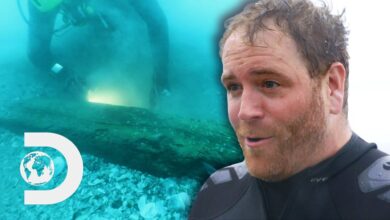
Josh Gates Investigates the 4,500-Year-Old Sunken City of Dwarka | Expedition Unknown
Josh Gates Investigates the 4,500-Year-Old Sunken City of Dwarka | Expedition Unknown


Across the world’s oceans lie the remnants of civilizations long forgotten, swallowed by rising seas and the passage of time. Among the most intriguing of these underwater mysteries is the legendary city of Dwarka, a site often described as India’s own “Atlantis.” In an unforgettable episode of Expedition Unknown, explorer and television host Josh Gates travels to India to investigate whether the ancient stories about this lost city could be rooted in real history.
Believed by some researchers to be more than 4,500 years old, Dwarka occupies a unique place where mythology, religion, and archaeology intersect. Through underwater dives, interviews with archaeologists, and visits to sacred temples, Gates attempts to determine whether the mythic city described in ancient Hindu texts might actually have existed beneath the waters of the Arabian Sea.
The Legend of a Golden City
The story of Dwarka begins in ancient Hindu mythology. According to sacred texts such as the Mahabharata, the city was the magnificent capital of Lord Krishna, one of the most revered deities in Hinduism. Descriptions portray Dwarka as a dazzling metropolis filled with grand palaces, wide streets, and defensive walls protecting its inhabitants.
The Sanskrit name “Dvāravatī,” often translated as “the city of many gates,” suggests an enormous fortified settlement with multiple entrances and elaborate architecture. Some ancient accounts even describe hundreds of opulent buildings and unimaginable wealth within its walls.




Yet the story does not end with prosperity. According to legend, after Krishna’s death the once-glorious kingdom mysteriously sank into the sea, disappearing beneath the waves and fading into myth.
For centuries, Dwarka was regarded primarily as a spiritual tale rather than a historical reality. However, discoveries along India’s western coast have begun to challenge that assumption.
A Sacred Place in Modern India
Today, the city of Dwarka still exists in the Indian state of Gujarat, sitting on the coast of the Arabian Sea. It remains one of the most sacred pilgrimage sites in Hinduism and is considered one of the four “Char Dham,” or holiest destinations for devotees.
For millions of believers, the legend of Krishna’s lost city is not merely a myth but a deeply meaningful religious tradition. Temples such as the famous Dwarkadhish Temple attract visitors from around the world who come to honor the ancient stories.
But beneath the waters near this modern city, archaeologists have discovered something intriguing: submerged stone structures and artifacts that suggest the possibility of a much older settlement hidden beneath the sea.
This is the mystery that drew Josh Gates and the Expedition Unknown team to the region.
Josh Gates Begins the Investigation
In the episode titled “India’s Atlantis,” Gates travels to India to search for evidence that the legendary Dwarka might have actually existed. His journey begins with historical research and conversations with religious scholars who explain the mythology surrounding Krishna’s city.
However, the real investigation starts offshore.
Gates joins marine archaeologists who have spent years studying the seafloor near Dwarka. These experts believe that ancient coastal settlements could have been submerged thousands of years ago due to rising sea levels and shifting shorelines.
In fact, geological research suggests that sea levels in this region have risen significantly over the last several millennia, potentially drowning earlier civilizations that once existed along the coast.
With this possibility in mind, Gates prepares for one of the episode’s most exciting moments: an underwater dive into the Arabian Sea.
Diving into the Arabian Sea
Equipped with diving gear, Gates descends beneath the waves with a team of marine archaeologists and divers. Their goal is to examine structures previously detected on the seabed.
What they encounter is fascinating.
Scattered across the ocean floor are large stone blocks and architectural fragments that appear to be arranged in geometric patterns. Some researchers interpret these as remnants of walls, foundations, or other man-made structures.
In certain areas, the divers observe massive stones with shapes resembling pillars or arches—features that could potentially indicate ancient construction.
While none of these discoveries provide absolute proof of the legendary city, they raise compelling questions. Were these stones placed by natural geological processes, or were they once part of a human-built settlement now lost to the sea?
For Gates, the mystery only deepens.
Clues on the Island of Bet Dwarka
The investigation does not end underwater. Gates also travels to Bet Dwarka, an island located north of the modern city.
Archaeologists working on the island have uncovered several intriguing artifacts, including pottery fragments, ancient structures, and a mysterious stamping seal.
These objects suggest that the region once hosted a thriving settlement with cultural and possibly ceremonial activities. According to researchers, the discoveries indicate that people lived in the area thousands of years ago.
However, whether this settlement is directly connected to the mythical Dwarka remains uncertain.
As Gates observes during the episode, archaeologists have “barely scratched the surface” of what might be hidden beneath the sands and surrounding waters.
Science vs. Myth
Despite the intriguing clues, the mystery of Dwarka remains unresolved.
Some archaeologists argue that the underwater structures could simply be natural formations or remnants of smaller coastal settlements rather than a massive lost city.
Others believe that ancient texts may contain exaggerated descriptions of real historical places. In this view, the legendary Dwarka could represent a real port city that gradually sank due to geological changes.
Still, many researchers caution that definitive proof has not yet been found. Multiple expeditions conducted by the Archaeological Survey of India have investigated the region, but the evidence remains inconclusive.
This balance between skepticism and possibility is exactly what makes the story so compelling.
A Mystery That Continues to Captivate
By the end of the episode, Josh Gates leaves India with more questions than answers—but also with a deep appreciation for the cultural and historical significance of the Dwarka legend.
He describes the experience as being surrounded by “thousands of years of myth, devotion, and celebration,” acknowledging that for many people the story of Dwarka is far more than an archaeological puzzle.
For believers, Dwarka is a sacred city connected to divine history. For scientists, it is a fascinating site that could reshape our understanding of ancient coastal civilizations.
And for explorers like Gates, it represents one of the world’s most captivating unsolved mysteries.
The Search for Dwarka’s Truth
The ocean has hidden countless chapters of human history beneath its waves. Rising seas have erased entire settlements, leaving only scattered ruins for modern researchers to interpret.
Dwarka may be one of those lost chapters.
Whether it proves to be a myth inspired by real events or the remains of a true ancient city swallowed by the sea, the search continues. New technologies such as underwater mapping, sonar imaging, and deep-sea archaeology may one day reveal what truly lies beneath the waters off India’s coast.
Until then, the legend of the sunken city of Dwarka remains a powerful reminder that history and mythology are often closer than we imagine.
And as Expedition Unknown demonstrates, the greatest discoveries sometimes begin with a simple question: what if the legend is true?