Ka-Ching! Cartoon Classics Cash In Big | Pawn Stars
Ka-Ching! Cartoon Classics Cash In Big | Pawn Stars

– [laughs] – Whoa, can I help you?
– I’d like to sell my “Simpsons” world.
– This looks like a pretty big “Simpsons” world. Homer kind of reminds me of my boss, Rick.
He’s a fat guy that eats a lot of donuts.
D’oh!
[crunching sounds] – I’m here at the pawn shop today to sell my World of Springfield “Simpsons” collection. There are 133 individual pieces, but there’s also I think 20 or 30 different environments that interact with the characters themselves.
The collection the whole time has been stored in containers up in my garage, so it was time to get rid of them. I’m hoping to get $2,000 for the entire collection. – You got a lot, a lot of cool stuff here.
It’s the biggest American family sitcom ever.
♪ Homer was kind of the star of it, just this kind of dimwitted, dumb dad who made bad choices, but he was a loving husband and he took care of his family the best way he knew how.
They first appeared in 1987 on “The Tracey Ullman Show,” and before it actually became a television show, Fox picked it up and did a Christmas special.
The numbers were good, so they did an actual series out of it, and here we are 30 years later.
– Right.
– These guys won tons and tons of awards.
Where did you get all this stuff?
– I started collecting them about 20 years ago.
– So how many pieces in total in the collection?
– 133 pieces. – Mm-kay.
I see you got some cool stuff here.
You got the family and their car, and, you know, this was always the opening scene.
What do we got here? – Stephen Hawking.
– Oh, Stephen Hawking, yeah. – Yeah.
– Wow.
I’ve never seen a “Simpsons” collection this detailed with this much stuff.
What are you looking to do with all this stuff?
– I’m looking to sell it.
– What kind of price are you looking for?
Because this is gonna take a lot of time for me to move and sell– a lot of labor, a lot of power, a lot of shipping.
– So I’m looking for 2,000.
– Mm-kay. – Which I think is super fair.
A lot of these environments themselves easily sell between 100 and 200.
– Well, I can’t just take your word for it.
– Okay.
– I have a toy guy right across the street.
– Cool.
– So if you have a few minutes to hang around, I can get him over here. – Absolutely.
– If we can come to a price where I think I can still make money, maybe we’ll have a deal. – Cool.
– He should be here in a few minutes.
– Cool, thank you.
I think anybody who works or runs a toy shop is gonna come in here and geek out just like I did, so I think they’re gonna side with me on this.
– Wow.
– Can you see me? Oh, there you are.
– Apparently you have the entire “World of Simpsons” here.
– Yes, it’s a “Simpsons” world, and you’re living in it.
– Wow. That’s impressive, man.
– I just want to get an idea of what you think everything is worth.
– You know, it really depends on what exactly you have here.
“The Simpsons” just– it’s got a huge fan base.
There’s tons of collectors for “Simpsons” stuff.
Playmates Toys acquired the licensing of “The Simpsons.” There’s hundreds upon hundreds of figures, there’s playsets, and “The Simpsons” were always known for being a little edgy, and being edgy, they would do things like, you know, Duffman here was this cartoon that, you know, sensationalized beer and drinking and the bar and– you know, they did the Stephen Hawking.
Like, a lot of people were offended that they produced a toy, and so Playmates took a lot of heat for actually producing that toy.
– So what do you think this collection is worth, retail value?
I want to know that before I start to consider what I could pay for it.
– Well, you know, looking it all over, you have playsets like the Main Street playset.
This used to be, like, a $250 playset, right?
Now, you’re looking at about a $65 playset.
Sometimes, when stuff is bought as a collectable, these toys don’t gain value, and in some case, they might lose a little bit of value.
And so for this type of a collection, I would expect your return on this to be around $2,200.
– D’oh!
[both laugh] – I appreciate you, Steve. Thank you.
– All right, man, all right. Good luck.
– Thanks, man. Appreciate it.
– Well, it’s definitely gonna hurt your asking price.
– Sure.
– If I’m gonna buy this collection, I’m really looking to be at about 700 bucks.
Yeah, I–that’s–no.
That’s madness.
If you could push this up to 1,000, I could walk out of here with my head high.
– This is gonna take a lot of time for me to move and sell– a lot of labor, a lot of power, a lot of shipping.
– But you’re gonna have so much fun doing this.
Walk down memory lane.
– I’d have much more fun taking a longer lunch.
– [laughs] – Would you do 950?
– If you could do 1,000, this would be awesome.
– I mean, for 50 bucks, I think I could probably still make a little money on it.
– Cool, thanks, man. – We got a deal.
– I appreciate it.
– Meet me over there and we’ll write it up.
– Awesome. Thank you very much.
So the $1,000 is definitely below what I was expecting, so I’m a little disappointed, but in the big picture, I’m actually quite satisfied because I’m gonna be using this money to buy an engagement ring for my girlfriend.
[camera shutter clicking] [quirky music] ♪ – Chum. – Is Grandpa here?
[dog whines] – What is going on?
– What do you mean? – I don’t know.
Where did all this “Simpsons” stuff come from, and why are you photographing your dog?
– I bought 130 Simpson pieces for 1,000 bucks.
Some of it’s worth a lot of money, like the big pieces, but a lot of them are only worth, like, 7 bucks, 10 bucks each, so to help move that stuff, I’m throwing in an autographed picture of Pinky.
– A dog can’t autograph a picture.
– She has a paw print and an inkpad and– – No one’s gonna buy something because your dog put its paw print on it.
– I don’t know. Did you see how cute she is?
Look at her.
[dog whines] – You know I’m not big about the dog at work anyway, but I allow it, but you actually have to be working when you’re at work, so– – She’s not just a dog, Rick.
– Pinky is not going to sell merchandise.
Pinky isn’t a real employee.
Pinky can’t talk to people.
It’s a dog. [dog growls] I let you bring the dog to work because the dog is cute.
– You just made her mad. – [sighs] – She heard that, Rick, and she didn’t like it.
– [sighs] – I guarantee you.
Because of her, merchandise will sell.
– Will you deal with this, please?
– No.
You’re the one that allows this to happen.
– Go do some real work.
– Do what you want to do, Chum. [dog whines] – It’s okay, Pinky. Let’s do a couple more.
[camera clicking] Oh, yeah, girl. Get it.
CHUMLEE: Hey, how you doing? DYAN: Good.
How are you? CHUMLEE: Good.
What do you have?
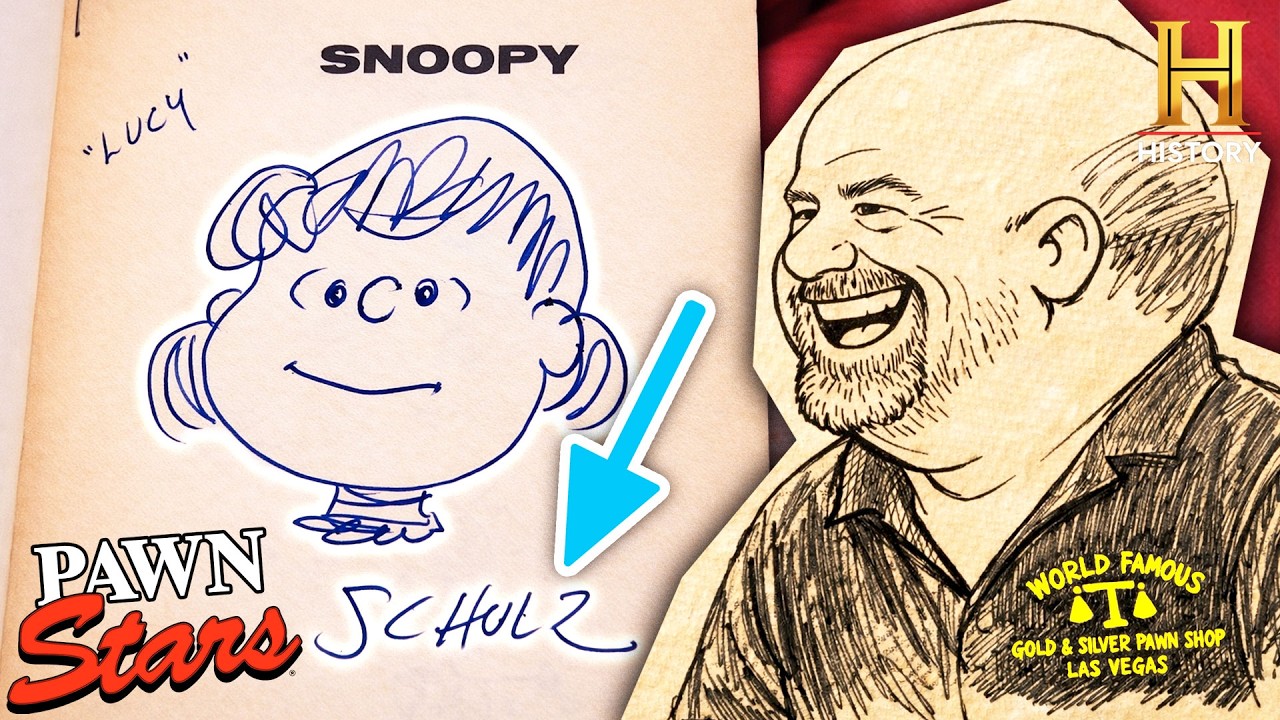
DYAN: I have a Snoopy book from 1958.
CHUMLEE: The new Peanuts book featuring Snoopy by Charles Schulz.
DYAN: And a hand drawn picture by Charles Schulz.
CHUMLEE: Oh, that’s pretty cool.
If you’re going to learn to swim, Lucy, why don’t you begin with the dog paddle?
Then, the next caption, you got Snoopy doing the dog paddle– Right.
CHUMLEE: –on the back just coasting along.
I guess they’re mad Snoopy can just swim like that.
[laughs] [music playing] DYAN: I’d like to try and sell my Snoopy comic book.
My favorite character is Snoopy.
I used to have a Snoopy doll when I was little.
My mom would buy me all the outfits to dress them in.
I’m hoping today to get about $5,000 for it.
The least I’ll take, probably a thousand.
CHUMLEE: So where did you get this?
My uncle actually sent it to me when I was about 8.
And we’ve had it packed away, and I came across it.
CHUMLEE: All right.
Peanuts is really cool.
It was a comic strip– DYAN: –that started in the 1950s.
Yeah.
With Charlie Brown and friends– DYAN: Right.
CHUMLEE: And I know that it evolved into a couple holiday specials.
Yeah, Snoopy is an iconic character, and peanuts was probably the most famous comic strip of all time.
I’ve never seen this particular book, but this looks more like the comic strip.
DYAN: Right.
Not a lot of people know Snoopy wasn’t even in the first Peanuts comic strip.
And when they did finally introduce him, he didn’t speak for two years.
Oh, Lucy.
That’s cute.
Did you draw that?
DYAN: I didn’t draw that, no.
I’m hoping that it was Charles that drew it.
CHUMLEE: Yeah, that would make this book pretty special if it was, huh?
DYAN: Right.
I know there’s a lot of Schulz stuff out there.
And this is iconic, so a lot of this stuff has been faked over time, I’m sure.
Do you know how much you want?
DYAN: 5,000.
CHUMLEE: 5,000.
That’s a lot.
I’ll give you five for it right now if you want to sell, but not thousand.
I want 5,000.
CHUMLEE: All right.
Well, if you don’t mind, I got a friend, Rebecca.
She’s the manager at Bauman Rare Books, and she sees lots of Schulz and lots of peanut.
Stuff.
So, she could tell us all about this book.
DYAN: All right.
CHUMLEE: All right.
I hope the book is real.
Once he mention that the signatures are faked a lot, it made me pretty nervous.
I’ve never had the book checked out before, but I’m pretty confident that it’s his signature.
Hi, Chum.
CHUMLEE: Hey, Rebecca.
I got a book for you.
So it’s Peanuts.
But when I think of Peanuts, I think of a little comic strip in the Sunday paper.
REBECCA: Right.
So, let’s take a look, shall we?
You’ve got the four panels for each of them.
That’s the way that Schulz did the comics for 50 years.
CHUMLEE: All right.
Comic strips are pretty popular in the ’50s when this started.
That being said, Peanuts changed everything.
It became the hit.
Schulz made millions from Peanuts.
You know, it’s actually in pretty beautiful shape.
The paper wrappers, essentially the what we call a paperback, they’re really, really fragile, and this one looks really nice.
Another thing is this red color.
It tends to fade a lot.
And this red is actually really bright and beautiful, so it’s– it’s quite nice.
DYAN: Thank you.
REBECCA: You took care of it.
Yeah.
And then we’ve got this drawing here.
We need to figure out if it’s by Schulz.
I assume that that’s what you wanted, right?
DYAN: Right.
Since she got this when she was eight from an uncle, I’m wondering, did her uncle just draw this picture and sign it or did Schulz actually draw this picture?
That’s a good question because probably about half or maybe even a little more than half are fake, so you have to be super, super careful when it comes to Schulz.
Well, that’s what I called you for, so– The thing about Schulz though is you can tell his drawings from others, because he was doing this every day for 50 years.
Forgers, they’re really drawing, trying to be really careful, getting it exact.
With this, you can see there’s some blotting with the pen, and the ink was having a little bit of a hard time coming out there.
It’s really hard for forgers to recreate.
So for that reason, both the drawing and the signature are real.
[music playing] DYAN: Awesome.
Is it worth $5,000 though?
Uh, that is the question.
If it were drawn with Snoopy, it could maybe get up that high.
With Lucy though, it’s actually worth less.
I would say you’re looking at 3,200 to 3,500.
Awesome.
Wow! CHUMLEE: All right.
Well, thank you.
REBECCA: My pleasure.
Thank you so much.
The type of person who would buy this book is the type of person who would read the comic strip, which is pretty much anyone who grew up between 1950 and 2000.
If Chum did buy this book, I don’t think he’d have a problem in the world selling it.
It would go like that.
All right.
So how much do you want to sell it for?
Um, what about 3– 3,000.
Um, that’s– that’s a lot higher than I want to go.
I’d be willing to take a chance right around 1,200.
DYAN: What about 25?
I’m really looking more down to 1,200 area, you know, maybe– maybe stretch it out to 14?
OK.
What about 2?
I mean, she said it herself.
He’s really popular.
Um, 14 is going to be where I– it’s just where I’m comfortable at.
So if you want to take 14, I could do it for you.
All right.
I’ll take 14. – All right.
It’s a deal. DYAN: All right.
Thank you. – All right.
I’ll meet you right over here.
DYAN: All right.
I’m a little disappointed that I didn’t get as much for it as she said it was worth, but I’m just happy that it all worked out, that it was real.
COREY HARRISON: What do we have here?
It’s Bugs Bunny, obviously.
It’s celebrating Bugs Bunny’s 50th birthday.
It was signed by Friz Freleng, the animator, and Mel Blanc, the voice.
Yeah, I don’t really know too much about Bugs Bunny.
COREY HARRISON: What do you mean?
He did that movie with Michael Jordan.
And he did Roger Rabbit.
No, that was a different rabbit.
COREY HARRISON: You never cease to amaze me.
EARL: Today, I’m here at the pawn shop to sell my signed Bugs Bunny photo.
I picked this up from a collector.
I don’t have any place to really put it up.
I know there’s not too many that are double signed like that.
COREY HARRISON: He’s one of the iconic cartoon characters in history.
He was always my favorite.
I mean, I always kind of looked at Mickey Mouse like he was a wimp.
And you couldn’t really get Bugs down.
You had two different guys always trying to shoot him, people dropping stuff on him.
I mean, he was like the first sarcastic cartoon comedian.
He did have a little bit of an attitude.
COREY HARRISON: Bugs Bunny has been around since the 1940s.
And he’s been in over 160 cartoons.
Not a bad career.
You got it from our collector.
Do you mind me asking what you paid for it?
It was in the 250 area.
COREY HARRISON: I mean, it’s framed really nicely.
I mean, there’s no nicks or cuts.
It’s in really good condition.
If you don’t mind, I mean, I’d like to have somebody come down and take a look at the signatures and I can go for a price from there.
That’s fine.
COREY HARRISON: I’m really hoping these signatures are legit.
I mean, this piece would look great in the shop.
Drew, what’s going on, man? – Hey, gentlemen.
How are you?
Bugs Bunny you talked about, right?
Yeah.
DREW: Well, whenever they have a situation where there’s autographs, the guys give me a call, because that’s something I have expertise on.
Bugs Bunny came out in 1940, officially.
Now, Mel Blanc, he’s known as the man of 1,000 voices, because he did almost all the voices for animation.
Friz Freleng, he was one of the top animators for Warner Brothers, and a producer, also.
Well, these two gentlemen have very interesting signatures.
We gotta take a closer look. – OK.
DREW: All right.
Well, when you’re examining signatures, you really have to look at all the different details– capitals and lowercase letters.
We’ll start with Mel Blanc.
This was done with a black felt-tip pen.
That’s a very distinguished way he makes his capital M, coming below the baseline.
And then he flies into like an epsilon E type of design.
Very interesting.
Well, let’s take a look at Friz Freleng, see what we have.
Because he tends to write in mostly capital letters.
Well, one major thing that we’re always gonna be looking for is, he drops the L way below the baseline.
OK.
Well, you know what, you take all the evidence together, all the evidence is what I need to see.
So this thing’s authentic. Absolutely.
Good, sweet.
All right.
You got two gentlemen who didn’t sign autographs together a lot.
And it’s a nice combination on one particular piece.
Value-wise, with both these signatures on one piece, that raises it a little bit.
It’s not original art, though it is, you know, nicely done and professionally framed.
Both together, probably retail around $500.
Sweet.
Good.
COREY HARRISON: Well, my man, I appreciate it as always.
Thank you very much. – Thanks, guys.
COREY HARRISON: I’m glad I talked to an expert, because I was really thinking the price would be a lot higher.
All right, so you heard my man.
He said 500 retail.
And you paid around 250 for it.
Right.
COREY HARRISON: And I’m willing to let you out of your investment with no gain here.
That’s about what I’m willing to pay is gonna be 250.
I’m thinking I might be able to get 350.
If you can come up to 300, I think we could have a deal.
Buddy, I’ll go 275, but I really can’t go any higher than that.
EARL: If I can’t make really a fairly decent markup on it now, maybe I’ll just put it back in my collection and keep it.
You know what, man, I’d rather make $50 than no dollars.
So deal. – OK.
Chum, you wanna go write him up?
Yeah.
I’ll meet you over there.
All right.
– Hey, how’s it going? – Hi.
– What do we got here?
– Illustration from a children’s book of Charlie Brown.
– Oh, good grief. – Good grief.
[exasperated trumpet flair] – I have an original Charles Schulz illustration. I’m a huge fan of Charlie Brown. If I can make a deal today for $1,300, I’m gonna buy some cowboy boots. – Yeah, it’s actually pretty cool. He created Charlie Brown in 1950.
I think the last one was printed in 2000?
Over 2,000 newspapers, 70-something countries.
I don’t know a person alive that hasn’t seen “A Charlie Brown Christmas.” You know, everybody loved Charlie Brown.
He’s everybody’s favorite loveable loser and I’ve got a friend that works with me that’s quite a bit like that. [laughs] – Schulz, he was very prolific.
– Yeah, I mean, there’s over 18,000 comic strips of this.
So what exactly do we have here?
– It was a book published in the ’80s, and if you read it, it says, “‘Peanuts’ characters created and drawn by Charles Schulz.” And this says “Backgrounds illustrated by Art and Kim Ellis.” So I’m hoping that this is an original art with the background done by his studio.
– And then what do we got here?
– This is evidently a production for the book.
– All right.
What are you looking to do with it?
– Sell it.
– So how much are you looking for it?
– Uh, $1,300.
– Definitely a possibility.
I just–I’m a little leery because I know that he drew a lot of stuff, but that being said I know a lot of people collect it.
Do you mind if I have a buddy of mine come take a look at it?
– That’d be great.
– So let me get him down here and have him take a look at it, and he can kind of give me a price.
– Great, I’m looking forward. – All right, hang out.
I’ll be right back. – Thank you.
I’m really interested to see what the art expert will say about the piece and what its value is.
What’s up, Chad? – Hey, Corey, how’s it going?
– How’s it going, buddy? – Real good.
Chad, nice to meet you. – Nice to meet you.
– Some Charles Schulz “Peanuts.” So let me take a look here.
So that’s a two-piece.
– So what do you think?
– So this is a work by Charles Schulz, who is maybe the best-known American artist.
Definitely cartoonist.
“Peanuts” didn’t happen until 1950.
He had a couple small successes, but they were with regional newspapers.
And then finally he sold “Peanuts.” This artwork is great.
It’s by Charles Schulz.
But, it’s not an original Charles Schulz.
The reason why is all of these Little Golden Books were actually collaborative art efforts.
– Huh.
– So this is a cell.
The top is going to be all of the characters– gonna be Charles Schulz’s work.
He wouldn’t let anyone else illustrate his characters.
He only illustrated his own people.
And the back was painted by Kim and Art Ellis.
It was a husband and wife team who worked for Little Golden Books for many, many, many years, And they would have done all of this background.
So what he would have done is he would have sketched it, and then they would have gone back over it and made the cell.
So it’s great, it’s very rare, but it’s not original.
You also have this piece.
It’s a printer’s proof.
It’s gonna show you the layout of where the text is, how they’re going to split the photograph.
– So what do you think it’s worth?
– If this was an original it’d be $15,000.
This is worth…
by itself, like, virtually nothing.
That’s where all the value is.
I’m gonna put a price of $1,500 on it.
– All right, appreciate it, Chad.
– Thanks, Corey. – Thanks for coming down, man.
Look, you wanted 1,300 bucks for it.
You know, you heard my guy.
I could probably get 15.
You wanna do 1,000?
– 1,100?
– 1,000?
♪ – 1,000. – Sounds like a plan.
– Thank you. – Let’s do some paperwork.
Come with me.
– Well, $1,000 is not peanuts. It wasn’t $1,300, but I’m happy, so I can go and buy some cowboy boots.
– Hello. – Hey. What do we got here?
– I’m interested in selling my Jetsons Lunchbox.
– The Jetsons were a pretty cool family.
– Absolutely.
– They’re, like, from the space age.
– Yeah. They were basically just the opposite of The Flintstones.
– [laughs] I’m here today because I’m really hoping to sell my really cool early 1960s Jetsons lunch box. I haven’t used it in many years since I’m no longer in elementary school. I am hoping to get about $700.
– This is pretty cool.
So did you use to watch The Jetsons when you were a kid?
– Oh, definitely, yeah.
The idea of being able to fly above the whole city, it was kind of exciting.
When I was a little girl, people were really interested in the space age because we were getting ready to go to the moon, in the early ’60s.
JFK said we want to put a man on the moon by the end of the decade.
So, it got a lot of people thinking and excited about outer space.
Well, I know it was never stated in The Jetsons, but it actually took place around, like, 2062, which we’re not too far away from now.
– Yeah, yeah. We’re not too far, yeah.
– I think we’re kind of far away from flying cars and houses in the sky, though.
– Yeah. – But…
crazy thing is, “The Jetsons” only had one original season.
– They really only lasted one season?
– Well, they remade them in the ’80s.
That’s why we remember it from when we were kids because in the ’80s, they made a bunch more.
– Kind of just baffled that you know this much about it.
– So, where did you get this thing?
– My mom got it for me when I was a little girl.
It was my lunchbox in elementary school.
– One of my favorite things about these is, this was like basically the first way for a kid to express themselves.
– Yeah. – I’m a Jetsons guy.
, I’m a Flintstones guy, I’m a Batman guy, I’m a Superman guy. Whatever your lunchbox was.
– I always wanted one of these growing up.
All I got was the brown paper bag.
– I’m really glad he likes it.
What are you looking to get for it?
– $700.
– I know that some of these old lunchboxes go for even more money than that.
The thing is, is every little aspect of it has to be a certain way with a certain thing, and not quite sure on it.
I got a buddy that works literally right across the street.
Do you mind if I give him a call and see if he can come down here really quick?
– Oh, absolutely, sure. – All right. Be right back.
– I’m really happy they’re gonna bring in an expert because I’m a little unsure what the value is.
This is the lunchbox.
– Oh, the Jetsons! – There you go.
– That’s awesome. Can I take a look at it?
– Oh, please.
– A really cool thing about The Jetsons is, is that ABC’s first primetime show in color were The Jetsons. – Wow.
– It only lasted one year. From ’62 to ’63.
So because of that, they didn’t have a lot of merchandise.
So Jetsons collectors latch on to almost anything they can find.
Where did you get this?
– My mom got it for me when I was a little girl.
– It’s in really, really good shape for a lunchbox that would’ve been used.
I do notice there’s one damage right here on the lid and that’s pretty common to have something like that.
The metal, yeah, it’s damaged real easy.
And then where these clasps go back, you can see that there’s a couple of marks here, where they actually hit the lunchbox, and an unused one wouldn’t have any type of…
– Mm. – Dent or damage there.
– No thermos?
– I think I have that thermos at home.
– Without the thermos, it does affect the value.
– So, what do you think it’s worth?
– It’s a really nice piece. The color is awesome.
It’s in pretty good shape, and it’s The Jetsons.
In this condition, with the thermos, you’d have been looking at, you know, $700.
Without the thermos, and as it sits, I’d have to say that you can expect to get $450 for it.
– Well, I appreciate you coming down, man.
– Thanks. See ya. – Thank you.
– I think this is a great item for the shop. Lunchboxes have a huge collector market.
It’s something the shop will have no problem getting rid of.
– So, what would you want for it?
– I would love to get $400 for it.
– You know I have to make money.
– Right.
– Do you have the thermos?
– I thought I had the thermos.
I need to go home and look in my garage.
♪ – I’ll make you a deal.
I will give you 400 bucks for it, if you promise to ship me the thermos.
– Absolutely. I know I have it somewhere.
– Okay. So we’ll make a deal at 400 bucks?
– That sounds wonderful. – Deal?
– Thank you so much. Thank you.
– All right. Chum will write you up over there.
– I cannot believe I’m taking $400 for the lunchbox.
That just blows my mind.
I’m gonna jet on home and find that thermos.
– Thanks, pal. – What is it?
– I guess I would have to open it up and see.
Aha.
Look at that.
– What? – Jetsons thermos. She sent it.
– So you got really, really lucky.
– No. I just had– – No, you got lucky.
– No, I just had a little faith.
– No, no, you got lucky, son.
– Nope, I just had a little faith.
That’s all. I knew she would send it.
– Just don’t have faith next time because eventually, it will get to you, all right?
That’s not the way we do business here, and you know that.
– You lucked out on that one.
– I ordered it myself.
That’s not even the right thermos.
Cost me 25 bucks for peace of mind.
– Sounds worth it to me.
– [Corey] Hey, what’s up, man, what do we got?
– Well, I got something kind of unique, when I was in college a professor had this on his office door, and he was trying to recruit students into his class, and it really caught my attention.
I was told that this was an original Doonesbury sketch.
– It’s pretty cool, he’s actually Doonesbury, right?
– Correct.
– OK, and I’m assuming that if he drew it for the professor then this might be what he looked like?
– I don’t remember.
(both laugh) My Doonesbury rendering is pretty unique, because it was hanging on a college professor’s office door, the professor had a relationship with the cartoonist, Garry Trudeau, I’d love to get $200 for it, I think it’s time to find a new home for it.
– The comic’s about a guy named Mike Doonesbury, I always thought it was kind of cool that he kind of aged as the cartoon got older.
You know he started off as what, a college student, and then, now he’s a grumpy senior citizen, right?
– [Customer] Probably so.
– It’s just one of those things where you can’t open up a Sunday paper and it not be there, I mean it’s a staple of the comics page in just about every newspaper in the world.
– [Customer] It is.
– Doonesbury might not be as recognizable as Far Side and Peanuts, but it’s an important comic strip over the past 30 years, so, I’d definitely be interested in owning an original sketch.
Any idea of what you’re looking to get out of it?
– I’d take $200.
– OK. Why didn’t he sign it?
– I don’t think it was ever meant for any kind of resale, or publication.
– It’d probably be worth $300 or $400 if he’d signed it, you know that?
On the other hand, there’s not really like any shortage of Doonesbury cartoons out there, you’d take $150 for it?
– $175, you got a deal.
– Alright, it’s kind of cool.
– Awesome.
– Come with me, we’ll write it up.
– Great.
You know $175, it’s a bird in a hand.
I’ll probably renew my season tickets for CSU Bakersfield basketball.
– How can I help you?
– Howdy, I came to sell my Pokémon card.
– Um, is this an error card? – Yeah.
– Yeah, well, it’s obviously an error card, right?
The back is blank. – That is right.
– I’m looking to sell my extremely rare Gastly error Pokémon card. It’s one of the rarest errors you’re probably going to find. Both sides are printed on one side of the card, and the other side is completely blank, something that definitely should have been caught in quality control. I’m looking to get $4,000 for my error Gastly Pokémon card.
– So this is actually pretty cool.
You know, Pokémon has been around since 1996, but it was, you know, brought here from Japan in 1999.
And everyone wanted to collect Pokémon cards, play Pokémon video games, and watch the Pokémon cartoons.
And typically, on a Pokémon card, you would have the back of the card, it would look like this Pokémon, and then the front of the card would have ben printed right here on this white space.
But you can actually see, the front of the card was printed right over the back of the card.
Can I take it out of the plastic?
– Yeah, go ahead.
♪ – And I mean, it does feel right.
I played thousands of games of Pokémon and looked at my cards many times.
So that is something I do know.
Even though it’s double printed, you can fully make out the back and you can fully make out the front.
So I really, really like that.
It’s actually pretty cool you have this error.
I’ve never seen one like this.
So how did you get this?
– So another collector opened a themed deck, and some of the cards inside had this error where they were printed twice on one side and not printed on the back.
And I purchased this one from him, and it’s been in my collection ever since.
♪ – So how much are you looking to get for it?
– I think I’d like $4,000 for it.
– Okay, uh, that seems like a pretty high price.
I don’t know if it’s too high, but error cards kind of have their own markets, so I need to have someone come down and take a look at it and first tell me that it is an authentic Pokémon misprinted card and not just something that someone was able to create on a printer and also, maybe shed some light on wht they think the value could be.
It could kind of be all over the place with these errors.
Should we get him in here and see what he says? – Sounds great.
– Give me just a few minutes. I’ll be right back.
– No worries.
So while I’m happy that the card is Gastly, I’m hoping that the offer they make me isn’t.
It feels like a good card to me, but…
I figured I’d get the pros down here.
– Yeah, you gotta be careful with some of these cards.
I mean, you know, these errors are worth a lot of money.
So there’s every reason for people to manipulate them.
This is an XY evolutions card printed in 2016.
Gastly, you know, obviously a popular Pokémon type.
And, you know, the manufacturing at these printing facilities is very top notch, and the security is really tight, and they really just look out for things like this, so the fact that this, you know, avoided the fate of getting pulled out of production– that’s just a miracle survival right there.
– Because it’s not a small error.
– No, it’s not a small–I mean, it’s blatantly obvious. That’s messed up.
Error collecting is something that really blossomed in the last five, six years, because you can have error cards that are very common, from $5 to $10 apiece, all the way up to $100,000 for some of the most rare errors on rarer cards.
If you have a really rare card with an error, that’s really dramatic, then it could be worth a lot of money.
So yeah, first off, we want to make sure it’s rea.
So I’ll take a look at it real quick.
♪ The intricate details here are just all there.
You know, the corners look correct.
The cut’s correct. Everything looks right.
Very happy to say that this card is unquestionably real.
This is–this is a true rarity right here.
– I had no doubt, but it’s good to hear you say it.
– Yeah, it’s a nice item.
– What kind of value do you think this has?
– I mean, I’d probably be right around $3,000, I think is a fair, fair value– fair retail value for that error.
– I think that’s a little bit conservative, but I respect your opinion.
– All right, well, his opinion is the one I have to live with, so…
Thank you for coming down and helping me out here.
– Always my pleasure, Chum. Take care.
Take care. – Thank you.
– All right, well, he thinks it’s worth about 3,000.
I’d be a buyer at 2,000. What do you think?
– I think 2,000 is a little low, you know.
2,000 is, you know, half of what I came in here looking for, and while I respect his opinion, you know, I do think it’s a little bit conservative.
– What about 2,300?
– Again, that still feels a little bit off for me.
But I’m still willing to compromise if you can go to maybe 2,500.
– It’s a very unique error card, so I think I’m comfortable at 2,500.
– That’s awesome.
– All right, well, I’ll tell you what.
Go meet me over there at the counter, and I’ll buy it from you.
– Sounds great. – 2,500.
– Cheers. – Sounds good.
– I’m walking home with some cash, so I definitely played this card right.